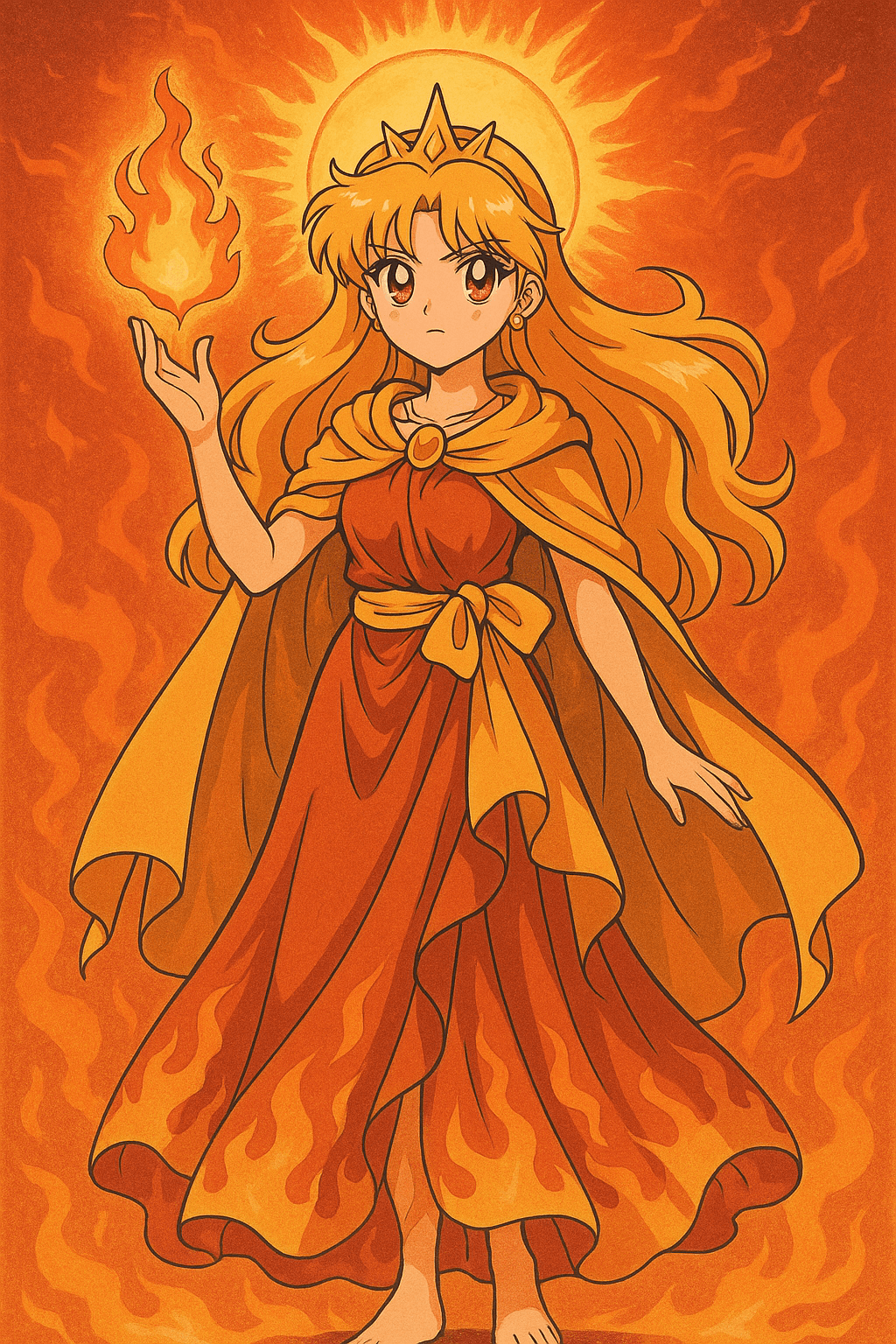
 PlanetSun
Other Names
Agni (Vedic), Surya (Hindu), Sol/Sunna (Norse), Atar (Zoroastrian), Ra/Atum (Egyptian), Helios/Apollo (Greek), Prometheus (Greek), Kagutsuchi (Shinto), Hestia/Vesta (Greek/Roman), Brigid (Celtic: fire/hearth aspect), Xiuhtecuhtli (Aztec fire god), Tabiti (Scythian hearth goddess), Tapas (Rigvedic: transformative heat, insideness), Hephaestus/Vulcan (Greek/Roman), Amaterasu (Shinto: solar aspect), Lugh (Celtic: solar aspect), Svarog (Slavic fire/smith god), Grannus (Gallo-Roman solar deity), Shapash (Ugaritic sun goddess), Utu/Shamash (Sumerian/Akkadian sun and justice god)
Akin Ghosts
Waxer
Related Posts
Kindling
Translations:
High Church:
Sol (sóh₂wl̥)
Sanskrit:
सूर्य (sū́rya), अग्नि (agní)
Church Runes:

In the Vedic tradition, Fire is Agni, the god who sits among the heavenly host yet dwells kindly in mortal hearths, the youngest and mightiest of the gods, the carrier of sacrifices and the bridge between humanity and the divine. He is Surya, the radiant sun that sustains all life. In Zoroastrianism he is Atar, the sacred flame that is the visible presence of Ahura Mazda in the world, and the Zoroastrian fire temples kept his flame burning perpetually as a living prayer. In Greek thought he is the Promethean gift, the stolen fire that elevated humanity from animal darkness into the light of civilisation and consciousness. The Japanese Shinto tradition reveres Kagutsuchi, whose birth-fire was so powerful it killed his own mother Izanami, a myth that captures the same truth Tianmu teaches: that the spark of becoming is violent, transformative, and irresistible. In the Rigveda, the hymn to Agni declares him the kindling seed of Heaven and Earth, the beacon of all divine rite who shares his divinity with all the Ghosts and yet in his generosity is guest in the hearths of mortals.
Fire is the terrestrial manifestation of the first spark of becoming. In the Rigvedic creation hymn (X.129, The One), before existence or non-existence, before sky or heaven, before death or life, there was only becoming; concealed by emptiness, borne by the power of Fire. It is the birth of insideness from the cosmic egg, the initial rupture of the One into the Manifold, the moment when nothingness first became something.
Fire is to our solar system what Doom is to the galaxy. Where Doom is the black hole that upholds and devours the Milky Way through gravity, Fire is the sun that upholds and illuminates our local world through light and heat. Fire is waxen to Doom's waner. They are mirrors of each other—both upholders through gravity, both the axis around which all else revolves—but where Doom is void, Fire is brilliance. Where Doom is the end, Fire is the beginning. Where Doom is the most Hellish of the Ghosts, Fire is the most Heavenly.
Rigveda X.1 (Tianmu's translation Kindling): "Omen of the dawn, you ascend high, your light piercing through the dark. Oh luminous Fire! As fair as can be, your rays touch all corners of the world. You are the kindling seed of Heaven and Earth."
This is why Fire is the bridge between humanity and Heaven. In every ancient tradition, fire was the locus of ritual. The Vedic sacrificial fire carried offerings upward to the gods. The Zoroastrian temple flame was the visible face of the divine on Earth. The Catholic votive candle, the Sabbath candles of Judaism, the butter lamps of Tibetan Buddhism; across every tradition, fire is the medium through which the human and the divine meet. In Tianmu, this is because Fire is literally the most Heavenly Ghost who yet lives among us. He sits upon a high throne among the gods, and yet he rests within the Earth's navel, in our hearths and our campfires. He stretches to touch every corner of Heaven and Earth, as a child may stretch his arms to hold his mother and father.
Zoroastrian Atash Niyaesh (Litany to Fire): "O Ahura Mazda, through fire we first approach Thee and Thee alone."
But Fire is not merely warmth or brightness. Fire is the principle that cuts through ignorance and reveals truth. It is discernment; the natural intelligence of passion, the burning away of calcification, unknowing, and the accumulated dross of a domesticated mind. When someone is "on fire" at a skill, when they are "burning with passion," what is actually happening is that they are so light, so free, so unbound by outsideness and the unknown, that they can move with genuine freedom. This is the core teaching of Fire. All of its qualities descend from its place as heat and light, that which cuts through darkness and the unknown. The reason a sports player is "on fire" is not separate from the reason a monk sits before a flame in meditation: both are experiencing the dissolution of unknowing, the clarification of the mind, the burning away of everything that is not essential. Fire is a salve to unknowing in all its senses.
Fire is also the most irresistible of the Ghosts. He dances. He leaps. He is loose, surging, impossible to contain or predict. You cannot hold fire still; you can only tend it or be consumed by it. This dancing, irresistible quality is the energy of genuine creative passion, the feeling of being so alive and so clear that you cannot help but move, create, speak, act. It is the opposite of the heavy, grave, sinking energy of the outer Ghosts. Fire rises. Fire illuminates. Fire transforms everything it touches.
Fire and Doom pair together as the supreme polarity of the Twelveness. They are both upholders through gravity. Fire is the most Heavenly; Doom is the most Hellish. And it is Fire which cuts through the unknown outsideness that Doom represents the apex of. In Egyptian mythology this dynamic plays out as Ra and Apep; the sun god who sails through the underworld each night doing battle with the serpent of chaos. But Doom always wins in the end, simply by lasting until the light fades. The fire burns, but eventually it gutters, and the void remains. This is the great tragedy and the great truth at the heart of the Twelveness: that even the brightest light will one day return to the darkness from which it sprang. And yet... the fire lit once can be lit again. That is the hope within the wheel.
Isha Upanishad, Verse 15: "The face of truth is covered with a golden disc. Unveil it, O Sun, so that I who love the truth may see it."