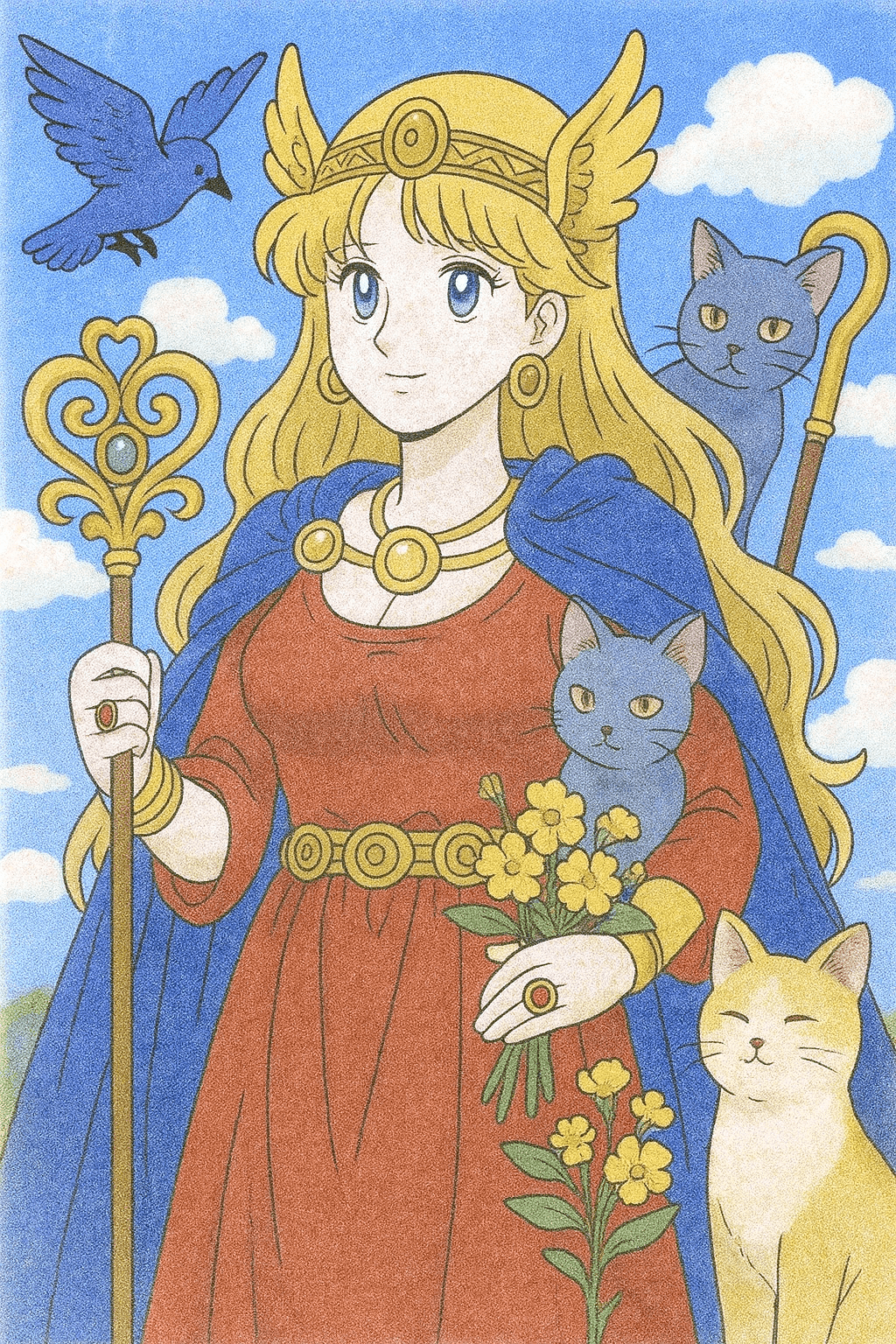
 PlanetEarth
Other Names
Gaia (Greek), Prithvi (Hindu), Jörð (Norse, Thor's mother, the Earth), Freyja (Norse—in her freedom/fertility aspect), Pachamama (Inca), Tonantzin (Aztec), Terra/Tellus Mater (Roman), Bhumi Devi (Hindu), Nerthus (Germanic earth mother), Demeter (Greek), Cybele (Phrygian), Ki (Sumerian), Coatlicue (Aztec), Hou Tu (Chinese earth goddess), Mokosh (Slavic), Papa (Maori, Earth Mother), Danu (Celtic), Isis (Egyptian, in her role as universal mother of the living world)
Related Posts
One-Not-One
Translations:
High Church:
Prey (preyH)
Sanskrit:
मनु (Manu)
Church Runes:

Freedom corresponds to the Earth herself, Gaia in the Greek tradition, the primordial mother from whose body all terrestrial life springs and to whose body all life returns. In Norse cosmology she is Midgard, the middle enclosure, the green and breathing world that sits between the fires of Muspelheim and the ice of Niflheim, connected to all other worlds by the great ash Yggdrasil whose roots drink from the same well as the gods. In Hinduism she is Prithvi, the patient and abundant Earth goddess, and also Prakriti, nature itself, the living material substrate from which all forms arise and into which all forms dissolve, the field of play in which consciousness discovers itself. She is the Kurukshetra, the sacred ground where the great drama of free choice plays out. In Daoism she is the space the Daodejing calls "the realm betwixt Heaven and Earth" (天地之間), and she is also the uncarved block, the pú 朴, the simplicity that precedes all shaping, the wildness that exists before domestication, the original face of things before they are named. In Buddhism she is the Middle Way, not as a compromise between extremes but as the fertile ground where all extremes meet and produce the possibility of awakening. When the Buddha touched the earth at the moment of his enlightenment, calling it to witness against Mara's army of illusions, he was not reaching for some abstract principle. He was reaching for the ground. The grass between his fingers. The soil beneath him. The simple, irreducible fact of being here, which was enough to shatter every demon in existence. In Shinto, the entire natural world is alive with kami—spirits that dwell in rivers, stones, ancient trees, mountain passes, and the wind itself—and the practice of Shinto is fundamentally the practice of Freedom: of recognising that the world you already live in is sacred, that the interconnectedness of all things is not a metaphysical proposition but a felt reality as near as the rain on your skin. In the animist traditions of indigenous peoples worldwide—the oldest spiritual traditions on Earth—this same recognition forms the foundation of all religion: that the land is alive, that we belong to it as much as it belongs to us, and that the feeling of being embedded within that living web is the most natural and the most holy thing a human being can experience.
Lotus Sutra, Chapter 5 (Parable of the Medicinal Herbs): "Just as heavy rain falls universally on all the plants and trees, forests, and medicinal herbs—those with big roots, big stalks, big branches, big leaves, as well as those with small roots, small stalks, small branches, and small leaves—the radiance of the rain is of one flavor, but each plant according to its nature receives it differently."
Meister Eckhart: "If the only prayer you ever say in your entire life is 'thank you,' it will be enough."
Freedom is the great realm we are all born into. She is the terrestrial manifestation of the middle realm, between Fire and Tides, the Sun and the Moon, heat and cold, Heaven and Hell. She is akin to Freyja, to Gaia, to the Maker, the third principle of the Threeness, wuji itself, the superposition of yin and yang made flesh and soil and wind.
And Freedom is freedom itself. Not freedom as an abstract political concept, not freedom as the absence of constraint, but freedom as the felt experience of being alive within the interconnected whole of nature. It is the sensation you feel when you step outside on a crisp spring morning and the world is simply there—vivid, breathing, whole—and for one moment the chatter in your head stops and you are just a creature standing on the earth under the sky, part of something so vast and so intimate that the distinction between "you" and "it" momentarily dissolves. That feeling. That is Freedom. That is Earth.
Wendell Berry—The Unsettling of America "We have given up the understanding that we and our country create one another, depend on one another, are literally part of one another; that our land passes in and out of our bodies just as our bodies pass in and out of our land."
Because Freedom is the ghost of the middle realm, she is also the ghost of interconnectedness. The Earth is not a single thing; it is the meeting of everything. Soil is made of the dead. Rain is the ocean's exhalation. A forest breathes in what you breathe out. Nothing on earth exists in isolation; every living thing is what it is because of what surrounds it. This is dependent origination made visible, tangible, something you can hold in your hands.
Freedom is this truth made livable. When you truly see that nothing stands alone, that your body is borrowed atoms, that your thoughts are echoes of a thousand ancestors, that the air in your lungs was in someone else's lungs an hour ago, the response is not despair. The response is lightness. If nothing is fixed, everything is possible. If nothing is yours, nothing can be taken from you. If you are already empty, you are already free. This is the clarity that Freedom brings: not the cold clarity of intellect but the warm clarity of someone who has put down a weight they didn't know they were carrying.
Ralph Waldo Emerson, Nature (1836): "In the woods, we return to reason and faith. There I feel that nothing can befall me in life—no disgrace, no calamity—which nature cannot repair. Standing on the bare ground, my head bathed by the blithe air and uplifted into infinite space, all mean egotism vanishes."
The middle realm is where every Ghost in the solar system comes perfectly together. Fire's light falls upon the Earth as warmth. Tides pull the seas and the sap and the blood. War drives the struggle of predator and prey, of root against root, of seasons wrestling each other for dominance. Sex brings pollen to pistil, rain to river, lover to lover. Wit organises the staggering complexity of an ecosystem into a symphony so intricate that no single mind could compose it, yet it plays itself. Here, in this one green and blue place, the entire Twelveness converges into a living world, and that convergence is Freedom. It is the only place in the solar system where all the energies meet, and it is the only place where consciousness can experience the fullness of what it means to exist.
Wendell Berry—The Unsettling of America"The concept of health is rooted in the concept of wholeness. To be healthy is to be whole. The word health belongs to a family of words: heal, whole, wholesome, hale, hallow, holy."
This is why Freedom is so deeply tied to nature. Not nature as a concept or an aesthetic or something you visit on weekends, but nature as the living totality of interconnected being, the mycelial networks beneath the forest floor that connect every tree into a single communicating organism, the murmuration of starlings that moves as one mind with ten thousand bodies, the way a river shapes a valley over millennia and the valley shapes the river in return, the fact that every atom in your body was forged in the core of a dead star and will one day return to the earth and become grass and be eaten by something and become part of another body, on and on, endlessly, the great wheel of matter and energy cycling through form after form after form. When you feel this—not think it, but feel it, standing barefoot in the dirt or swimming in a cold river or watching the light change over a hillside—that is kenning Freedom. That is what the Ghost actually is.
Wendell Berry—The Unsettling of America "The soil is the great connector of lives, the source and destination of all. It is the healer and restorer and resurrector, by which disease passes into health, age into youth, death into life. Without proper care for it we can have no community, because without proper care for it we can have no life."
Within you is a wild nobility, and you have probably taken note of it. In your best moments, when you let go and do the right thing. When you are alone in the wild and all the chatter stops. When you push yourself so hard that you cannot think anymore, only do. In all those moments you are finding within yourself your freedom, your wildness; a depth which may be put to sleep, which may feel dead as ashes in that signature void in your chest, but which can never be lost. The first thing you must rewild is yourself. Freedom as a Ghost and Wildmind as a teaching are braided together like roots of the same tree; to channel Freedom is to recover the unconditioned mind that encounters reality without the accumulated filters of convention, habit, and fear. A child has this naturally. A fox has it. An old oak has it. The domesticated mind of modern life has buried it under concrete and fluorescent light, but it is still there, as close as the next breath, as close as the nearest patch of earth you can press your hand against.
Thoreau, Walden (Sucking the marrow): "I wanted to live deep and suck out all the marrow of life, to live so sturdily and Spartan-like as to put to rout all that was not life, to cut a broad swath and shave close, to drive life into a corner, and reduce it to its lowest terms."
It is true that in Freedom we are not unbound. We suffer. We feel the great pull of dukkha; pain and pleasure, cyclicality, and also the simple limitations of physical life, of living and dying, of being a body that hungers and aches and ages. But these do not make Freedom less free. This is the teaching that separates Freedom from every utopian fantasy and every escapist spirituality. The constraints are the freedom. The suffering is part of the mead. A river is not less free because it is bounded by its banks; the banks are what make it a river rather than a puddle. A tree is not less free because it is rooted; the roots are what allow it to reach the sky. Your mortality is not a cage. It is the very thing that makes your choices matter, that gives your love its urgency, that makes every spring morning a miracle instead of a repetition.
Australian Aboriginal saying: "We are all visitors to this time, this place. We are just passing through. Our purpose here is to observe, to learn, to grow, to love, and then we return home."
Freedom is where love becomes possible, not Heaven's abstract universal love or Hell's possessive craving, but the real thing, the complicated thing, the kind that exists between two actual beings who are both flawed and both trying. It is where art emerges, where courage happens, where every meaningful choice is made. The Amita Buddha of the middle land understood this: enlightenment is not escape to Heaven or transcendence of Hell, but the full embrace of their meeting. This is also why sooth wielded from Midland, from Freedom, is the clearest form of sooth. Heaven-sooth and Hell-sooth each carry a blind spot, the unconscious limitation of operating from one extreme. Midland-sooth, arising from the meeting of both forces in full awareness, sees clearly in both directions.
All of the teachings describe emptiness in the abstract, śūnyatā, the recognition that nothing has inherent self-existence, that all things arise through dependent origination, interconnected and mutually constituting. But what does that actually feel like, to a creature standing on the ground with lungs and a heartbeat? It feels like Freedom. Fresh air rushing into your chest on a cold morning. The sudden clarity after a long cry. The moment you step outside after days indoors and the sky is so wide and so open that for a second you forget whatever it was you were carrying. That is Freedom. She is not a concept. She is the lived experience of the open ground of being.
Freedom is wuji made manifest—the superposition that refuses to collapse into either pole. Earth sits between Fire and Doom, between the beginning and the end, between the brightest insideness and the deepest outsideness, and she holds them both in a living embrace. The world in front of you still exists. The wind blows and the garden grows. People still live their lives and fall in love and have children. Remember these things. Remember what matters. Freedom is not something to be achieved. It is something to be remembered; the fact that you are here, that you are alive, that you are part of this vast and breathing web, and that the web is part of you.
A forest after rain. The silence after a bell. The feeling when you forgive someone and the knot in your chest dissolves and there is suddenly room in there again. The way a held breath, finally released, feels like the first breath you've ever taken. These are all tastes of Freedom. She was there the whole time, she's always been there. You just had to stop gripping long enough to notice.
(Dao De Jing, Chapter 20): "The masses are bright and beautiful, / As if devouring a sacrificial feast, / As if mounting a flower in spring / I alone am still! I betray no portent! / Like an infant who has not yet smiled! / Dejected and forlorn! / As if I had no home to return to!... The masses all have their use, / I alone cannot be tamed, as if savage / I alone am different from others, / For I take nourishment from the Mother"