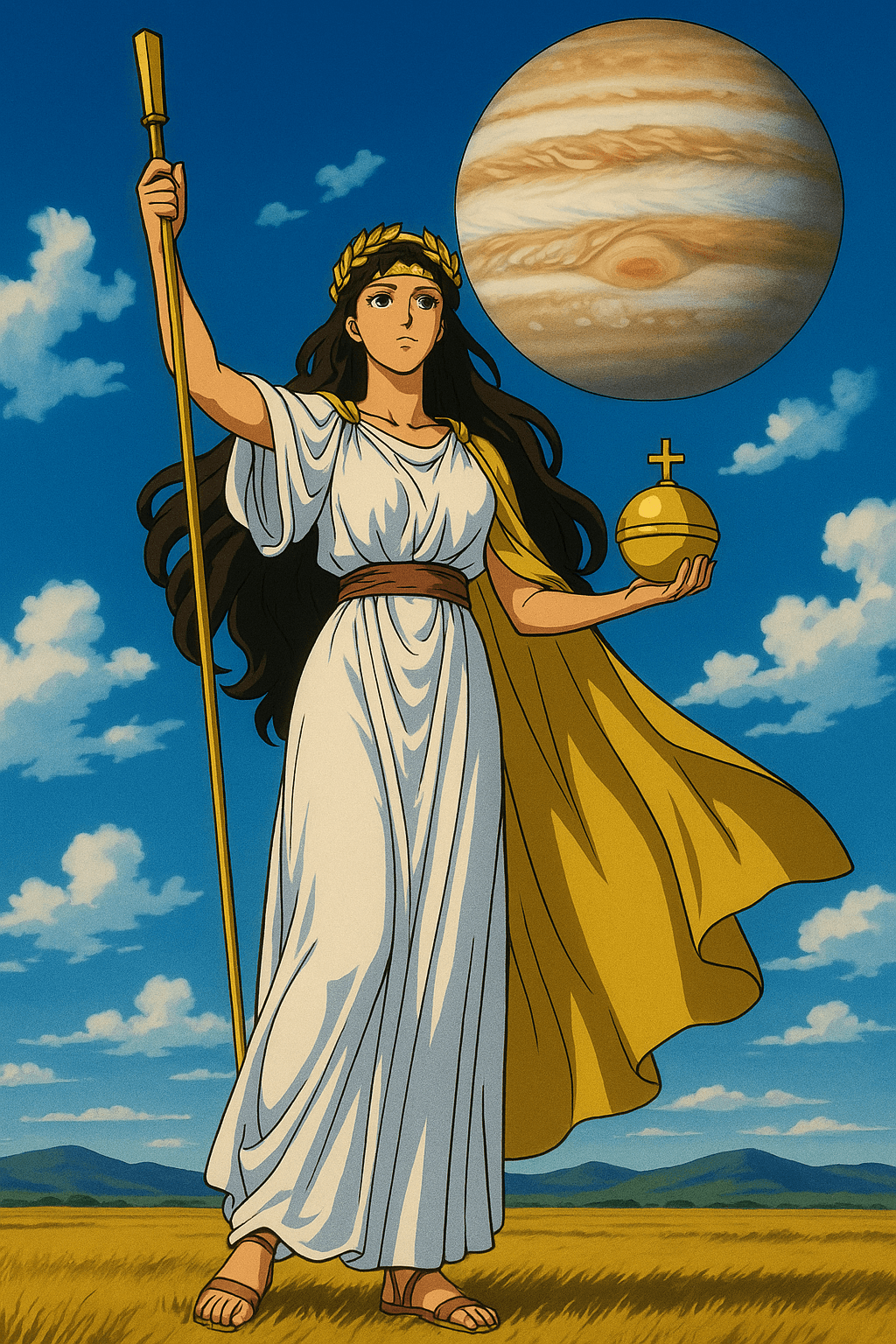
 PlanetJupiter
Other Names
Jupiter, Zeus,
Akin Ghosts
Zeus (Greek), Jupiter (Roman), Indra (Vedic, as king of gods), Aryaman (Vedic, god of the Milky Way, hospitality, nobility), Thor (Norse, in his expansive/protective aspect), Odin (Norse, in his kingly/conqueror aspect), Marduk (Babylonian), Amun-Ra (Egyptian, as supreme king), Perun (Slavic, thunder king), Dagda (Celtic, father-chief), Shangdi (Chinese, supreme deity/emperor of heaven), Tian (Chinese, Heaven as ruler), Ukko (Finnish thunder god), Taranis (Gaulish thunder god), Tengri (Turkic/Mongol sky god)
Related Posts
Translations:
High Church:
Mon (mon-)
Sanskrit:
अर्यमन् (Aryaman)
Church Runes:

Man corresponds to Jupiter, Zeus in the Greek tradition, king of the gods, wielder of the thunderbolt, lord of the sky and the established cosmic order. In the Vedic tradition he is Indra, the mighty warrior-king of the devas, and more precisely Aryaman, the god of the Milky Way, of hospitality, honour, and the bonds that hold human society together, whose very name became the root of the word "Aryan," meaning noble. In Norse mythology he is the kingly aspect of Odin and the expansive generosity of Thor combined, the energy that builds halls, gathers companions, and ventures into the unknown not from curiosity but from ambition and the drive to master. In Confucianism he is the Junzi, the noble person whose cultivation of virtue allows them to lead others and hold civilisation together through the sheer force of their moral example. In Roman religion Jupiter Optimus Maximus,"the best and greatest", was the patron of the entire Roman state, the god invoked at the beginning of every enterprise, the guarantor that human ambition could align with cosmic order. Wherever you find empire-builders, city-founders, lawgivers, and pioneers, you find the energy of Man at work.
Man has a dual nature with Muse. The solar system is roughly split in the middle between the known and the unknown, insideness and outsideness. From the Sun to Saturn are the known planets, those which were discovered and spoken of by the ancients, those which orbit within the inner light of the Sun rather than further out in the inky waters of deep space, closer to Doom. Man and Muse sit on either side of this great divide, facing in opposite directions.
Genesis 1:28 (The original mandate of Man): "And God blessed them, and God said unto them, Be fruitful, and multiply, and replenish the earth, and subdue it: and have dominion over the fish of the sea, and over the fowl of the air, and over every living thing that moveth upon the earth."
While Muse looks outward toward Doom and ponders it—the keeper of the threshold—Man looks inward toward Fire. Muse is the future looking to the past. Man is the past looking toward the future. It is Man that makes mankind venture into the distance, erect tall towers, and reach and strive for the sky. It is Man that propels civilisations upward, that makes them powerful and great and brings them beyond control. It is Man that makes us long for more, that brings us discipline or authority with others, and that makes us take the first step on long journeys, to reign in the world and take it in our hands.
Hávamál, Stanza 77: "Cattle die, kindred die, every man is mortal: but the good name never dies of one who has done well."
Jupiter is the past looking forward, the bright, expansive energy that takes what has been built and pushes it further. Saturn is the future looking back, the dark, contracting energy that sees what is coming and prepares. Both are salves to imbalance in perspective. A civilisation with too much Jupiter and not enough Saturn is one that expands recklessly, builds without wisdom, conquers without understanding what it has conquered, and eventually collapses under the weight of its own ambition. This is precisely the condition of the modern world, which suffers from severe Saturn rejection, all expansion, no reflection; all future, no past.
Aryaman's path is the Milky Way itself, for the path of dharma is to metaphorically reach the centre of the galaxy, to realise Doom in its totality and accept the freedom one finds in the inevitability of it. Man is the energy that sets us on that path. Without Man, we would never begin. Without Muse, we would never arrive.
Bhagavad Gita 3.35: "It is far better to discharge one's prescribed duties, even though faultily, than another's duties perfectly. Destruction in the course of performing one's own duty is better than engaging in another's duties, for to follow another's path is dangerous."
There is a particular feeling that Man embodies which is difficult to describe but instantly recognisable. It is the feeling of the first step on a long journey when you do not yet know the way. It is the feeling of a civilisation at its dawn, building its first walls, naming its first kings, looking outward at the horizon and feeling not fear but hunger. It is the feeling of a young person leaving home for the first time, or a scientist staring at an unsolved problem, or an athlete in the starting blocks before the gun. It is forward momentum, the raw, almost irrational drive to go further, build higher, reach farther, become more than what you are.
Man is the energy that erects tall towers. He is the voice that says let us go there, before anyone has worked out how. He is the ambition that turns a village into a city and a city into an empire, the pioneering impulse that crossed the Atlantic and split the atom and put boots on the Moon. There is something almost reckless about Man, a willingness to overreach, to build beyond what is wise, to stake everything on a vision of what could be rather than a sober assessment of what is. This is his glory and also his danger. Jupiter, the planet, is a failed star, a body so massive it nearly achieved fusion, nearly became a second sun, but fell just short. That astronomical fact captures Man perfectly: incandescent with potential, pulling everything in his orbit toward himself, striving for the light of Fire but not quite reaching it. The gap between what Man is and what Man reaches for is the engine of civilisation itself.
Analects 15.29 (Confucius): "It is Man who is capable of broadening the Way. It is not the Way that broadens Man."