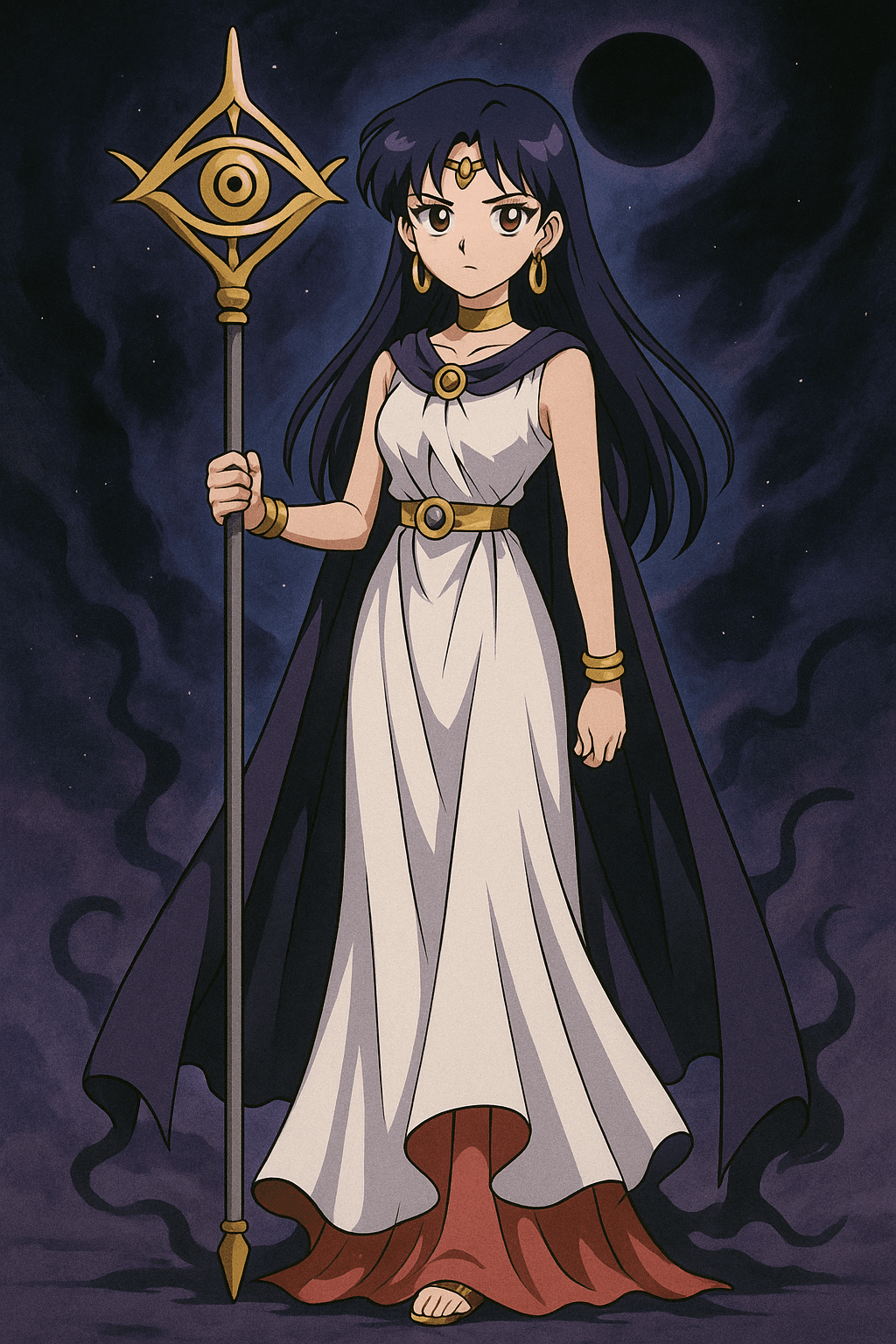
 PlanetPluto
Other Names
Hades/Pluto (Greco-Roman, the unseen one), Yama (Hindu/Buddhist, in his aspect as first seer beyond death), Odin on the Tree (Norse, in the act of seeing beyond), Da'at (Kabbalistic, the hidden sephirah in the Abyss), the Pythia/Oracle of Delphi (Greek), the Völva (Norse, seeress), Tiresias (Greek, the blind prophet), Cassandra (Greek, the cursed seer), Anubis (Egyptian, guide between worlds), Hermes Psychopompos (Greek, guide of souls to the underworld), Izanami (Shinto, in the underworld, the one who has crossed over), Persephone (Greek, queen of the underworld who sees both worlds)
Akin Ghosts
Related Posts
Add links or text here
Translations:
High Church:
Sekweti (sekʷ-e-ti)
Sanskrit:
ईक्षण (īkṣaṇa)
Church Runes:

Sight corresponds to Pluto, Hades in the Greek tradition, lord of the underworld and the dead, the unseen one, the god whose very name became a word for invisibility (the "Helm of Hades"). In Hindu tradition, Sight is Yama in his deepest aspect, not merely the god of death but the first mortal, the first being who crossed the threshold and saw what lay beyond, and who from that vision became the judge and guardian of the crossing. In Norse mythology, Sight is Odin on the tree, not the wise king who has already integrated his knowledge, but Odin in the act itself, suspended over the void, clinging to the runes he is pulling from nothingness, screaming between worlds. In Kabbalistic tradition, this is Da'at, the hidden, unnumbered sephirah that sits in the Abyss between the knowable and the unknowable, the point where all understanding collapses and something beyond understanding begins. In the Greek mystery traditions at Eleusis, initiates underwent a ritual death and rebirth in which they were said to "see," to have a vision so profound that it permanently altered their relationship to mortality. The Greek word for this experience, epopteia, literally means "the act of seeing," and the initiates were called epoptai, "those who have seen." Across traditions, the pattern is the same: at the very edge of existence, where being meets non-being, there is a faculty of perception that transcends ordinary sight, and those who develop it walk forever after with one foot in each world.
Mare comes from the same word as Mara, and this is essential. Daymare, Nightmare, and Sight form a triad: the three outer Ghosts beyond Muse's threshold, deeper into the outsideness that separates the knowable solar system from the unknowable void of Doom. They represent the unconscious, the unknown, the regions of experience that most people never voluntarily enter and that threaten to swallow those who do.
Tibetan Book of the Dead (Bardo Thodol): "O nobly born, when thy body and mind were separating, thou must have experienced a glimpse of the pure truth—subtle, sparkling, bright, dazzling, glorious, and radiantly awesome... Be not daunted thereby, nor terrified, nor awed. That is the radiance of thine own true nature. Recognize it."
Hávamál, Stanza 138-139 (Odin's self-sacrifice—the Rúnatal): "I know that I hung on a windswept tree nine long nights, wounded with a spear, dedicated to Odin, myself to myself, on that tree of which no man knows from where its roots run. No bread did they give me nor a drink from a horn, downwards I peered; I took up the runes, screaming I took them, then I fell back from there."
Sight is the last Ghost in our solar system, dancing on the edge between the dark unknown regions beyond Muse and the true oceanic void of nothingness that the cosmos and Doom swim within. This is the most dangerous path. Those who channel Sight must learn to dance with madness, or be devoured by it.
Pluto orbits at the very edge of what we can call our solar system, sometimes even crossing Neptune's orbit in its eccentric path, a cosmic vagabond that was once considered a planet, then reclassified, as if the astronomers themselves could not decide whether it belonged to the known world or had already crossed over into the unknown. This astronomical ambiguity mirrors the Ghost perfectly. Sight exists in the interstitial space between the something of our solar system and the nothing of the galactic void. It is not fully in either realm, and those who channel it are not fully in either realm either.
"Healer and psychopomp, the shaman is these because he commands the techniques of ecstasy—that is, because his soul can safely abandon his body and roam at vast distances, can penetrate the underworld and rise to the sky. He can go below and above because he has already been there."—Eliade
Consider Odin dropping his eye into Mimir's well. Consider him clinging to the world tree, impaled on its branches, clutching his runes atop the void. This is the characteristic sensation of Sight, the feeling of drawing a bucket into the well of outsideness to take something back, of reaching into nothingness and pulling out a handful of meaning, of spinning prophecy from thin air while just barely dodging the descent into the maddening void.
(Völuspá, Stanzas 28-29 Tianmu Translation) "Why have you come? And what do you seek? I soothsee all Odin, I know where your eye sleeps Deep in the inky depths of Muse's black well Yet he drinks it as if it were mead, while your sight drowns! Need I speak your doom, allfather?"
And notice what follows in the Hávamál. Odin does not merely receive the runes, he learns to use them. "Do you know how to carve? Do you know how to read? Do you know how to stain? Do you know how to test? Do you know how to ask? Do you know how to sacrifice? Do you know how to dispatch? Do you know how to slaughter?"
(Hávamál, Stanza 141)"Then I began to quicken and be wise, and to grow and to thrive; word from word found a word for me, deed from deed found a deed for me."
If you master Sight, it lets you pull insight from the void itself. Seers, oracles, visionaries, those uncanny individuals who seem to know things they have no business knowing, they are all channeling Sight in some form. But the mastery is everything. Without it, Sight is indistinguishable from madness. The oracles of Delphi inhaled toxic fumes to enter their prophetic states; the Norse völvas practised seiðr on the edge of societal acceptance, revered and feared in equal measure; the shamans of Siberia underwent initiatory illness and psychic dismemberment. In every tradition, the seer pays a terrible price for their gift, because the faculty of Sight is not free, it is purchased with a piece of your sanity, a piece of your ordinary humanity, a piece of your ability to live comfortably in the known world.
Kena Upanishad 2.3: "It is known to him to whom it is unknown; he does not know to whom it is known. It is unknown to those who know, and known to those who do not know."
The three outer Ghosts, Daymare, Nightmare, and Sight, form a progression deeper and deeper into outsideness. Daymare is the first encounter with the mechanical emptiness beyond the threshold. Nightmare is the descent into the psychic depths where meaning dissolves and reforms in terrifying shapes. Sight is the final edge, where even Nightmare's dissolving symbolism falls away and there is nothing left but the raw interface between being and non-being. To reach Sight and survive is to have gone further into the unknown than almost any consciousness can go and returned with something real. It is a rare and terrible gift.