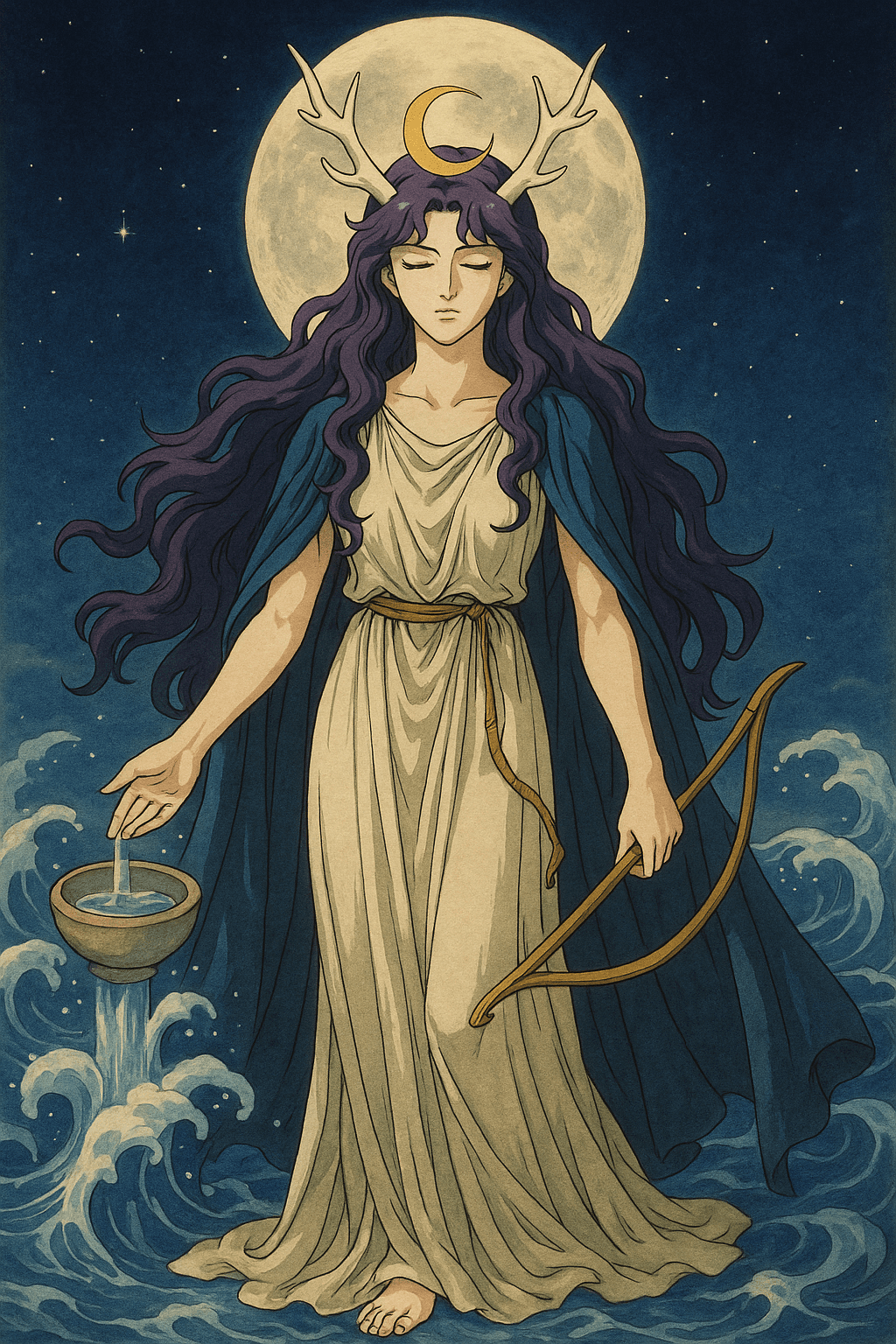
 PlanetMoon
Other Names
Soma (Vedic), Luna/Selene (Greco-Roman), Artemis/Diana (Greek/Roman, lunar huntress), Chandra (Hindu), Máni (Norse), Tsukuyomi (Shinto), Thoth (Egyptian, lunar aspect), Hecate (Greek, dark moon), Nanna/Sin (Sumerian/Akkadian moon god), Chang'e (Chinese), Ix Chel (Mayan moon goddess), Coyolxauhqui (Aztec moon goddess), Khonsu (Egyptian moon god), the Waner (Tianmu Threeness), Hina (Polynesian), Cerridwen (Celtic, cauldron/cycles), Mama Quilla (Inca), Alignak (Inuit)
Akin Ghosts
Waner
Related Posts
Add links or text here
Translations:
High Church:
Mehns (mḗh₁n̥s)
Sanskrit:
सोम (soma)
Church Runes:

Tides corresponds to the Moon, Soma in the Vedic tradition, the god of the sacred drink that granted visions and connected mortals to the divine, whose waxing and waning mirrored the cycles of birth, death, and rebirth. In Greek mythology she is Selene and Artemis both, the luminous huntress of the night who governs the wilderness and the threshold between the civilised and the wild. In Norse cosmology the Moon is Máni, who is chased eternally across the sky by the great wolf Hati, a myth that captures the sense of something being pulled, drawn, pursued by forces just beyond sight. In Japanese Shinto, Tsukuyomi is the Moon god who dwells in eternal separation from the Sun goddess Amaterasu, embodying the melancholy distance between light and dark, day and night. In virtually every coastal and agrarian civilisation, the Moon governed the calendar, the planting seasons, the tides of the sea, and the menstrual cycle, the rhythms that structured all of life before the invention of artificial time. The Moon is the oldest clock, and her face is the oldest symbol of the cyclicality that governs all things beneath the stars.
Tides concerns herself with the setting of the sun and the rise of the moon, the cyclicality of nature, the inevitable ebb and flow of time, and death and rebirth. She is heady and grave, sinking into the Earth and carving her own road through impenetrable terrain. She is, in a very real sense, gravity itself.
(Daodejing, Chapter 78): "Nothing in the world is as soft and yielding as water. Yet for dissolving the hard and inflexible, nothing can surpass it. The soft overcomes the hard; the gentle overcomes the rigid."
Tides pulls on us. She draws us through life, animating our will and acting upon us from just out of sight. The telltale feeling of Tides is the slow, clear lurch of nigh, the fading into darkness and the background, and yet feeling unstoppable, building and building to a tidal wave. She brings the cycles of nature to everything. The most obvious example is the very seas themselves, which she pulls on to form the waves that crash upon the shores. And so it is in life—in all life, not just human—that when we throw ourselves off a cliff, take a leap of faith, or dash ourselves against the rocks of life to see if we survive, we are like the waves that are drawn by the very Tides.
Ecclesiastes 3:1-4: "To every thing there is a season, and a time to every purpose under the heaven: a time to be born, and a time to die; a time to plant, and a time to pluck up that which is planted; a time to kill, and a time to heal; a time to break down, and a time to build up; a time to weep, and a time to laugh."
Tides is slow to shift but tectonic when she does. She is a force that refreshes all things, eroding away calcification to rebirth the mind or usher in a new age. Consider how the Moon governs not only the seas but the biological rhythms of nearly every living creature on Earth, the menstrual cycle, the spawning of coral, the migration of crabs, the behaviour of wolves. These are not metaphors. The Moon literally pulls on the water in our bodies, in our cells, in the sap of trees and the blood of animals. Tides is the most viscerally physical of the Ghosts, the one whose influence you can feel in your own body if you pay attention, the heaviness of a full moon night, the restless insomnia, the strange pull toward something you cannot name.
Heraclitus, Fragment 12: "Upon those who step into the same rivers, different and ever different waters flow down."
Where Fire rises and illuminates, Tides sinks and draws. Where Fire is the most Heavenly ghost in Heaven, Tides is the threshold of the Earthly, the liminal space where the known begins to shade into the felt-but-unseen. She is the waner to Fire's waxer within the inner planets, and her energy is the energy of letting go, of releasing, of allowing things to fall away so that new things can grow in their place.