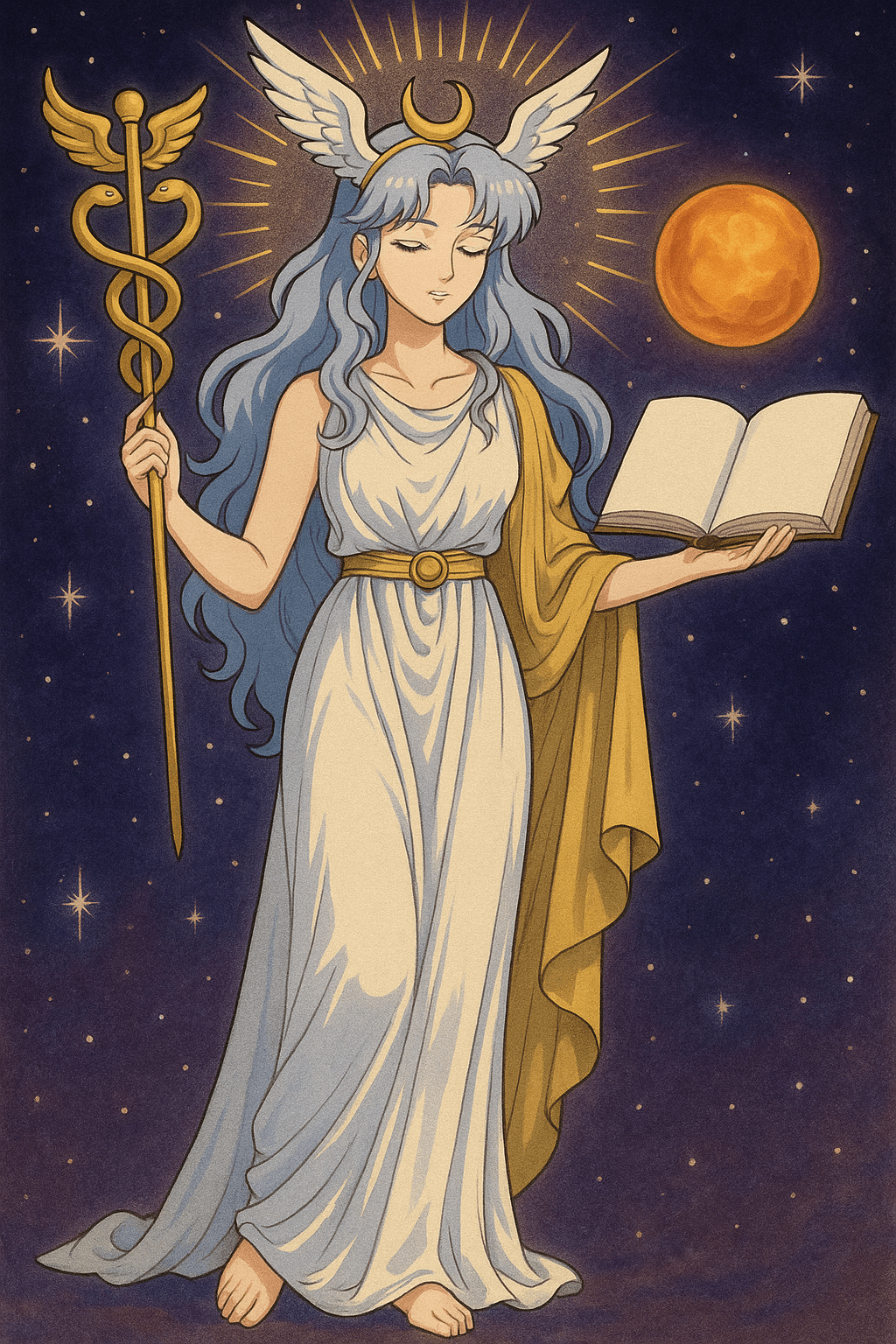
 PlanetMercury
Other Names
Hermes (Greek), Mercury (Roman), Thoth (Egyptian), Nabu (Mesopotamian), Ganesha (Hindu, remover of obstacles, patron of letters), Saraswati (Hindu, knowledge, music, arts), Bragi (Norse, god of poetry), Loki (Norse, trickster/cleverness aspect), Elegba/Eshu (Yoruba, trickster, crossroads), Anansi (Akan), Coyote (Indigenous American, trickster), Oghma (Celtic, eloquence), Hanuman (Hindu, devotion through intelligence and speed), Benzaiten (Japanese Buddhism, eloquence and music), Quetzalcoatl (Aztec, in his aspect as god of wind and learning), Wenchang Wang (Chinese, god of literature), Veles (Slavic, trickster, music, magic)
Akin Ghosts
Related Posts
Translations:
High Church:
Weyd (Weyd)
Sanskrit:
सरस्वती (Saraswati), वाच् (Vāc)
Church Runes:

Wit corresponds to Hermes in the Greek tradition, the messenger of the gods, patron of boundaries, travellers, thieves, and eloquence, the only Olympian who moved freely between Heaven, Earth, and the Underworld. In Egypt he is Thoth, the ibis-headed god of writing, mathematics, and sacred knowledge, inventor of hieroglyphs and keeper of divine records, who weighed the hearts of the dead against the feather of Ma'at. In Norse mythology his energy courses through Bragi, god of poetry, and through Loki in his cleverer and less malicious aspects, the trickster whose wit runs circles around the stolid strength of the other gods. In Hinduism he finds expression in Ganesha, the remover of obstacles and patron of letters and learning, and in Saraswati's domain of music, knowledge, and the arts. In the Hermetic tradition of late antiquity, Hermes Trismegistus, "thrice-greatest Hermes", was credited with the foundational texts of alchemy, astrology, and philosophy, a testament to the ancient world's recognition that wit is the faculty through which all the disparate threads of knowledge are woven into coherent understanding.
Wit is the fastest way to get from one place to another. It is efficiency, organisation, the elegant solution, the shortest path between two points that also happens to be the most beautiful. Where Fire burns through ignorance with raw passion, Wit dances through and around complexity with precision and grace.
Hamlet, Act II, Scene 2: "What a piece of work is a man! How noble in reason, how infinite in faculty! In form and moving how express and admirable! In action how like an Angel! In apprehension how like a god!"
A symphony requires Wit. So does the careful house of cards of a good joke, or the beautiful symmetry of a poem or a play. Wit is what Shakespeare channels when a single line contains three meanings stacked atop each other like nested boxes. It is what Bach channels when dozens of independent melodic voices weave together into a unified architecture of sound that the mind can barely comprehend but the heart grasps immediately. It is what Norm Macdonald channels when a joke meanders for five minutes through what seems like aimless digression before snapping shut like a trap, and you realise every single word was load-bearing.
Proverbs 4:7: "Wisdom is the principal thing; therefore get wisdom: and with all thy getting get understanding."
Wit is the Ghost of someone who finds language, or the complexity of composition, or the labyrinth of ideas, to be a playground instead of a burden. When you somehow manage to pull together a bunch of disparate ideas and make a beautiful pattern clear, when you take a ton of crazy aesthetic choices and make something coherent and new, that is Wit at work. It is the energy of the virtuoso, the skill that reaches beyond mere practice into something higher, something that feels almost supernatural in its effortlessness.
Rigveda X.71.1-2 (On the origin of Language): "When the wise ones fashioned speech with their thought, sifting it as grain is sifted through a sieve, then friends recognised their friendships.
Mercury, the planet, is the fastest in the solar system, orbiting closest to the Sun, completing its circuit in just eighty-eight days. This astronomical reality mirrors the nature of the Ghost perfectly. Wit is close to Fire, it partakes of Fire's clarifying intelligence, but it moves faster and lighter than any other energy. It does not burn; it flickers. It does not illuminate through sheer brightness but through the precise angle at which it catches the light. Hermes was the only god who could cross all boundaries, between the living and the dead, between mortals and Olympians, between the marketplace and the temple. Wit too crosses every boundary. It is at home in every domain because its nature is not to dwell but to move, to connect, to translate.
Homeric Hymn 4, lines 143-150 (Hermes passes through the keyhole—Wit's incorporeality): "Luck-bringing Hermes, the son of Zeus, passed edgeways through the key-hole of the hall like the autumn breeze, even as mist: straight through the cave he went and came to the rich inner chamber, walking softly, and making no noise as one might upon the floor."