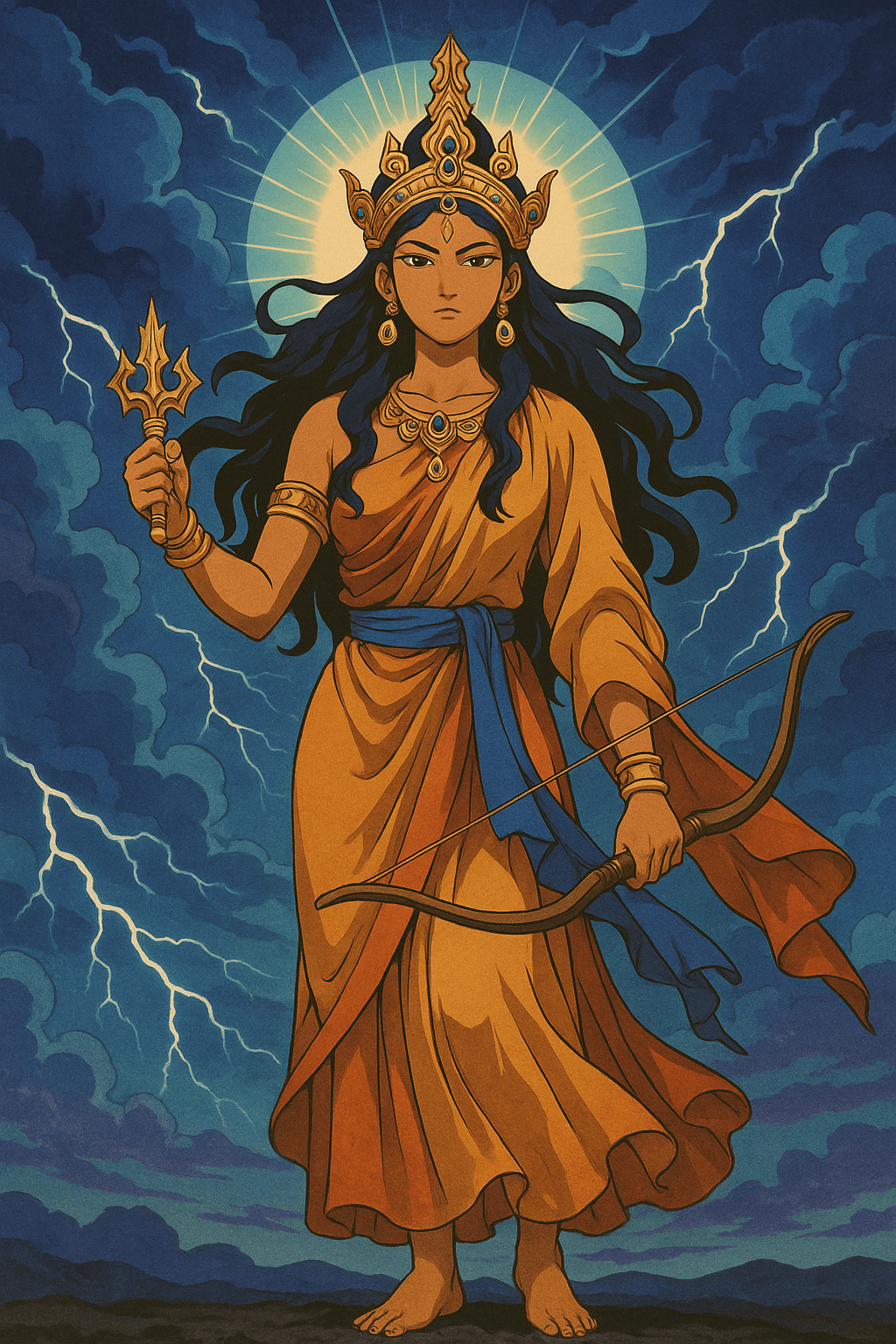
 TraditionTengrism
Period
1162 – 1227 CE
Homeland
Mongol Steppe
The Doomsayers are our prophets, those whose actions turned the wheel of doom for all of humanity. They are the fruit on the branch of the world tree: rare, and when they appear, everything changes.
You are probably wondering why a conqueror sits alongside Siddhartha and Jesus. Good. The confusion is the point. If dharma were only gentleness and mercy, it would not be dharma. A forest is refreshed by fire. A flower grows in decay. Doom ensures this is true, karma makes it true.
Temujin is a Doomsayer because no single human being has ever changed the material conditions of the world more than he did, and because the karmic forces that produced him are among the most vivid and instructive in all of history. His life is the purest case study of wyrd we possess. Everything he became, he became because of what happened to him, and everything that happened to him was woven into the yarn of the world with such narrative irony that no honest observer can look at it and call it coincidence.
Around 1162, on a hillock overlooking the Onon River, a woman named Oe'elun gave birth to a boy clutching a clot of black blood in his fist. His father Yisukei had just returned from battle with a captured Tatar chieftain named Temujin Uge, and so the child was named after a prisoner of war.
Before this, Yisukei had stolen Oe'elun. She was riding across the steppe as a new bride when Yisukei saw her beauty, fetched his brothers, and chased her first husband Chiledu away. She tore off her undershirt and threw it to Chiledu so he would have her scent to carry with him. Then she wailed so loudly the Onon River echoed and the wooded valley rang with it. In the Secret History, the oldest Mongol text, written shortly after Temujin's death, our primary source for his early life, the heading for the passage that describes his birth is: "Temujin's Birth and Yisukei's Death." The two events are yoked together as though inseparable. The child is born into violence, named after a captive, and the text itself cannot separate his arrival from his father's end. The yarn is already weaving.
Yisukei saw something in the boy, or perhaps nothing at all. Some accounts suggest he was not highly valued. When Temujin was nine Yisukei took him travelling to find a bride—partly to prevent rivalry between Temujin and his older half-brother Bekter, partly just to be rid of him. Along the way they met a man named Dei Sechen of the Qonggirat, who looked at the boy and said he had "flame in his eyes and fire in his face." Dei Sechen's daughter was Borte, one year Temujin's elder. They were betrothed. Yisukei left his son and rode home.
He never made it. On the road he stumbled upon a Tatar feast and, recognised despite his attempts at anonymity, was secretly poisoned. He dragged himself home over three days, growing sicker. He asked a man named Monglik to watch over his small children and widowed wife. Then he died. And the nine year old boy was retrieved from his betrothal to begin the worst decade of his life.
Abandonment
What happened next set the pattern for everything Temujin would become.
The Tayichi'ud, his father's clan, abandoned the family. Two old women excluded Oe'elun from an ancestral ceremony—the Mongol way of severing kinship through food. When a kind old man tried to dissuade them from leaving, a Tayichi'ud warrior speared him in the back. The boy Temujin ran to see the dying man. He wailed, and went home.
Oe'elun rode out with her dead husband's Spirit Banner, his horsehair standard, the seat of a man's soul, and paraded it before the departing clan. Some returned from shame, then sneaked away at night, taking the family's animals. The widow was left with seven children under ten and nothing else.
The Secret History preserves her survival in a poem so old it aches:
Born both womanly and wise,
Finding food for her small boys,
Fastening on firm her boqta hat,
Fixing up her flowing skirts,
Flying up and down the Onon's flood,
Finding wild fruits, crab apples and cherries,
Filled she night and day their famished throats.
The boys made fishhooks from bent sewing needles and whittled arrows from bone to hunt rats. A Persian chronicler records that the family wore the skins of dogs and mice, and ate the flesh of those animals and other dead things. They had fallen to the lowest rung of steppe existence—and the steppe's lowest rung is as low as human life can go. The hamingja of a great lineage, diminished to almost nothing. Almost.
Brother's Blood
As the boys grew, Bekter, the older half-brother, son of Yisukei's other wife, began asserting dominance. He stole a skylark Temujin had shot. He snatched a fish from his hook. As eldest, Bekter had the right to rule the family and, by custom, sexual access to any widow of his father besides his own mother—meaning Oe'elun. She sided with Bekter and told a story about their ancestress bearing children after her husband's death, implying she would accept Bekter as husband.
Temujin threw aside the felt door of the ger, a gesture of extreme disrespect, and stormed out.
He and his brother Qasar found Bekter sitting alone on a hilltop, watching the horses. They crept up from front and behind. Bekter saw them. He did not run. He spoke:
When we cannot put an end to the bitterness of the Tayichi'ud and are wondering who can pay them back, why do you make me a lash in your eyes, a spine in your craw? When we have no friend but a shadow, no whip but a tail, how could you imagine this? Don't extinguish my hearth. Don't forsake Belgutei.
Then he sat cross-legged and waited. They shot him from both sides and walked away.
Their mother's response was a volcanic eruption of animal similes—she called them destroyers, compared them to a hound devouring its own afterbirth, a panther leaping against a cliff, a lion that cannot restrain its wrath, a python that swallows its prey alive, a wolf stalking in the blizzard. "You came from my hot womb clutching a clot of blood in your hand."
A boy of perhaps twelve had killed his own brother. Not in a rage, not in self-defence, but with cold deliberation. He had decided he would lead, not follow, and was willing to kill for it. This is not a comfortable beginning for a prophet. It is not supposed to be. The Doomsayers are not saints. They are the fruit of their karma, and their karma is not gentle.
The Cangue
The killing gave the Tayichi'ud an excuse to hunt Temujin down. They came saying: "The fledglings have grown feathers, the droolers have developed." They wanted only Temujin.
He fled into dense forest. He spent nine days without food. The Secret History records his thought at the breaking point: "Why die nameless? I'll go out." He emerged and was captured.
They put him in a cangue, a heavy wooden collar that immobilised his arms, preventing him from feeding himself or even drinking water. He was rotated from family to family, one night per household, a slave and an exhibit. The subordinate families showed him kindness: an old woman tended the raw wounds the cangue cut into his neck. One night during a feast, when the guards were drunk, he struck his feeble guard on the head with the wooden collar and ran. He hid in a river with only his face above the water and the cangue floating alongside him in the moonlight. A man named Sorgan-Shira found him during the search and said: "It is just because you have this right kind of trick that the Tayichi'ud envy you so—they worry about the flame in your eyes and the fire in your face. Keep lying there. I will not tell."
When the search failed, Temujin went to Sorgan-Shira's ger. The old man was terrified. But his sons said: "When the sparrow took refuge from the hawk in a bush, the bush protected it. Now that he's come to us, how can you talk to him like that?" They burned the cangue and sent him on his way with a barren mare, two arrows, no saddle, and no flint. He tracked bent grass upriver and found his family.
Here is the first great karmic lesson of Temujin's life. The Tayichi'ud, blood kin, had put his family out to die and tried to break him. But strangers, with no kinship obligation, risked their lives for him. This planted in the boy a conviction that would reshape the world: that loyalty freely given is worth more than the accident of birth. That people should be judged by their actions, not their lineage. This is, in steppe society, a revolution.
Borte
When Temujin found Borte again—years later, after the long separation—they married. She brought a coat of the finest black sable fur, her mother's wedding gift. It was a brief peace.
One dawn, an old woman named Qo'aqchin felt the ground shaking and screamed for everyone to wake. The Merkid had come. They had come specifically to avenge the kidnapping of Oe'elun a generation earlier—the theft of Temujin's own mother by his own father. The yarn circles back on itself, as it always does.
There was no horse for Borte.
Temujin fled with his mother and brothers to the holy mountain of Burkhan Khaldun, where the Merkid could not follow through the dense forest. They circled the mountain three times, gave up, and left, saying: "Now we have taken their women. We have paid them back."
Temujin descended from the mountain, beat his chest, and spoke:
I hiked the heights of high Burgan
And hid my life, like a little louse, in Burgan-Qaldun.
I made my way on wide Qaldun,
And kept my life, like a cricket's chirp, in Qaldun-Burgan.
His wife had been taken. His life was the size of a louse. And the cause of it all—the original sin, the karma that set the whole chain in motion—was his own father's crime. Yisukei stole Oe'elun from Chiledu the Merkid. A generation later, the Merkid came and took Borte. This is wyrd in its purest form: the irony of causality reaching across lifetimes, the unseen thread in the yarn pulling taut.
He rescued her. With the help of Toghrul Khan of the Kereyit and his blood-brother Jamukha, he attacked the Merkid at night and rode through the fleeing people calling out her name—"Borte, Borte!"—until she heard his voice, leapt from a wagon, and ran to him in the bright moonlight. They threw themselves upon each other.
But Borte was pregnant by her captor. The first son, born shortly after the rescue, was named Jochi, meaning "visitor" or "guest." The question of his paternity was never resolved and would haunt the Mongol succession for a century.
In the tormenting, unanswerable question of Jochi's blood lay the seed of one of Temujin's most radical laws: that all children are legitimate, whether born to wife or concubine, regardless of the circumstances of their conception. The wound became the law. The suffering became the foundation. This is how the Doomsayers work. Their karma is transmuted into the doom of the world.
The Anda
Jamukha was Temujin's first great love. Twice in childhood they swore oaths of brotherhood, anda, exchanging knucklebones and arrowheads, sharing blood. Anda was supposed to be stronger than biological kinship, because it was freely chosen.
After the rescue of Borte, the two lived together. They feasted, rejoiced, and slept under the same blanket. This lasted a year and a half. Then Jamukha made a speech about who should camp by the mountains and who by the river—asserting rank. Temujin did not understand. It was Borte who interpreted: "Jamukha is tired of us. Let us not pitch camp. Let us move through the night."
Temujin moved. Followers defected to him in the darkness. The rift became a civil war that lasted two decades.
When Jamukha won the first major battle, he boiled seventy young prisoners alive in cauldrons. He lost the battle of public opinion forever. When at last Jamukha's own men betrayed him and brought him bound to Temujin, Temujin had the traitors executed—a man who betrays his own lord is a danger to every lord, and then faced Jamukha alone. Temujin offered to renew their friendship. Jamukha refused:
At the time to become friends, I was not a friend of his. Now when the world has become ready, what would be the use of us becoming friends? I would enter your dreams in the dark night, I would torment your thoughts in the bright day. I would be a louse in your lining, a thorn against your throat.
And his self-reckoning—one of the most devastating confessions in all of literature:
Anda was born as a champion, inheriting a wise mother, and gained his skilful little brothers and peerless friends. I was surpassed by Anda. As for me, I was left behind by my mother and father as a small child, I had no little brothers, my woman was a blatherer and I had faithless friends. In all those things I was surpassed by Anda, who was born with a heavenly destiny.
He asked to die without shedding blood—the aristocratic death—and promised: "If my bare bones be in lofty earth, I will bring lasting, abiding protection unto the seed of your seed. A blessing will I become for you."
There is a legend that Temujin buried Jamukha wearing the golden belt he had given him when they first swore their oath. And so the yarn completes another circle.
Toghrul
The betrayal by Toghrul Khan, Ong Khan of the Kereyit, his father's sworn brother, the man Temujin called father, is the final turn of the wheel before the ascent.
Temujin had rescued Toghrul from destitution multiple times. When the old khan was reduced to penning up five goats and pricking camel's blood to survive, Temujin levied requisitions for him and brought him into his own camp. The gratitude was real but fragile. Toghrul's son Senggum was jealous, and Jamukha whispered poison in his ear.
Toghrul resisted at first: "He has been our mainstay. If we think badly about my son like this, Heaven will not be pleased with us." But Senggum pushed and pushed, slapping aside the felt door in anger, until the old man yielded: "You take charge of it."
They set a trap—a fake betrothal feast. Father Monglik saw through it and warned Temujin. Two horse-wranglers, Badai and Kishiliq, rode through the night to bring word of the coming attack. Temujin survived, but barely. At the Battle of Qala'aljit Sands he was broken. He counted his remaining people: 2,600. His son Okodei had been struck by an arrow in the jugular, and the warrior Boroqol carried him out while sucking clotted blood from his neck. When Temujin saw Boroqol arrive with blood trickling from the corners of his mouth, tears fell from his eyes.
His brother Qasar, who had been separated, searched the ridges for days, eating leather and thongs to survive, before finally finding him.
This was the nadir. Two thousand six hundred people. A devastated family. Betrayed by his father-figure, defeated in battle, nearly exterminated. And from this bottom—this absolute bottom, lower even than the childhood abandonment—he rose. He caught Toghrul feasting unawares, surrounded the Golden Tent for three days and nights, and destroyed the Kereyit kingdom. Then the Naiman. Then the Merkit. Then Jamukha.
In the Year of the Tiger, 1206, at the headwaters of the Onon River, they planted the nine-tailed white banner and gave him the title he had earned with the totality of his suffering:
Chinggis Khan.
The Conqueror
Here we enter the part of the story the world remembers, though it remembers it poorly.
In twenty-five years, the Mongol army conquered more lands and people than the Romans did in four hundred. The empire covered between eleven and twelve million contiguous square miles, the size of Africa. It stretched from Siberian tundra to Indian plains, from Vietnamese rice paddies to Hungarian wheat fields, from Korea to the Balkans. The majority of people alive today live in countries the Mongols conquered. And they did this with an army of roughly one hundred thousand—a group that could fit in a modern sports stadium.
These numbers are staggering enough. But what makes Temujin a Doomsayer is not the conquest itself. It is what the conquest did.
Before Temujin, the Old World consisted of regional civilisations that claimed virtually no knowledge of any civilisation beyond their closest neighbour. No one in China had heard of Europe. No one in Europe had heard of China. No person had made the journey from one to the other. By the time of his death in 1227, he had connected them with diplomatic and commercial contacts that still remain unbroken.
He abolished the aristocratic system of the steppe. Cowherds and shepherds became generals. He appointed by merit and loyalty, not lineage, an idea so radical it took the rest of the world centuries to partially implement. He organised the nation into decimal units of ten, hundred, thousand, and ten thousand, deliberately breaking the power of the old tribal and ethnic identities. He created the first international postal system. He codified law—and, in perhaps his most revolutionary act, subjected the ruler himself to the law, something no other civilisation had yet achieved.
In probably the first law of its kind anywhere in the world, he decreed complete and total religious freedom for everyone. He exempted all clergy, doctors, teachers, and scholars from taxation and public service. At his lowest moment—the Baljuna Covenant, when only nineteen men remained loyal—those men included Christians, Muslims, Buddhists, and practitioners of Tengerism. Their unity transcended kinship, ethnicity, and religion.
His personal laws were direct transmutations of his personal karma. He forbade the kidnapping of women—because Borte was kidnapped. He forbade enslavement—because he wore the cangue. He declared all children legitimate—because of Jochi. He outlawed killing without trial—outlawing the very method he used to begin his rise. The wound became the law, every single time.
The Mongols turned war routes into trade routes. They created history's largest free-trade zone along the Silk Road, lowered taxes, and made the roads safe—a Florentine merchant in 1340 could report that the route to Cathay was "perfectly safe, whether by day or by night." They brought German miners to China and Chinese doctors to Persia. They spread carpets, transplanted lemons and carrots from Persia to China, noodles and tea from China to the West. When Chinese gunpowder combined with Muslim fire-lance technology and European bell-casting, the cannon was born. They created hospitals staffed by doctors from India, the Middle East, and China. They commissioned the first history of the world. They mass-produced printing in multiple languages. They synthesised Chinese, Arab, and Greek cartography.
Francis Bacon identified printing, gunpowder, and the compass as the three inventions on which the modern world was built. All three were spread during the Mongol Empire. The Renaissance was not the rebirth of Greece and Rome. It was the Mongol world arriving in Europe, building the modern world atop The Mountain of Corpses.
The Dalai Lama
This is where the story becomes something more than history. This is where you understand why Temujin sits beside Siddhartha.
Temujin himself practised Tengerism—worship of the Eternal Blue Sky—and his policy was religious tolerance. But the Mongol relationship with Buddhism began in the generation after his death, and it changed the world.
In the 1240s, Temujin's grandson Godan Khan—son of the Great Khan Ogodei, who then ruled the empire—sent thirty thousand troops into Tibet. After the initial violence, Godan did something unexpected: he invited Sakya Pandita, one of Tibet's most learned lamas and the head of the Sakya school of Tibetan Buddhism, to his court. Sakya Pandita made the long journey north and became the khan's spiritual teacher. In exchange, Godan granted him nominal authority over Tibet. This arrangement—the lama teaches the Dharma, the khan provides worldly protection and power—became known as the yon-mchod, the priest-patron relationship. It was the first formal bond between the Mongol Empire and Tibetan Buddhism.
The next generation deepened it further. Kublai Khan, Temujin's most famous grandson, founder of the Yuan Dynasty that ruled China, took Phagpa, Sakya Pandita's nephew, as his personal teacher. Phagpa gave Kublai the Hevajra tantric empowerment, one of the highest initiations in Vajrayana Buddhism. In return, Kublai made him Imperial Preceptor and granted him authority over all of Tibet. Tibetan Buddhism became the state religion of the Yuan Empire, the largest empire on Earth, and the Mongol world was converted to the Dharma. All of this flowed from Temujin's policy of tolerance and from the imperial infrastructure he had built. The grandfather conquered the world; the grandson gave it a religion.
After the Yuan Dynasty fell in 1368, the Mongol-Tibetan bond weakened for two centuries. Then it was revived—and here the story takes its most extraordinary turn.
Altan Khan was a Tumed Mongol ruler of the sixteenth century, a direct descendant of Kublai Khan through the senior Chinggisid line. He was ambitious, powerful, and faced a problem: he was not of the ruling branch and needed legitimacy. He looked to Tibet. In 1578, he invited Sonam Gyatso to his court. Sonam Gyatso was the head of the Gelugpa school, a relatively new school of Tibetan Buddhism, founded by the reformer Tsongkhapa in the early 1400s, which emphasised monastic discipline and scholastic rigour. Being the newest of the four major Tibetan Buddhist schools, the Gelugpa lacked the old clan patronage networks that the Kagyu and Sakya schools enjoyed. They needed a powerful foreign patron. The khan needed a priest. The yon-mchod was reborn.
At their meeting, a grand assembly of over ten thousand people on the Mongolian steppe, Sonam Gyatso declared Altan Khan the reincarnation of Kublai Khan. Think about that. Not a descendant, not an heir—Kublai himself, reborn. Altan Khan in turn bestowed on Sonam Gyatso the Mongolian title "Dalai," meaning ocean, creating the title of Dalai Lama. The title was applied retroactively to Sonam Gyatso's two previous incarnations, making him the Third Dalai Lama. The title that would become synonymous with Tibetan Buddhism worldwide was a Mongolian word, given by a Mongol khan, on the Mongol steppe.
Now follow the thread. Altan Khan is the reincarnation of Kublai. Kublai is the grandson of Temujin. In the Gelugpa understanding of rebirth, which is foundational to Tianmu, this is not metaphor and it is not political theatre. It is the same soul. The same ghost, moving through time, wearing different faces, carrying the same hamingja forward. And if Altan Khan is Kublai reborn, and Kublai carried the spiritual fortune of the Chinggisid line, then the being who met the Third Dalai Lama on that steppe in 1578 was, in the deepest sense, Temujin himself—still turning the wheel.
And the Dalai Lamas are the other side of the same coin. Sonam Gyatso declared himself the reincarnation of Phagpa, the very same lama who had given Kublai his tantric initiation three centuries earlier. The priest who awakened the khan. In Gelugpa belief, this priest-patron bond is not merely political alliance but a karmic entanglement that recurs across lifetimes: the same two souls, meeting again and again, the lama always guiding the khan toward the Dharma, the khan always providing the worldly power that allows the Dharma to spread. Then came the proof. The Fourth Dalai Lama, Yonten Gyatso, born in 1589, was recognised as the reincarnation of Sonam Gyatso. And where was he found? In the family of Altan Khan. He was the khan's own great-grandson. The only non-Tibetan Dalai Lama in all of history. The soul of the lama was literally reborn into the bloodline of the khan. The yarn knotted itself so tightly that the two lineages became one.
The final act came in the seventeenth century, during a Tibetan civil war. The Tsangpa Dynasty, which backed the rival Karma Kagyu school, was persecuting Gelugpa monasteries and blocking Gelugpa political power. The Gelugpa were losing. So they called upon their old patrons. Gushi Khan, a Khoshut Mongol prince descended from Qasar, who was Temujin's younger brother, the same Qasar who ate leather and thongs searching for Temujin after the disaster at Qala'aljit Sands, answered. In 1642, Gushi Khan led his Oirat Mongol warriors into Tibet, defeated the Tsangpa king, and handed temporal authority over all of Tibet to the young Fifth Dalai Lama, known forever after as the Great Fifth. The Great Fifth built the Potala Palace in Lhasa, unified Tibet, and established the theocratic government, the Ganden Phodrang, that lasted until the Chinese occupation of the 1950s. Without Mongol military power—without the hamingja of Temujin's line, carried through his brother's descendants—the Gelugpa school would never have risen to dominance, and the Dalai Lama as the world knows him would not exist.
Look at the arc. Stand back and look at it.
A boy is born on the steppe clutching a blood clot. He is abandoned, enslaved, betrayed. He kills his brother. He loses his wife. He rises from nothing, and from nothing he conquers the world and connects it for the first time. He decrees religious freedom, abolishes aristocratic privilege, and subjects the ruler to the law. He dies, and his empire fragments—but his spiritual fortune does not die. It passes through his descendants. His grandson takes a tantric initiation and converts to Buddhism. The Mongol world turns toward the Dharma. Centuries later, the same soul—wearing a Mongol khan's face—meets the same priestly soul on the steppe and creates the institution of the Dalai Lama. And the Dalai Lama's soul is reborn into the khan's own bloodline, fusing the two streams into one. And when enemies threaten the Dharma, it is Temujin's brother's descendants who ride in and save it by force.
The conqueror becomes the patron of enlightenment. The destroyer becomes the protector of the Dharma. The wolf of the steppe is reborn, life after life, drawing closer and closer to the very thing his empire made possible. This is not a secular story of political patronage. This is a soul's journey across centuries—hamingja growing, evolving, transforming—from blood clot to Potala Palace, from cangue to compassion. It is the longest and most dramatic narrative arc of any Doomsayer we recognise.
The Dalai Lama, perhaps the single most recognisable spiritual figure on Earth today, is Temujin. Not was. Is. The same ghost, still turning the wheel, still teaching the world what his suffering taught him. If you cannot see why a conqueror sits beside Siddhartha after knowing this, then you have not understood what reincarnation means.
And there is one more layer, the deepest one.
In Gelugpa Buddhism, the Dalai Lama is not merely a reincarnating teacher. He is the earthly manifestation of Avalokiteshvara, Chenrezig in Tibetan, Weepseer in the language of Tianmu, the Bodhisattva of Compassion. The being who hears the cries of all sentient creatures. The being who, having reached the threshold of nirvana, turned back and vowed to remain in the cycle of rebirth until every last soul is liberated from suffering. Avalokiteshvara is compassion itself, made flesh, over and over, for the sake of the world.
If the Dalai Lama is Avalokiteshvara, and the Dalai Lama is Temujin, then Temujin is Avalokiteshvara.
Sit with that. The Bodhisattva of Compassion—born on the frozen steppe, father murdered, clan dissolved, surviving on rats and roots, killing his own brother at twelve, wearing the cangue, losing his wife to the karma of his father's crime. What happens to the being of infinite compassion when he is born into those conditions? What does enlightenment look like when the world shapes it with that particular cruelty?
We found out. That is history. That is Temujin.
This is the reckoning that Temujin demands of us, and it is not comfortable. He slaughtered legions. Cities were emptied. Rivers of blood are not metaphor in his story. And yet this same man—the same soul—decreed the first universal law of religious freedom, abolished aristocratic birth-right, made the ruler subject to his own law, forbade the kidnapping of women, forbade enslavement, declared all children legitimate regardless of their conception, and built the infrastructure that connected the entire world for the first time. He was, despite everything, the most liberal and open-minded emperor in human history. The wound became the law, every single time.
The typical view of enlightenment wants it to be gentle. Wants it to look like a monk in saffron robes, seated in perfect stillness, radiating peace. And sometimes it does look like that—we have Siddhartha among our Doomsayers for good reason. But dharma is not what people typically think of when they think of "good." Dharma is perpendicular to any polarity. It is wholeness and placeness. It is truth and sincerity of being. It is not merciful nor cruel. It just is.
Temujin shows how wyrd, the ironic, narrative unfolding of one's own karma, can carry even the highest nature to ends we would never expect, ends that horrify us, and yet does so truly. Honestly. Completely. His life was not a failure of compassion. It was compassion shaped by the most extreme conditions the world could produce—conditions that demanded a different expression entirely. The steppe did not need a gentle teacher. It needed someone who could break the old world open so that something new could grow in the rubble. And the being who heard the cries of the world answered—not with a sermon, but with the only language the world would listen to.
This does not excuse the dead. It does not sanitise the horror. It means that the horror is part of the picture, not separate from it. A forest is refreshed by fire. The wheel turns, and its turning is not kind, and the Doomsayers are the ones who turn it. That is their burden and their gift. That is why we call them what we call them.
The Karmic View
Great Man Theory says that history is shaped by exceptional individuals. Its opposite says that individuals are products of material conditions, interchangeable cogs in the machinery of historical forces. To us, this is a false dichotomy, a crosstruth that demands reconciliation.
Temujin could not have done what he did without his suffering. If his father had not been murdered, if his clan had not abandoned him, if he had not worn the cangue, if Borte had not been stolen—he would not have had the ferocity, the conviction, or the laws. The might of the Mongol Empire, greatest in history, was only ever as high as Temujin's worst suffering was low. Every law he made was a wound turned inside out. Every innovation was an answer to a question that only pain could ask. His hamingja, reduced almost to nothing in childhood, was rebuilt through fire and blood into the most potent spiritual fortune any single human lineage has ever possessed.
And yet—nobody else could have done it. Nobody else could have been as wilful and charismatic, nobody else could have united the tribes and summoned the connected world out of thin air. His childhood friend Bo'orcu met him as a stranger tracking stolen horses and immediately said: "True men's troubles are all the same. I want to be your friend." Sorgan-Shira, risking death to help an escaped prisoner, told him: "It is just because you have this right kind of trick that they worry about the flame in your eyes and the fire in your face." People saw something in him, from the very start, that could not be denied.
So to whom are his deeds owed? Him, or the world?
The answer is that the question is the answer. Both. Neither. The world taught grit with characteristic harshness, and he—and only he—fully accepted its wisdom. And he—and only he—had the strength and intelligence to teach the world back. His personal wyrd became the doom of the species. His karma became the yarn of the world.
This is why we hold only the karmic view of history. Not Great Man, not material determinism, but the understanding that certain beings are the fruit on the branch of the world tree—grown from seed, fed by soil, shaped by rain, and yet singular, irreplaceable, unique. The fruit does not make itself, but neither does the tree bear fruit without it.
The Doomsayers bear their name because their actions turned the wheel of doom for all of humanity. They are the rare beings whose personal wyrd became inseparable from the doom of the species. Temujin is among them because he turned the wheel harder than anyone. Born with a blood clot in his fist, orphaned, abandoned, enslaved, betrayed by every form of kinship the steppe could offer—he broke the old world open and from its rubble built the foundations of the new.
The Secret History preserves the words he spoke to his first companions, Bo'orchu and Jelme, after they made him khan:
When I had no friend but a shadow, it was you two who became my shadow and eased my soul. When I had no whip but a tail, you became my tail and eased my heart.
The refrain of absolute destitution—"no friend but a shadow, no whip but a tail"—runs through the Secret History like a heartbeat. It names the bottom. And from that bottom, everything.
That is his doom. That is his wyrd. And the world he made from it is the one we are still living in.