 TraditionChristianity
Period
1412 – 1431 CE
Homeland
Domrémy, France
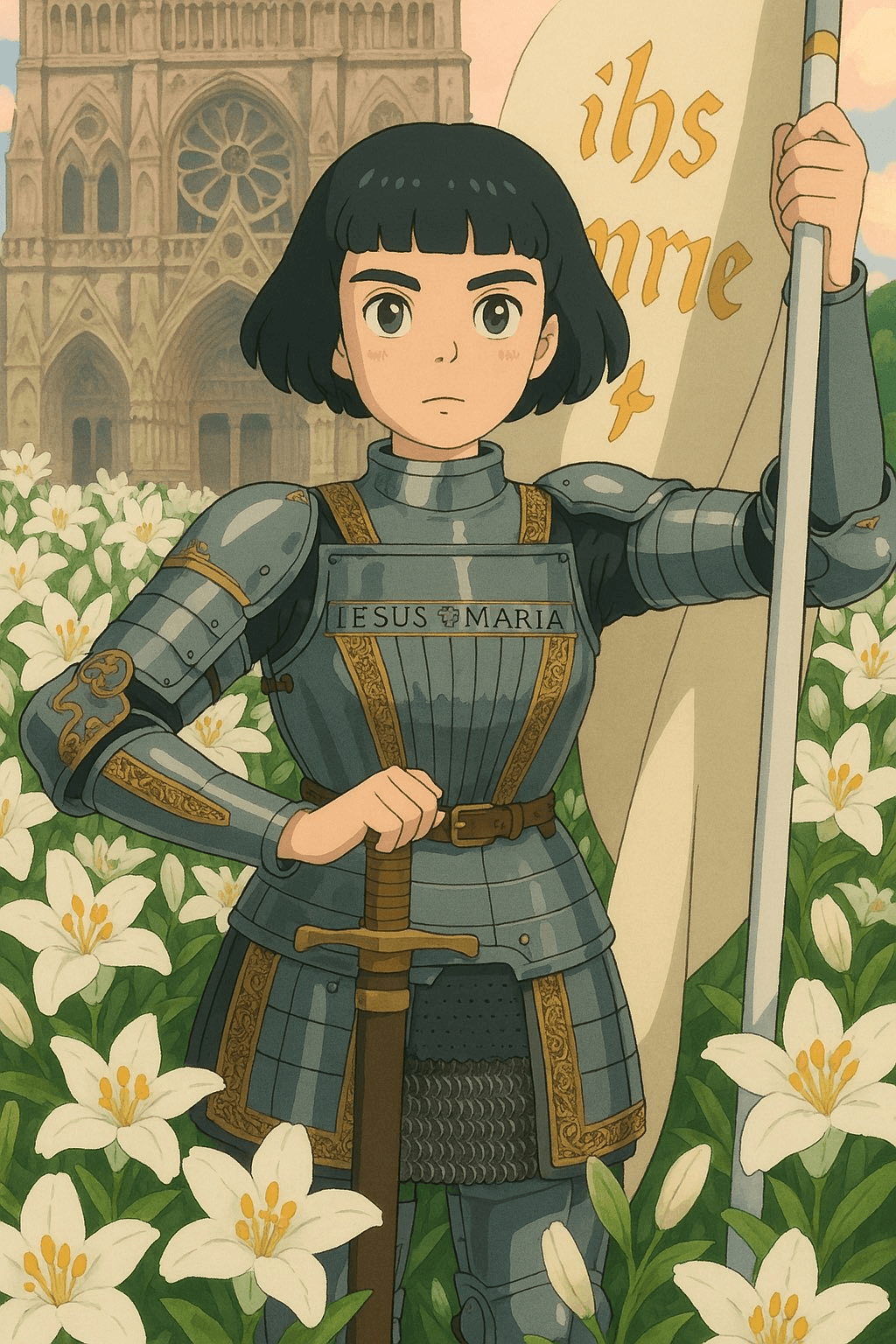
Her name was Jehanne. She was born around 1412 in Domremy, a small village on the border between the Duchy of Bar and the Duchy of Lorraine. Her father, Jacques d'Arc, was a farmer and a minor village official. Her mother, Isabelle Romee, was a devout woman who had made the pilgrimage to Rome, hence her surname. Joan could not read. She could not write. She could spin and sew. She knew her prayers. She was, by every account, an ordinary girl from an ordinary family in a village so small it barely appeared on maps.
Near the village stood an ancient beech tree the locals called the Fairy Tree of the Bourlemont. The women and children gathered there to sing, to dance, to weave garlands and hang them on the branches. Joan's godmother claimed to have seen fairies there. The village held onto folk customs far older than Christianity—offerings at springs, dances at sacred trees, a quiet belief in spirits who were neither angels nor demons but something else, something that lived in the land itself. The Church would later use this against her. But for the girl growing up in Domremy, the world was simply alive, and the divine was not locked inside a building.
She was thirteen when the voices began. Summer, in her father's garden, around noon. A blinding light, and then a voice. She was terrified.
Joan, at the Trial of Condemnation (1431): "I was thirteen when I had a Voice from God for my help and guidance. The first time that I heard this Voice, I was very much frightened. The Voice came to me about the hour of noon, in the summer-time, in my father's garden. I heard this Voice to my right, towards the Church; rarely do I hear it without its being accompanied also by a light."
The voice came back the next day, and the next, and every day after that for the rest of her life. She identified the speakers as the Archangel Michael, Saint Catherine, and Saint Margaret. They were as real to her as the people she lived with—more real, perhaps, because they never lied to her and never left. They told her things that turned out to be true. They gave her instructions she did not ask for and did not want. Go to the Dauphin. Save France. Crown the king.
She was a teenage girl who heard voices and believed them. The whole of her extraordinary life follows from that single, simple fact. She believed, and she acted, and she did not stop.
The War
France in 1429 was a country that had been losing for as long as anyone could remember. The Hundred Years' War had been grinding on since 1337. The English controlled most of northern France. The Duke of Burgundy, France's most powerful vassal, had allied with the English after the assassination of his father. The Treaty of Troyes in 1420 had disinherited the Dauphin, the future Charles VII, and declared the English king heir to the French throne. Charles held a rump court south of the Loire, derisively called the "King of Bourges" by his enemies. He had no money, a fractious and demoralised army, and very little reason to hope.
Orleans was under English siege. If it fell, the road south would be open, and what remained of independent France would collapse. The war was, by any rational assessment, lost.
Into this walked a seventeen-year-old peasant girl who had claimed that God had sent her. She had already fought to get there. She had persuaded Robert de Baudricourt, the local garrison commander at Vaucouleurs, to give her an escort, but only after being turned away twice. She cut her hair, dressed in men's clothing, and rode eleven days through enemy territory to reach the Dauphin at Chinon. When she arrived, Charles reportedly hid himself among his courtiers to test her. She walked straight to him.
Joan, to the Dauphin's court: "I am sent by God to help you and your kingdom. The King of Heaven sends word through me that you will be anointed and crowned."
She was examined by theologians at Poitiers, who found nothing wrong with her and concluded that the king should make use of her. She was given armour, a household, and a place at the head of the army marching to relieve Orleans.
The siege broke within nine days of her arrival.
She had predicted she would be wounded. Fifteen days before the assault on the Tourelles, documented in a letter from a Brabant diplomat preserved in the Brussels archives, written before the event, she said she would be struck by an arrow between the neck and shoulder but would not die. On May 7th, 1429, an English crossbow bolt hit her precisely there. She was carried from the field weeping from the pain. She pulled the bolt from her own body, or had it pulled, the accounts vary. Then she went back, and led the final charge that took the fortress and broke the siege.
Dunois, the Bastard of Orleans, at the Rehabilitation Trial (1456): "From the time she joined the army, the soldiers were changed into other men."
After Orleans, a string of victories opened the road to Reims. Joan urged speed. The coronation took place on July 17th, 1429. She stood beside Charles VII with her white banner as the archbishop anointed him with the sacred oil of Clovis, in the cathedral where French kings had been crowned for centuries. When asked later why her banner was displayed at the coronation, she said: "It had shared in the toil. It was right that it should share in the honour."
She had done what she said she would do. She had done exactly what the voices told her to do.
The Capture
After the coronation, Joan warned Charles that her time was short.
Joan, to the king: "I will only be with you for one year. It is needful that you use me to the full."
The king did not listen. He preferred negotiation to fighting. Joan's momentum stalled. An assault on Paris in September 1429 failed, she was wounded again, this time in the thigh, and Charles ordered a retreat. Through the winter and spring, Joan fought in smaller engagements, increasingly sidelined by a court that had used her and no longer knew what to do with her.
On May 23rd, 1430, at Compiegne, she was pulled from her horse during a Burgundian sortie. She was captured. The Burgundians sold her to the English. Charles VII, the king she had crowned at Reims, did not send a single soldier, pay a single coin, or make a single diplomatic effort to get her back.
Her voices had told her at Melun that she would be captured before Midsummer Day. She was taken on May 23rd.
She spent the next year in prison.
The Trial
The trial of Joan of Arc is one of the most documented legal proceedings of the Middle Ages, and one of the most corrupt. Bishop Pierre Cauchon of Beauvais organised and ran it. He was an English partisan who had been driven from his own bishopric by Joan's military campaigns. He had a personal grudge and an English paycheck. The entire purpose of the trial was to convict Joan of heresy, thereby discrediting her mission and, by extension, the legitimacy of Charles VII's coronation.
The proceedings violated canon law at nearly every turn. Joan should have been held in a Church prison, guarded by women. She was held in the English military prison at Rouen, guarded by male soldiers, chained, and according to multiple later testimonies, subjected to harassment and attempted assault. Cauchon had not established Joan's infamy before proceeding, as required. Assessors who objected to the conduct of the trial were threatened or removed. One cleric who challenged Cauchon's jurisdiction was jailed. The trial records show signs of falsification—favourable testimony suppressed, documents altered.
Joan had no advocate. She was nineteen years old, illiterate, alone, and facing a panel of roughly sixty trained theologians and lawyers. And she held her ground.
They tried to trap her. They asked whether she was in a state of grace, a question designed to be impossible. If she said yes, she was a heretic claiming certainty about something the Church taught no one could know. If she said no, she admitted to being in mortal sin. Either answer condemned her.
Joan: "If I am not, may God put me there; and if I am, may God so keep me."
The courtroom fell silent. The trial notary recorded the astonishment. An assessor protested that the question should never have been put to her. She had answered with a line that any devout Christian might pray, and in doing so had turned a theological trap into a statement of simple faith. She was not being clever. She was being honest, and her honesty was more precise than all their learning.
The decisive moment came when the judges explained the distinction between the Church Triumphant, God and the saints in Heaven, and the Church Militant, the Pope, the hierarchy, the institutional Church on Earth. They demanded Joan submit her voices and her mission to the judgement of the Church Militant.
She refused.
Joan: "I submit myself to the Church Triumphant. As for the Church Militant, if they should command anything contrary to the command which has been given to me by God, I would not consent to it."
The notary marked her answer responsio mortifera, the fatal reply. An illiterate peasant girl had just told the most powerful religious institution in the Western world that God outranked it, and that she had access to God and they did not.
The Fire
On May 30th, 1431, Joan was burned alive in the Old Marketplace of Rouen. She was nineteen.
She had been given a chance to save herself. Under enormous pressure, alone, abandoned, chained, facing the pyre, she had briefly signed an abjuration, a document recanting her claims. Within days she took it back. She resumed wearing men's clothing—some accounts say because her women's clothing was stolen by guards, others that she simply could not sustain the lie. She reaffirmed her voices.
Joan, after recanting her abjuration: "God has sent me word through Saint Catherine and Saint Margaret of the great pity it is, this treason to which I consented in making abjuration, and that I was damning myself to save my life."
She would rather burn than say what she heard was not real.
They brought her to the marketplace. She was tied to a tall pillar so the crowd could see. She asked a Dominican friar to hold a crucifix high where she could see it above the flames. She forgave everyone. She called on her saints. Her last word, repeated, was the name of Jesus.
Joan, from the stake, to Bishop Cauchon: "Bishop, I die through you!"
The executioner reported that after the fire, her heart and internal organs would not burn despite repeated attempts. The Cardinal of Winchester ordered the remains thrown into the Seine. Whether this is history or legend, it was believed by those who were there. The executioner sought out the Dominican friar afterward, shaken, convinced he had burned a saint. The secretary to the King of England said openly: "We are lost. We have burned a holy woman."
Isambard de la Pierre, at the Rehabilitation Trial (1456): "I was there at her end. I pray God that my soul may be where I believe hers is."
Nearly everyone present, English soldiers, French clergy, the Cardinal himself, wept. They all knew. They burned her anyway.
After
Twenty-five years later, France had won the war that Joan had made winnable. Charles VII, the king she crowned, the king who let her burn, finally authorised an investigation into her trial. Pope Callixtus III appointed Inquisitor-General Jean Brehal to reexamine the case. One hundred and fifteen witnesses testified. On July 7th, 1456, the original conviction was declared null. The court found that the trial had been conducted through fraud, deceit, and procedural corruption. Brehal called Joan a martyr and declared that Cauchon himself was guilty of heresy.
Joan's mother, Isabelle Romee, had petitioned for the retrial. She was old. She had walked from Domremy to Paris to plead for her daughter's name. The rehabilitation hearing was held in Notre-Dame. Isabelle was there to see it.
In 1920, four hundred and eighty-nine years after they burned her, the Catholic Church canonised Joan of Arc. The timing was political. The First World War had just ended. France needed symbols of national unity. The Vatican needed to normalise relations with the French republic. Joan, who was already the national heroine, was the obvious candidate. They took the girl who had told the Church that God's authority superseded theirs and placed her in the Church's own calendar of saints. They took the most radical act of spiritual independence in medieval history and filed it under obedience.
The irony is perfect, and it is old. Institutions kill the genuine article, and then they canonise it. They burn the woman who heard God directly, and then they build a church in her name and tell the faithful to pray to her—through the proper channels, of course.
Why She is Honoured
Joan of Arc is a Holyman of Tianmu because she lived out her truth honestly, at the highest possible cost, and refused to deny it even when denial would have saved her life.
She was not a theologian. She did not produce a teaching or found a tradition or write a single word. She was a person, a young, ordinary, frightened person, who heard something real and followed it. She followed it through mockery and doubt, through battlefields and royal courts, through prison and trial and fire. And at the end, when the institution offered her life in exchange for saying it was all a lie, she chose the fire.
That is what a holy life looks like. Not perfection, not saintliness in the sanitised sense, not the quiet contemplation of a monastery cell. A holy life is a life lived in honest alignment with what you know to be true, regardless of what it costs. Joan knew what she heard. She knew what the voices told her. And she would not say otherwise, not for the Church, not for the king, not to save her own skin.
The Holymen of Tianmu are not prophets. They are not cosmic figures. They are people, men and women throughout history who lived bravely, who chose truth over comfort, who faced their deaths without pretending to be something they were not. There have been thousands of them and there will be thousands more, famous and anonymous, in every century and every country, wherever someone has stood up straight and said: this is what I know, and I will not be moved.
Joan is the first name in our calendar because hers is the clearest case. She had nothing—no education, no wealth, no title, no institutional support. She had only the voice and the courage to follow it. Everything else was taken from her: her freedom, her reputation, her king, her life. She kept the one thing that mattered. She kept her honesty.
We do not honour her because she was a saint. The Church made her a saint, and the Church burned her first. We honour her because she was a person who chose not to lie, even when lying was the only thing that could save her. That choice, to stand in the truth and accept what comes, is the most human act there is, and it is the thing that makes a life holy.
Joan, at her trial, asked about the light: "The light comes from the same side as the Voice."