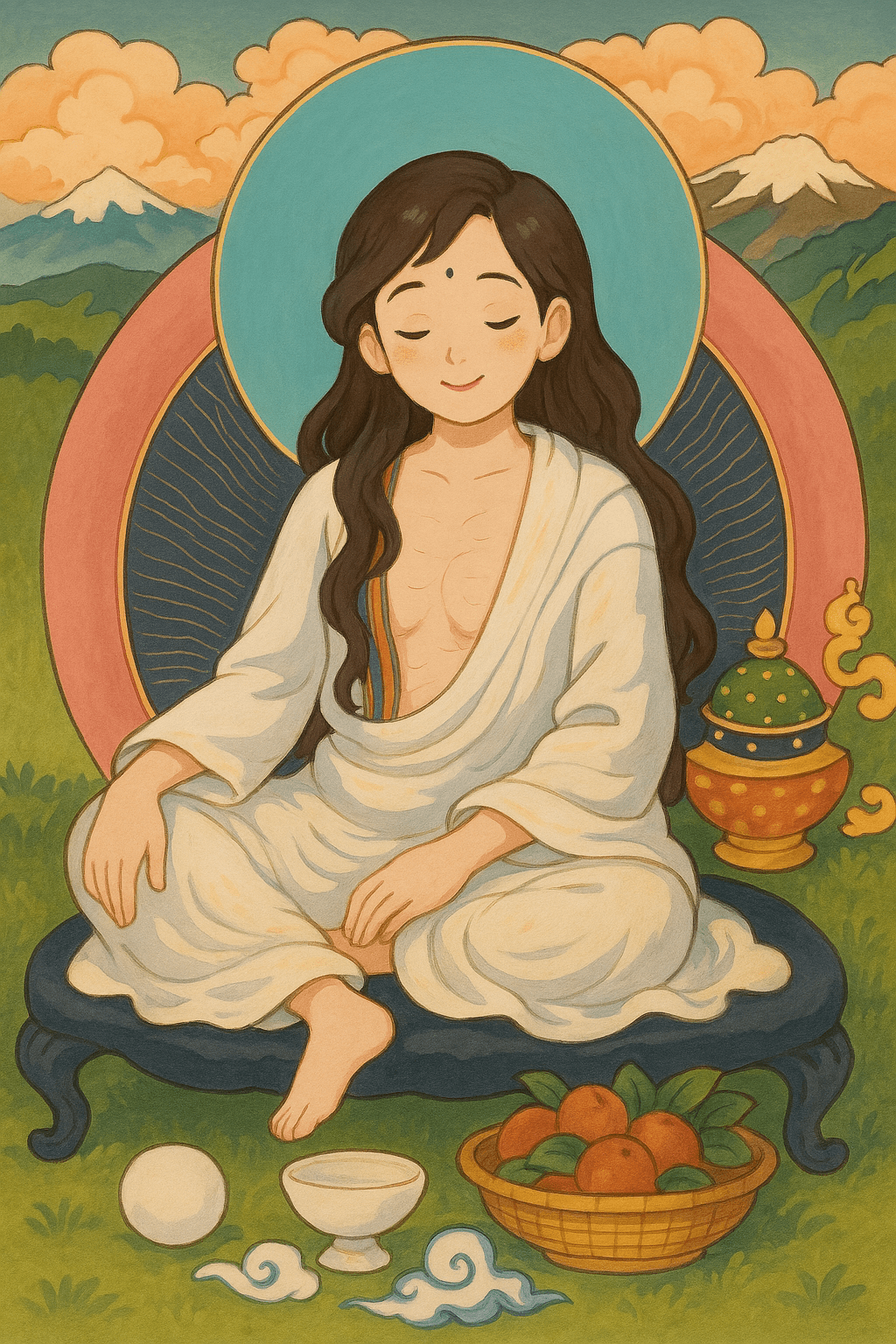
 TraditionTibetan Buddhism
Period
1040 – 1123 CE
Homeland
Gungthang, Western Tibet
He killed thirty-five people before he turned twenty. He spent twelve years in a cave eating nettles until his skin turned green. He became the most beloved saint in Tibetan history, and he did it without institutional support, without monastic ordination, without anything except a teacher who beat him and a will that would not break.
His name was Mila Thopaga — a Joy to Hear. He was born around 1040 CE in the village of Kya Ngatsa, in the Gungthang region of western Tibet, near the Nepalese border. His father, Mila Sherab Gyaltsen, was a prosperous trader. His mother, Nyangtsa Kargyen — White Garland of the Nyang clan — was intelligent, beautiful, and proud. He had a younger sister, Peta. The family was comfortable. The boy was loved. Nothing in the early years suggested what was coming.
His father died when he was seven.
On his deathbed, Sherab Gyaltsen drew up a testament. He entrusted everything — the house, the land, the livestock, his wife and children — to his brother Yungdrung Gyaltsen and his brother's wife, Khyung Tsha Pedon. The arrangement was simple: the uncle and aunt would serve as guardians until Milarepa came of age, at which point the inheritance would be returned.
The uncle and aunt took everything and returned nothing.
They appropriated the entire estate. Milarepa, his mother, and his sister were reduced to servants in what had been their own household. They were fed scraps. They wore rags. The boy who had been a joy to hear became a labourer in his own home. When he turned fifteen, his mother held a public banquet — the last gesture of dignity available to her — and formally demanded the inheritance. The uncle and aunt refused. They denied the testament, denied the debt, and humiliated her before the village.
The mother's response was not acceptance. It was not resignation. It was rage — a rage so complete that it would reshape her son's life, destroy thirty-five people, and set in motion the most extraordinary spiritual transformation in Tibetan history.
The Storm
Nyangtsa Kargyen sold a field — the last thing she owned — and gave her son the proceeds. She told him to go and learn black magic. She did not want justice. She wanted revenge. She wanted the uncle and his family destroyed, and she wanted her son to do it.
Milarepa went. He found a sorcerer named Lama Yungton Trogyel, and then a second teacher, Lama Yonten Gyatso, who taught him the lethal arts. He was a gifted student. He learned quickly. The rage that his mother had planted in him was the engine, and the engine had no governor.
The uncle's son was getting married. The village gathered for the wedding feast. The house was full.
Milarepa, from a distance, cast the spell. The house collapsed. Thirty-five people died in the rubble.
The uncle and aunt survived.
When his mother received the news, she displayed his letter of success like a banner. She waved it publicly. Thirty-five corpses, and she celebrated.
The villagers were horrified. They threatened to attack Nyangtsa. She sent word to her son demanding more. He returned to Yungton Trogyel and learned hailstorm magic. He summoned storms that destroyed the entire harvest of his home village — every crop, washed away just before the gathering. The people who had watched him grow up, who had known his father, lost everything.
He was not yet twenty years old. He had killed thirty-five people and ruined hundreds more. He was the most hated man in Gungthang, and the instrument of his mother's rage, and somewhere underneath the sorcery and the destruction, something was breaking.
The Towers
The remorse was not immediate, but it was total. The tradition records him asking himself, unceasingly, how he might practise genuine dharma — not the magic that kills and destroys, but the teaching that frees. He sought out a Nyingmapa lama named Rongton Lhaga, who recognised something in him and sent him to a man named Marpa.
Marpa Lotsawa — Marpa the Translator — lived in Lhodrak, in southern Tibet. He was a farmer, a husband, a father, and one of the great masters of his age. He had travelled to India multiple times, studying under the mahasiddha Naropa, and had brought back the transmissions of Mahamudra and the Six Yogas. He was also, by temperament, ferocious.
When Milarepa arrived, Marpa was ploughing a field. He offered the young man a cup of beer. Milarepa drained it. Marpa took this as a good sign. Then he refused to teach him anything.
What followed was approximately six years of systematic, relentless, apparently pointless cruelty.
Marpa ordered Milarepa to build a tower — round, on the eastern ridge. Milarepa built it. Marpa inspected the work and told him to tear it down. Every stone, every timber, returned to its original place. He had not fully considered the design.
He ordered a second tower — semicircular, on the western ridge. Milarepa built it. Marpa came and said he had been drunk when he gave the instructions. Tear it down. Return every stone.
A third — triangular, on a northern hill. Milarepa was a third of the way through when Marpa arrived and accused him of building a sorcerer's ritual shape. An inauspicious form. Tear it down.
The fourth tower was square, nine stories with a tenth-story pinnacle, built on new ground. Marpa swore it would never be torn down. He swore that upon completion, the teachings would be given. Milarepa asked that Dagmema, Marpa's wife, witness the promise. She did.
Milarepa built the tower with his bare hands. By the seventh story, his back was a mass of open sores. Pus and blood ran from three wounds. He carried stones with the sores weeping. Dagmema bandaged him at night.
Throughout the years of construction, Marpa beat him, berated him, drove him from group initiations with blows, dangled the teachings and snatched them away. Milarepa was reduced to suicidal despair. He very nearly killed himself.
Dagmema was the only tenderness in those years. She brought him food. She comforted him when he wept. She argued with Marpa on his behalf. At one point, unable to bear it any longer, she forged a letter using Naropa's seal to get Milarepa unauthorised teachings from another of Marpa's students. The forgery was discovered. The consequences were severe. But Dagmema never stopped.
The tower was completed. Marpa relented. And the man who had been broken open by six years of labour finally understood what the labour had been: not punishment, not sadism, but the most brutal and effective method of purification ever devised. The karma of thirty-five deaths and a village destroyed could not be erased by meditation alone. It had to be ground out of him, stone by stone, sore by sore, tower by tower. Marpa had not been cruel. Marpa had been precise.
Milarepa received the empowerment of Chakrasamvara, the Six Yogas of Naropa, and the Mahamudra transmission. His initiatory name was Shepa Dorje — the Laughing Vajra.
Then Marpa sent him away, to meditate alone in the mountains, for the rest of his life.
The Nettles
He went to the caves. He went alone, with nothing, and he did not come back.
The primary cave was Drakar Taso — White Rock Horse Tooth — in the Mangyul region, high in the Himalayas near the Nepalese border. He found a stream and a patch of stinging nettles. He had no food. He had no patron. He had nothing except the practices Marpa had given him and a will that had survived six years of towers.
He ate nettles. He boiled them and drank the broth and ate the leaves. For roughly three years at that cave, nettles were his only food. He made nettle cloth. He made nettle flour. His body became skeletal — bones jutting, skin slack. His skin turned green. Not metaphorically. The nettles stained him, and the colour would not leave.
He kept warm through tummo — the inner heat yoga, one of the Six Yogas of Naropa. Seated in snow, in thin cotton cloth, he generated heat from within. This is why he is called Milarepa — Mila the Repa, the cotton-clad one. He needed nothing else. The fire was inside.
Hunters stumbled on him and fled, thinking he was a ghost. Villagers from his home town found him and mocked his miserable condition. He sang to them. He always sang.
His sister Peta found him. She had become a beggar after their mother died — wandering from village to village, serving for scraps. Hunters had told her that her brother was alive in the mountains but looked like he was dying. She came and saw a green skeleton in a cave and thought it was a spirit. When she realised it was her brother, she wept.
At some point during the cave years, Milarepa returned to his childhood home. He found it in ruins. Inside, he found his mother's bones.
The tradition says he took her remains and meditated, merging her consciousness with his own mind. The woman whose rage had sent him to the sorcerers, whose demand for vengeance had killed thirty-five people, whose fury had been the engine of everything — he held her bones and released her.
He meditated in the caves for approximately twelve years. He practised at Lapchi, at Chubar, at a dozen sites across the Tibet-Nepal border. At one cave he sat with a butter lamp balanced on his head for eleven months. The practice was total, uncompromising, and solitary. He was not building an institution. He was not gathering followers. He was a man in a cave, doing the work.
He attained full enlightenment in a single lifetime. The tradition is unambiguous about this. Whatever the historical layers beneath the story — and scholars have noted that earlier accounts by his own student Gampopa describe a simpler life without the murders or the towers — the tradition holds that the murderer from Gungthang, the green skeleton in the cave, achieved in one life what most beings take countless lifetimes to approach. Not because he was gifted. Because he would not stop.
The Songs
He sang. Wherever he was, whoever he met, he sang.
The Hundred Thousand Songs of Milarepa — the Mila Grubum — is one of the great literary works of Tibet. The title is conventional; "hundred thousand" in Tibetan means "very many." The version we have was compiled by Tsangnyon Heruka, the Madman of Tsang, in 1488, roughly three hundred and fifty years after Milarepa's death, drawing on older biographical and song traditions.
The songs are spontaneous verse teachings — dharma delivered through poetry, woven into the narrative of encounters with students, demons, hunters, spirits, and villagers. They cover everything: emptiness, compassion, the nature of mind, the illusoriness of phenomena, the practice of meditation, the confrontation with death. They are tender and fierce and strange and sometimes funny. They do not read like scripture. They read like a man talking.
This matters. Milarepa did not write treatises. He did not systematise the dharma. He did not build monasteries or establish institutions. He sat in caves and sang to whoever showed up, and the songs were the teaching. The form and the content were inseparable — a man who had stripped away everything, possessions, status, comfort, safety, even food, speaking directly from what was left when everything else was gone.
His most important student was Gampopa, a physician-turned-monk who had already mastered the Kadampa teachings of Atisha. Gampopa heard Milarepa's name spoken by three beggars and was seized with an irresistible need to find him. Milarepa, who had foreseen his coming, deliberately delayed their meeting for two weeks to cool Gampopa's spiritual pride. When they finally met, Milarepa handed him a skull cup full of alcohol. For a monk, this was a serious transgression. Gampopa drained it without hesitation. Milarepa declared it an excellent sign.
After Gampopa departed, Milarepa told his other students that he had dreamt a yellow bird flew from him to Central Tibet and landed on the peak of a great mountain, where yellow geese from all directions gathered. The dream was a prophecy. Gampopa went on to found the formal Kagyu lineage, integrating Milarepa's wild cave tradition with monastic discipline. Four of Gampopa's students founded the four major sub-schools. Together, Marpa, Milarepa, and Gampopa — Mar-Mi-Dag Sum — are the three founders of the Kagyu school. The cave yogi who wanted no institution became the root of an institution that has lasted nine hundred years.
His other principal student, Rechungpa, was the opposite of Gampopa — temperamental, defiant, disobedient. He broke his vows, studied sorcery, lived in luxury with a wife. He also made three dangerous journeys to India to retrieve texts Milarepa needed, and he received the entirety of Milarepa's teachings where Gampopa received only the essential introductions. The moon to Gampopa's sun — wild where Gampopa was disciplined, unreliable where Gampopa was steady, but devoted in the way only the difficult are devoted.
Milarepa did not choose only the good students. He chose the real ones.
The Poison
At a wedding feast at Drin, a wealthy scholar-monk named Geshe Tsakpuhwa publicly prostrated before Milarepa. He expected Milarepa to return the gesture before the crowd of patrons. Milarepa did not return it. The geshe's face went dark with humiliation.
Tsakpuhwa mixed poison into curdled milk. He promised his concubine a large turquoise if she would deliver the poisoned food to Milarepa's cave.
When the woman arrived, Milarepa perceived the poison through clairvoyance. She had a sudden crisis of conscience and begged him not to eat it.
He ate it anyway.
His reasoning, as the tradition records it: his principal students were realised. His life's work was complete. His death would serve as a final teaching on impermanence. And unless the woman delivered the poisoned food and he consumed it, the geshe would never give her the turquoise he had promised.
He ate the poison partly to ensure a concubine got her pay.
He died at approximately eighty-four years of age. The sorcerer who had killed thirty-five people, who had built and torn down towers until his back was an open wound, who had eaten nettles until his skin turned green, who had sat in caves for twelve years and sung the dharma to anyone who would listen — he chose his death, and he chose it with his eyes open.
Why He is Honoured
Milarepa is a Holyman of Tianmu because he is the proof.
Every tradition says that the path is open to everyone. Every tradition says that no one is beyond redemption. Every tradition says that the worst sinner can become the greatest saint. Milarepa is the one who actually did it. Not in parable, not in metaphor, not in theological speculation — in the flesh, in the mountains, on nettles and cold stone and the sheer force of a will that would not break.
He killed thirty-five people. He was not a good man who slipped. He was a weapon aimed by his mother's rage, and he hit his target, and he did not miss. The house collapsed, the people died, the crops were destroyed, and the boy from Kya Ngatsa had more blood on his hands than most warlords.
And then he stopped. Not because he was caught, not because an institution demanded it, not because the karma caught up with him in some mechanical sense. He stopped because something in him broke open — the same break that the traditions call remorse, that the existentialists call the encounter with what you have actually done. He looked at what he was and could not bear it. That was the beginning.
What followed was not quick and it was not clean. Six years of towers. Twelve years of caves. A body wrecked by stones and nettles. A teacher who appeared to hate him and a wife who was the only kindness in the world. Nobody saved him. Marpa did not save him — Marpa built the conditions. The caves did not save him. The practices did not save him. He saved himself, stone by stone, nettle by nettle, song by song, through a will so ferocious that even the karma of thirty-five murders could not outlast it.
That is what makes him holy. Not the enlightenment — the will. The refusal to accept that what he had been was what he would always be. The refusal to die as a murderer. The decision, made in the wreckage of his own life, to become something else, and the willingness to pay whatever that cost, for as long as it took, with no guarantee it would work.
He had no institution behind him. He had no monastery, no ordination, no lineage credentials. He was a layman in a cave, wearing cotton, eating weeds, singing to hunters. He was the most unrespectable seeker in the entire Buddhist tradition — a murderer, a sorcerer's apprentice, a man whose own sister thought he was a ghost. And he attained in a single lifetime what the most disciplined monks, with all their resources and all their scholarship, could not.
The tradition says the cave won. The cave always wins, if you stay long enough. But the staying is everything. Anyone can enter a cave. Milarepa is the one who did not leave until the work was done.
We honour him because he is the answer to the question that every person carrying a past asks: is it too late for me? His life says no. It says no with thirty-five bodies and six years of towers and green skin and a skull cup of beer and a hundred thousand songs rising from the mountains into the thin Himalayan air. It is never too late. The path is open. The cave is waiting. The only thing required is a will that will not break.
Frightened by death, I went to the mountains.
Again and again I meditated on death's uncertain hour,
and took the stronghold of the deathless nature of mind.
Now I am done with the fear of dying.