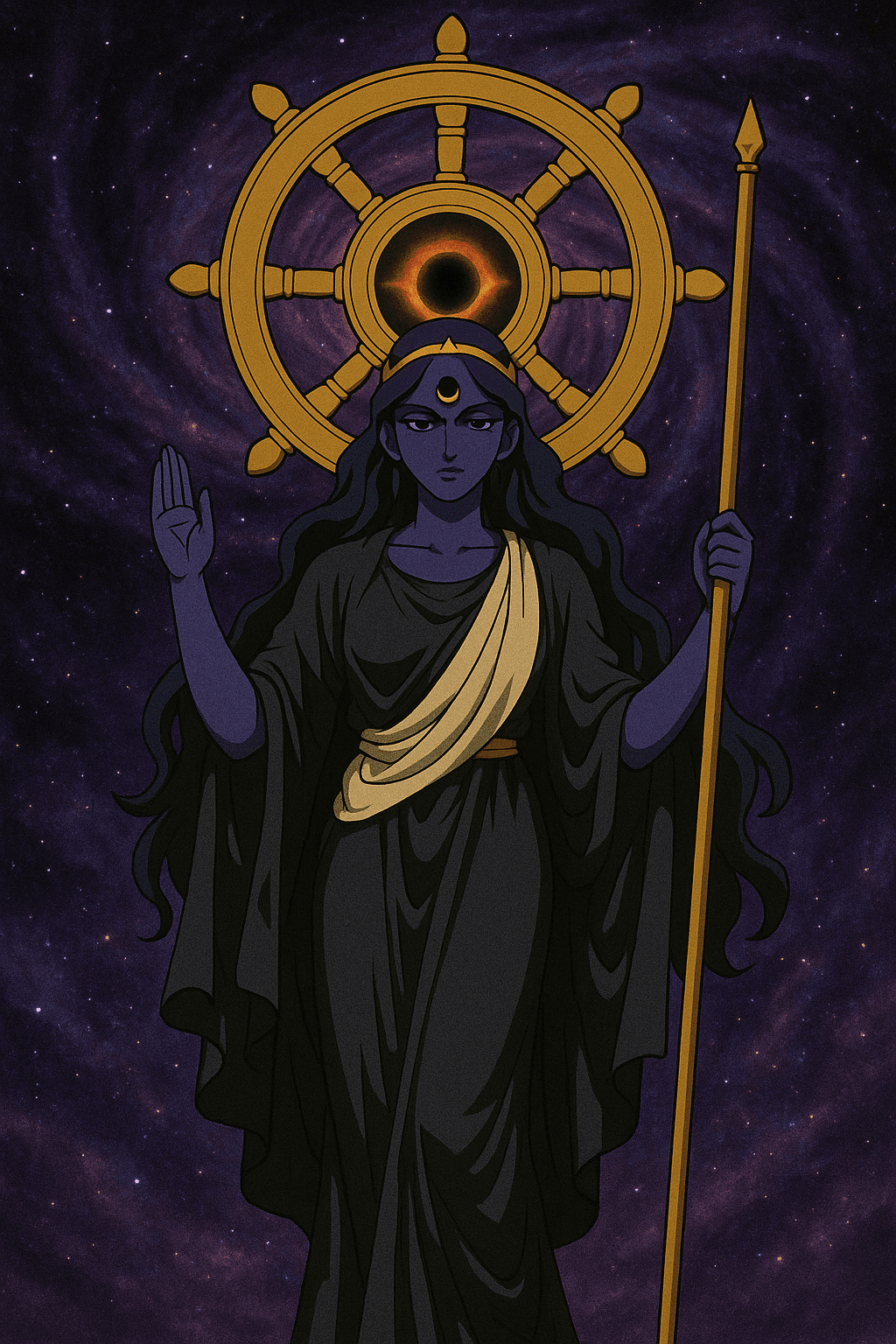
 PlanetSagittarius A, The Black Hole at the Centre of the Galaxy
Other Names
Satan/Ha-Satan (Hebrew), The Demiurge/Yaldabaoth (Gnostic), Kali (Hindu), Cronus/Saturn in his devouring form (Greek/Roman), Fenrir, Jörmungandr (Norse), Apep/Apophis (Egyptian), The Grim Reaper/Death (European), Yama (Hindu/Buddhist), Hel (Norse), Mahakala (Tibetan Buddhist), Shiva as Nataraja the cosmic destroyer (Hindu), Zurvan (Zoroastrian), Mot (Canaanite god of death), Ereshkigal (Sumerian), Izanami in the underworld (Shinto), Tlaltecuhtli (Aztec earth-devourer), Kālacakra, the Wheel of Time (Vajrayana), Ankou (Breton/Celtic death figure), Pluto/Hades in his function as lord of all that ends (Greco-Roman)
Akin Ghosts
Muse
Related Posts
Add links or text here
Translations:
High Church:
Domos (dʰóh₁mos)
Sanskrit:
काली (Kālī)
Church Runes:
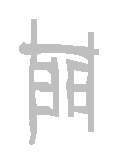
Doom is the Demiurge of the Gnostics; Yaldabaoth, the blind god, the lion-faced serpent who created and rules the material world, whom the Gnostics hated as the jailer of divine sparks trapped in flesh. Doom is Kali in her most terrifying aspect; the black goddess who dances on the corpse of Shiva, wearing a necklace of severed heads, her tongue dripping with the blood of the universe she has devoured, and who is yet worshipped as the Divine Mother precisely because her destruction is the precondition of all new creation. Doom is Saturn-Cronus in his devouring form; the Titan who ate his own children because he knew they would one day overthrow him, the god of time who consumes everything he generates. Doom is the Wheel of Dharma, literally "that which upholds," the oldest and most universal religious symbol, found from India to Ireland, from the Buddhist Dharmachakra to the Celtic sun wheel to the Norse solar cross. Doom is Apep, the Egyptian serpent of chaos who encircles the underworld and whom Ra must battle each night in order for the sun to rise again. Doom is Fenrir, the great wolf of Norse mythology whose jaws stretch from Earth to sky and who will swallow Odin himself at Ragnarök. Doom is the Grim Reaper, the skeleton with the scythe, the figure at the end of every road. And Doom is Satan in his oldest and most honest guise; not the melodramatic villain of medieval Christianity, but the Adversary, Ha-Satan, the tester and accuser whose function in the divine court is to confront every soul with the truth it least wants to face.
Völuspá (Prophecy of the Seeress), Stanza 57-58: "The sun turns black, earth sinks in the sea, the hot stars down from heaven are whirled; fierce grows the steam and the life-feeding flame, till fire leaps high about heaven itself."
Kali Stotram (Hymn to Kali): "Thou art Kali, the original form of all things, and because Thou devourest time, Thou art Kali. Because Thou art the origin of all things, and because Thou art Kali, Thou art the original form."
At the centre of the galaxy is Sagittarius A*, the supermassive black hole around which our entire existence revolves. Its gravity upholds the Milky Way. Without it, the galaxy would fly apart, the stars would scatter, the solar system would never have formed, and none of us would exist. And yet it is also the maw that will, in the fullness of time, devour everything it sustains. It is the non-existence from which we sprang and the non-existence to which we return. It is our beginning and our end, our origin and our destination, the alpha and the omega of galactic existence.
Revelation 1:8: "I am Alpha and Omega, the beginning and the ending, saith the Lord, which is, and which was, and which is to come, the Almighty."
This is Doom. This is dharma. In Old English, "doom" meant fate, law, and judgement; the cosmic verdict that determines the nature and the end of all things. In Tianmu, Doom serves as our word for dharma: the law that sustains the universe, makes it run, and ultimately consumes it. On a personal level, your doom is your nature, what you are on a deeper level, the thing you must find and abide by. Your doom is not imposed from outside; it arises from within, from the Yarn of your own karma and the Hamingja of your ancestral line. To find your doom and live it honestly is the central imperative of a well-lived life. To live in misalignment with your doom is to suffer, not as punishment, but simply because a thing that denies its own nature cannot be at peace.
Doom is the most important Ghost, and also the most terrifying to embrace, for it comes with the inevitability of all things. He is far beyond the unknown of our solar system, out past the threshold of Muse, past the churning unconscious of Daymare and Nightmare and Sight, in the absolute outsideness that is the ground of all existence. Because he is our ultimate fate, our ultimate doom, he is also the law and the judge of our world. It is before Doom that we meet our ends and ultimately know our place in the galaxy.
We circle around him. We circle around time. How cyclical.
Beowulf, lines 2590-2591 (The dragon fight, Beowulf's last stand): "Each of us must await the end of his path in this world."
Because Doom is the hardest to accept, the most powerful, and the most terrifying of the Ghosts, he is also typically the last Ghost to accept on the path to enlightenment. A vast amount of religious belief worldwide is centred specifically around the fear and refusal of Doom. This is the Gnostic hatred of the Demiurge and material reality, the ultimate act of adharma. The Gnostics looked at the force that holds creation together and guarantees our end and our beginning, the weighty gravity of life itself, and they despised it. They called it the blind god, the evil creator, the jailer. They rejected the physical world as a prison and longed for escape to some higher, purer realm untouched by matter and death. This is what fear looks like when it wears the mask of spirituality.
Others grow to worship Doom, and that is worse. To worship something is to subordinate yourself to it, and those who worship Doom—the worst kabbalists, the darkest occultists, those who fetishise the void and seek annihilation as a form of transcendence—reject the physical world for nothingness just as thoroughly as the Gnostics do, only from the opposite direction. Both are refusals of Freedom. Both are refusals to stand in the middle realm and accept reality as it is: beautiful and terrible, finite and meaningful, doomed and therefore precious.
The path of dharma is neither hatred nor worship, but acceptance. Aryaman's path is the Milky Way because to walk the path of dharma is to metaphorically journey to the centre of the galaxy, to realise Doom in its totality and accept the freedom one finds in the inevitability of it. This is what Odin did when he sacrificed his eye to Mimir's well. He peered past the boundary of the knowable, past Saturn's threshold, into the depths of outsideness where Doom himself resides. And he was terrified. He clutched his runes and clung to the world tree, impaled upon its branches, hanging over the void. But eventually he let go. And in letting go, he gained not just knowledge but wisdom, the kind of wisdom that transforms a king into a sage, a ruler into a priest.
This is a distinct contrast to the Gnostic response. The Norse did not hate what they saw in the well. They did not call Doom evil, or the material world a prison, or the body a tomb. They accepted. They drank from the cup. Mimir drinks the waters of his well as if they were sweet mead. The horror of Doom is only horror as long as you cling to the knowable. The moment you let go, the horror becomes freedom.
Doom is also the terrestrial manifestation of outsideness and nothingness. He is the absolute of the material realm, close to Mara, or Mare—outsideness itself—who is the lord of the material realm, and the ur-fear. And yet this is precisely why Doom is so pivotal. To accept Doom is to accept the most terrifying thing in the galaxy, and thus to finally, truly, and fully embrace the world as it is. That is enlightenment.
The symbol of Doom is everywhere: the Wheel of Dharma, the sun wheel, even the Nazi's Black Sun, and the eclipse, whether in real life, Berserk, or Dark Souls. To be Doomed is a terrifying thing, to be laden with some great inevitability that is far beyond you. Consider the ending of Beowulf, the great English elegy, where the fall of the hero means the inevitable end and exile of the Geats. Consider the Fall of Arthur, where his very attempt to usurp fate with the assistance of Merlin causes it to descend upon him in the form of his incestuous bastard child. These are honest views of Doom, views that accept the inevitability of returning to dust and the tragic, beautiful nature of wyrd.
Doom is, out of all the Ghosts, the most omnipresent hand in history. That is why the Doomsayers are so essential. Touched by Doom, each of them turned the wheel and changed the world. But many lesser people have too, and many evil ones. Doom brings empires to ashes so that the rubble can birth something new. He changes things so that the world can adapt to the shifting logic as the wheel of time turns on and on and on. And those truly touched by Doom have something otherworldly about them, something horrifying; a void under their words and actions, something unknowable and bigger than them which inexorably pulls them forward.
Fire and Doom pair together as the supreme axis of the Twelveness. They are both upholders through gravity, Fire of our solar system, Doom of the galaxy. Fire is the most Heavenly and Doom is the most Hellish. It is Fire that cuts through the unknown outsideness which Doom represents the apex of, as Ra battles Apep each night through the underworld. But Doom always wins in the end, simply by lasting until the light fades. This is not cause for despair. It is cause for urgency, for gratitude, for the kind of fierce and tender love that only arises when you know, truly know, that everything you love will one day end.
At their extremes, insideness and outsideness become indistinguishable. Somethingness pushed far enough becomes nothingness; nothingness pushed far enough becomes somethingness. One and zero. This is crosstruth; the deepest teaching of the Manifold and the final mystery that Doom holds at its centre. The black hole devours all light, and yet at the centre of absolute darkness, the mathematics suggest something that our minds cannot even begin to comprehend: a singularity, a point of infinite density, where all the laws of physics break down and something entirely new begins.
Perhaps that is the secret. Perhaps that is what Mimir tastes in the water of his well, and why he drinks it as if it were mead.
Revelation 21:1 (The old world passes): "And I saw a new heaven and a new earth: for the first heaven and the first earth were passed away; and there was no more sea."
The wheel turns. The fire kindles and gutters. The tides rise and fall. We are born and we die and we are born again. And at the centre of it all, patient and eternal and terrible and beautiful, Doom waits: not as an enemy to be defeated, not as a god to be worshipped, but as the truth to be accepted, the law to be lived, the fate to be embraced, the eternal dance, without beginning or end.
That is the Way of Tianmu. That is the freedom at the heart of the Twelveness.
Everything returns to ash, and it is true. Nothing ever happens on the grand scale of historiography. But the garden grows, and the wind blows, and people still fall in love. Remember what matters.