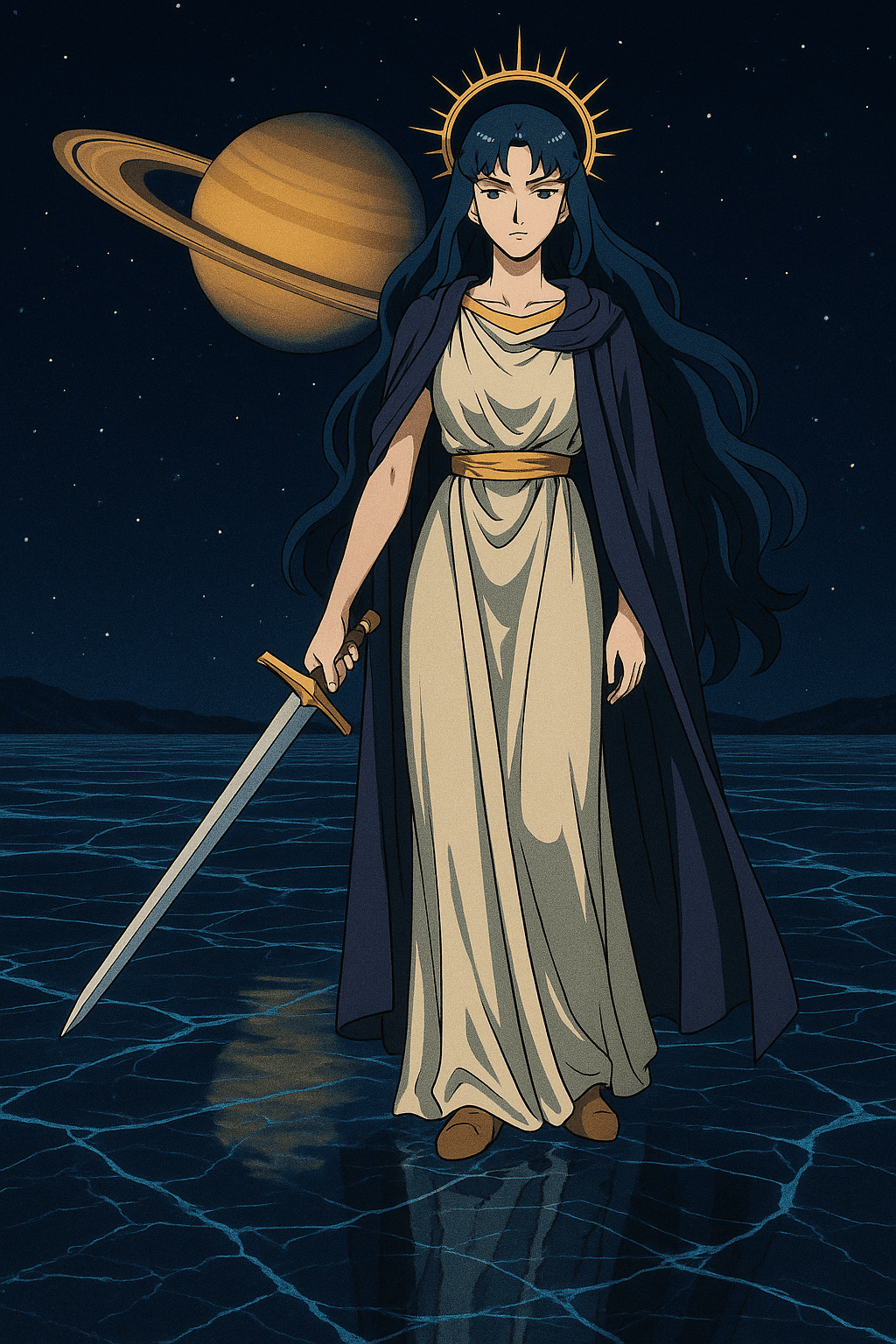
 PlanetSaturn
Other Names
Cronus/Saturn (Greco-Roman), Mimir (Norse), Shani (Hindu), Binah (Kabbalistic, the sphere of Understanding), El (Canaanite, ancient father god), Enki/Ea (Sumerian, deep wisdom), Thoth (Egyptian, in his aspect of ancient records and time), Grandfather Time (European folk), Väinämöinen (Finnish, ancient bard/sage), Zurvān (Zoroastrian ,god of infinite time), Ptah (Egyptian, the aged craftsman/shaper), Utnapishtim (Mesopotamian, the ancient survivor who holds primordial wisdom), Chiron (Greek, the wounded teacher), Xibalba lords (Mayan, rulers of the underworld threshold)
Akin Ghosts
Doom
Related Posts
*Muse's Doughter
Translations:
High Church:
Fader (ph₂tḗr)
Sanskrit:
द्यौष्पितृ (dyauṣpitṛ)
Church Runes:

Muse corresponds to Saturn, Cronus in the Greek tradition, the Titan who devoured his own children, a terrifying image that encodes a profound truth: that time consumes everything it creates, that the past devours the future, that the same force which brings things into being also guarantees their end. In Norse mythology he is Mimir, the wise jötunn who guards the well at the root of Yggdrasil, the well of wisdom that sits at the boundary of all that is knowable. In Hindu astrology, Saturn is Shani, the slow-moving god of discipline, suffering, and karmic reckoning, feared and respected in equal measure as the great teacher who reveals truth through hardship. In Kabbalistic tradition, Saturn is associated with Binah, Understanding, the Great Mother, the sphere of form and limitation that gives shape to the infinite light. In Roman religion, Saturn presided over the Golden Age, a time of primal harmony before the divisions of civilisation, and the festival of Saturnalia was a return to that primordial state, a reversal of social order where masters served slaves and the normal rules were suspended. Across all traditions, Saturn marks the boundary: between the known and the unknown, between order and chaos, between the visible world and whatever lies beyond it.
Muse is the threshold guardian who, from his place on the edge of the insideness of our solar system, peers into the depths of the well at Doom himself. He is the future looking to the past, as opposed to Jupiter's past looking to the future. Backwards movement, history, true wisdom and insight, these are the realms of Muse, but also discipline and a specific kind of strength. Not the expansive strength of Man, which builds and conquers, but the contracting strength that holds fast, that endures, that refuses to look away from what is uncomfortable.
Orphic Hymn 13 (To Kronos/Saturn, Thomas Taylor translation): "Ethereal father, mighty Titan, hear, great fire of gods and men, whom all revere: endued with various counsel, pure and strong, to whom perfection and decrease belong. Consumed by thee all forms that hourly die, by thee restored, their former place supply; the world immense in everlasting chains, strong and ineffable thy power contains. Father of vast eternity, divine, O mighty Saturn, various speech is thine: blossom of earth and of the starry skies, husband of Rhea, and Prometheus wise. Obstetric Nature, venerable root, from which the various forms of being shoot; no parts peculiar can thy power enclose, diffused through all, from which the world arose."
Without Muse, we would be unable to ever face our dharma, our Doom, our death. But with him we can face the uncomfortable subconscious realms which threaten always to devour us with entropy, and that resolve is what lets us become great, what lets us sip on poison as if it were wine and savour the pains of life as we savour the joys. Without Muse, we are lost, stranded in the ocean that is always just outside our safe bubble.
Shani Stotram (Hymn to Saturn in Vedic astrology): "Salutations to the slow-moving one, salutations to the son of the Sun, salutations to the one born of Shadow, salutations to the lord of Shani. He who recites this hymn with devotion shall be freed from the influence of Saturn's harsh gaze."
Our modern world suffers from severe Saturn rejection. Our leaders and institutions have forgotten history's lessons, creating a civilisation that is Jupiterian without Saturnine balance, all ambition and expansion with no reflection, no memory, no willingness to look backward and learn from what has already been. This imbalance produces a culture that is perpetually surprised by consequences it should have foreseen, that repeats the same catastrophes in new costumes, and that mistakes novelty for progress and movement for direction.
It is no coincidence that in ancient times Saturn was so often referred to as a sun, the Egyptians identified him with a solar principle, and the so-called "Black Sun" of esoteric traditions points to the same recognition. Saturn is not the Sun, but he is the Sun's dark mirror: the upholder of a deeper, older, and more terrible order. If the Sun upholds our local world with light, Saturn upholds the boundary with darkness. He is the gatekeeper between the known and the unknown, the interstice preceding the path of dharma.
The Norse myth of Odin and Mimir's Well is the definitive story of Muse. Odin sacrificed his eye by dropping it into Mimir's well—the boundary of all that is knowable, metaphysically the boundaries of our solar system—and in doing so was able to peer into the unknown and gain its wisdom. Mimir, the Saturn of the Norse, drinks from the well readily, as if it were sweet mead. But Odin, the more Jupiterian figure, was terrified by what he saw and clutched his runes and impaled himself on the branches of the world tree, clinging to the knowable before finally letting go. The story demonstrates the seeming horror of dharma as long as you cling to the knowable, and the absolute freedom of letting go. In Norse mythology, the Odin of the present has taken the leap and peered into the final doom of the galaxy, and it is this that takes him from leader to wiseman, from king to priest. A distinct contrast to the Gnostic hatred of the same vision.
This is why Muse's energy is discipline. Not discipline as punishment, not discipline as deprivation, but discipline as the specific kind of strength that allows you to face what is uncomfortable and not break. It is the discipline of the monk who sits in meditation when every fibre of his body screams to get up. It is the discipline of the historian who reads the record of humanity's failures without succumbing to cynicism. It is the discipline of the parent who tells a child the hard truth instead of the comfortable lie. Muse's discipline is not rigid, it is the flexibility of something that has been tested and tested and tested and has not snapped. He is stern because the territory he guards is dangerous, and sentimentality at the threshold gets people killed.
Gylfaginning (Prose Edda, Snorri Sturluson): "Under that root which turns toward the frost giants is Mímir's Well, wherein wisdom and understanding are stored; and he is called Mímir, who keeps the well. He is full of ancient lore, since he drinks of the well from the Gjallar-Horn."
There is a reason Saturn was so often identified with the sun in the ancient world. The Egyptians associated Saturn with a solar principle. In Jewish and Islamic mysticism, Saturn occupies a position of supreme cosmic authority. The Romans celebrated Saturnalia as a return to the primordial Golden Age, a time before the divisions of civilisation, when the original order still held. Why would the furthest, coldest, slowest planet be identified with the source of all light?
Because Muse is the face of Doom as seen from within the known world.
Doom himself, Sagittarius A*, the black hole at the centre of the galaxy, is esoteric in the deepest sense. He is hidden. He cannot be seen with the naked eye. He was not even confirmed to exist by astronomers until the twentieth century. He operates from a distance so vast that his influence is felt only as a subtle, invisible gravity shaping the orbits of all things. Doom is the law that governs everything, but he governs from behind a veil so thick that most conscious beings never perceive him directly. He is the esoteric sun, the hidden centre, the secret axis, the truth that lies behind all other truths.
Muse, by contrast, is the exoteric face of that same principle. He is the outermost visible planet, the one the ancients could actually point at in the night sky and say: there. He is the place where the gravity of Doom first becomes perceptible from within the known world. If Doom is the black hole at the centre of the galaxy, Muse is the event horizon, the point at which you first begin to feel the pull, the boundary beyond which the ordinary rules of insideness start to bend and warp under the weight of what lies beyond.
This is why Saturn gets conflated with the sun. He is not the sun in the sky, that is Fire. But he is a sun to those who stand on Earth and look outward toward the unknown. He is the brightest thing visible at the edge of the dark. He is the last light before the void. And just as the sun is the upholder and cyclicality of our solar system, Muse is the upholder and cyclicality of the boundary, the guardian who ensures that the known and the unknown remain in their proper relationship, that insideness does not collapse into complacent ignorance and that outsideness does not flood in unchecked. He upholds the threshold the way Fire upholds the day, and for those standing at the edge, his light is the only light there is.
This is also why the ancients feared and revered Saturn in equal measure. Hindu astrology treats Shani as the great teacher who reveals truth through hardship. The Kabbalistic tradition associates Saturn with Binah, Understanding, the Great Mother, the sphere of form and limitation that gives shape to the infinite. In every tradition, Saturn is the god you do not want to meet but must. He is the face of your death, the face of your limits, the face of everything you have refused to learn. But he is not death itself. He is the threshold that stands before death, and his function is to prepare you. To discipline you. To make you strong enough to face what lies on the other side.
Doom is the truth. Muse is the preparation for the truth. And without the preparation, the truth destroys you.
"And yet in Man's footsteps I found you, Father / Man to Muse I turned around towards your laughter / That glacial pull; ink in my veins, razor in marrow / Is there any rest under your eye?"