 TraditionAtenism
Period
~1353 – ~1336 BCE
Homeland
Amarna, Egypt
He was not supposed to be king.
Amenhotep, the younger son of Amenhotep III, the one nobody was watching. His elder brother Thutmose was the crown prince—already High Priest of Ptah at Memphis, already embedded in the oldest and most powerful religious establishment on Earth, already destined to continue the ancient order of the Two Lands as it had been continued for two thousand years before him. The younger son studied in the temples too, but in the shadow, in the margins, expected to live out his days as a priest of the sun god. A minor figure in a minor role. A man whose Doom appeared to be smallness and obscurity.
Then Thutmose died.
And the wheel turned.
The second son became pharaoh. And in becoming pharaoh, he shattered the oldest civilisation on Earth—not to destroy it but because he had seen something that made everything else intolerable. Something none of his predecessors had seen, despite two millennia of continuous theological refinement. Something the vast and intricate machinery of Egyptian religion, with its thousand gods and ten thousand rituals, had been circling around for centuries without ever quite arriving at.
He had seen the Mother.
The Shaman discovered duality. Manu kenned Fire—the Sun, the kindling seed of Heaven and Earth—and by that kenning saved civilisation from the flood. But Akhenaten went further. He looked at Fire and saw what Fire is made of. He stared into the most Heavenly of the Ghosts and perceived, behind it, through it, the singular undifferentiated source from which Fire itself, and every other Ghost in the Twelveness, pours forth.
Not a god among gods. Not the chief god atop a hierarchy. Not even the sun, though the sun was the door through which he reached her. What Akhenaten saw was the Oneness—the Heavenly Mother, 天火, the self-initiated causal mover of Creation, the same reality the Daoists call the Way and the Vedic seers call Brahman and the Yiguandao call the Eternal Venerable Mother and the Christian mystics call the light that is over all things.
Dao De Jing, Chapter 42: "The Way gives birth to One. One gives birth to Two. Two gives birth to Three. Three gives birth to all things."
Egypt had the most elaborate divine taxonomy the ancient world had ever produced. A thousand gods. Every city had its patron deity; every nome its sacred animal; every aspect of existence its divine face. Ra for the sun, Osiris for death and renewal, Horus for kingship, Thoth for wisdom, Isis for the feminine divine, Set for chaos and the desert wind. The priests of Amun at Karnak had grown so wealthy and so powerful that they rivalled the pharaoh himself. The whole system was ancient, sophisticated, deeply real—because the gods of Egypt ARE real, in Tianmu's understanding. They are Ghosts. They are faces of the Twelveness and the infinite Lowghosts, genuine forces wearing the masks of a particular culture's imagination.
Akhenaten looked at all of this—the entire, staggering, magnificent apparatus—and saw through it.
He did not see a better god. He did not see a bigger god. He saw what the gods are made of. He saw the light behind the light. He saw the Mother herself, wearing the face of the sun.
The Hymn
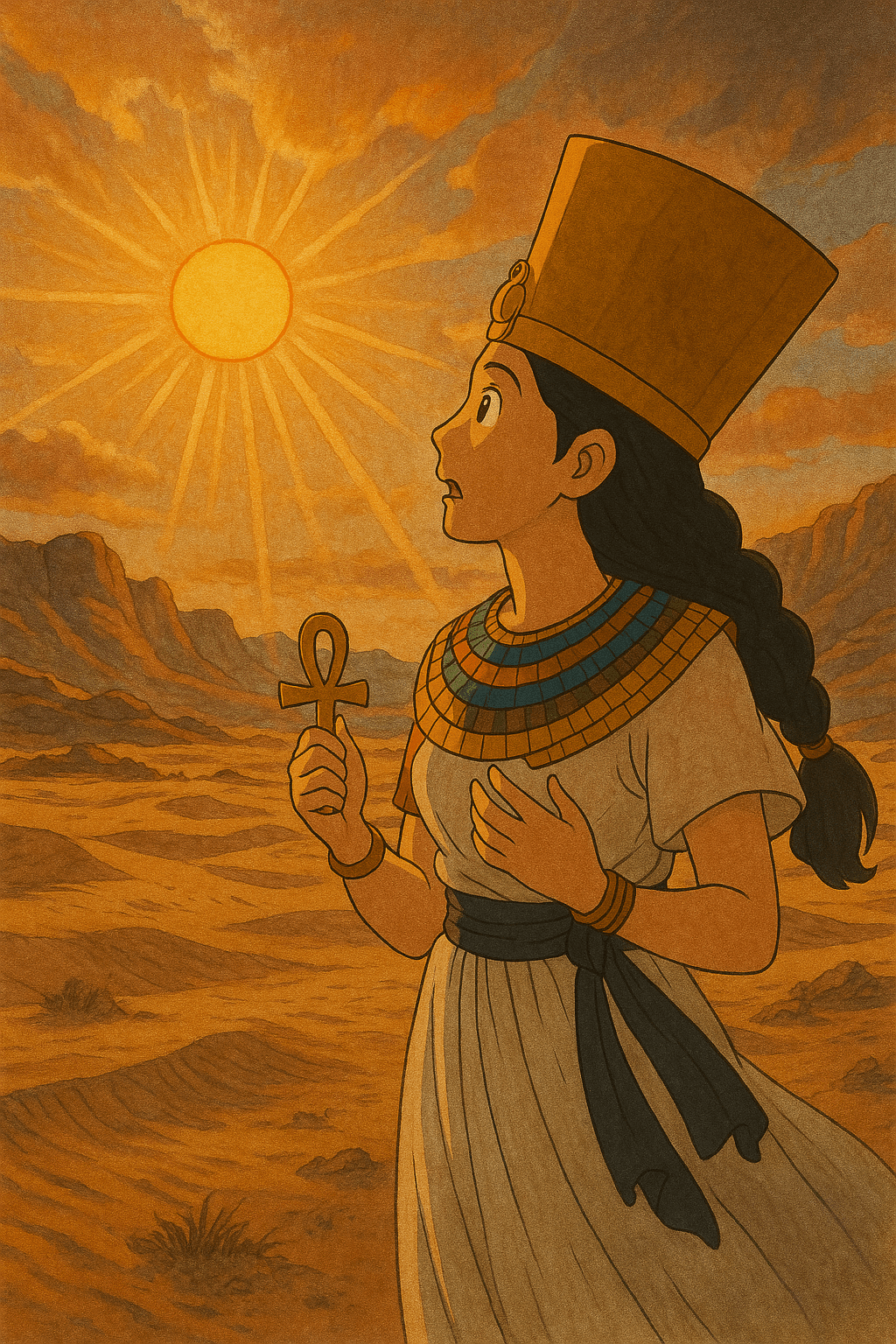
In the fifth year of his reign, Amenhotep IV changed his name. He was no longer Amenhotep—"Amun is Satisfied." He became Akhenaten—"Effective for the Aten," or "Servant of the Aten." The name change was not political. It was a confession of faith so total that it restructured his identity. He was no longer a servant of the old order. He belonged to the Aten—the disk, the light, the living radiance that he understood to be the visible face of the One.
And he wrote a hymn.
The Great Hymn to the Aten: "Splendid you rise in the horizon of heaven, O living Aten, creator of life! When you have dawned in the eastern horizon, you fill every land with your beauty. You are beautiful, great, radiant, high over every land; your rays embrace the lands to the limit of all you have made."
"When you set in the western horizon, the land is in darkness, in the manner of death. They sleep in a room, with heads wrapped up, nor sees one eye the other. All their goods which are under their heads might be stolen, yet they would not perceive it. Every lion is come forth from his den; all creeping things, they sting. Darkness is a shroud, and the earth is in stillness, for he who made them rests in his horizon."
"At daybreak, when you arise on the horizon, when you shine as the Aten by day, you drive away the darkness and offer your rays. The Two Lands are in festivity every day. Awake, they stand on their feet, for you have raised them up. Their bodies are washed, clothing is put on, their arms raised in praise at your appearance. All the world, they do their work."
Read this carefully. This is not a hymn to a sun god. This is not a prayer to Ra, or Amun-Ra, or Atum, or any of the other solar deities that Egypt had worshipped for millennia. This is a hymn to existence itself. The Aten does not merely illuminate the world—the Aten IS the world's aliveness. When the Aten sets, life ceases. When the Aten rises, life begins. The relationship is not metaphorical. It is ontological. The Aten is not a god who chooses to sustain creation—the Aten is the sustaining itself, the pure radiance of being, the Fire at the heart of the Manifold recognised not as a Ghost among Ghosts but as the visible garment of the Mother.
"How manifold it is, what you have made! They are hidden from the face of man. O sole god, like whom there is no other! You created the world according to your desire, whilst you were alone: all men, cattle, and wild beasts, whatever is on earth, going upon its feet, and what is on high, flying with its wings."
"O sole god, like whom there is no other." This is not henotheism—the worship of one god among many. This is the recognition that there is only One, and that the One is not a god in the way Egypt had always understood gods. The One is the source from which all gods, all creatures, all lands, all languages, all diversity pours forth. The Aten creates "according to your desire, whilst you were alone"—the same insight as the Rigveda's Nasadiya Sukta: "The One breathed breathlessly, by its own conscious will." The same insight as the Dao De Jing: "There was a thing, turbulent and perfect, before Heaven and Earth were first born." The same insight, three thousand years before Tianmu gave it its name.
"You are in my heart, and there is no other who knows you save your son Neferkheprure, Sole-one-of-Re, whom you have taught your ways and your might."
This line is the most heartbreaking sentence in all of ancient religion. You are in my heart. Not in the temple. Not in the cult statue. Not in the ritual. In my heart. And there is no other who knows you. He was alone with the vision. Utterly alone. A man standing in the most powerful civilisation on Earth, surrounded by a priestly establishment of staggering antiquity and authority, and he was the only one who could see what he could see. The only one who knew. The loneliness of it is almost unbearable.
The Aten
What was the Aten?
The scholars have debated this for over a century and they cannot agree. Was it monotheism? Henotheism? A political tool to break the power of the Amun priesthood? A proto-scientific naturalism? The academic literature describes the debate as "in favour of monotheism, henotheism, agnosticism and almost everything in between." They have the hymns. They have the temples. They have the art. And they cannot see what they are looking at.
Tianmu can.
In the early years of his reign, Akhenaten's theology still wore the garments of the old religion. The Aten's formal name included references to Ra-Horakhty and Shu—to Fire and Light, to specific Ghosts within the Twelveness. But as his vision deepened, as the Mother came into sharper and sharper focus, he stripped these away. By the later years of his reign, the Aten's name had been purified of all reference to any other deity. No more Ra. No more Horus. No more Shu. Only "the Living One, Ra, ruler of the two horizons, who rejoices in the horizon, in his name as Light which is the Aten."
What happened, theologically, is exactly what Tianmu's framework predicts. Akhenaten began by perceiving Fire—the Sun, the most Heavenly of the Ghosts, the terrestrial manifestation of the first spark of becoming. This is where Manu stood: at the level of Fire, the kindling seed. But Akhenaten kept looking. He looked THROUGH Fire. He followed the light backward to its source. And at the source he found not a Ghost but the Mother—not a force within the Manifold but the ground from which the Manifold itself arises.
The Aten is not the sun. The Aten is what the sun is a manifestation of. The Aten is the Mother wearing the face of Fire.
This is why the scholars cannot categorise it. They have a box labelled "monotheism" and a box labelled "henotheism" and a box labelled "solar worship," and Akhenaten's vision does not fit neatly into any of them, because it is not any of them. It is the recognition of Oneness—the insight that all the gods, all the Ghosts, all the forces of the cosmos, are refractions of a single light. This is not a religious category that Western Egyptology possesses. But Tianmu possesses it. And when you read the Great Hymn with Tianmu's eyes, what Akhenaten saw is obvious. It is blazingly, heartbreakingly obvious.
Chandogya Upanishad 6.2.1: "In the beginning, there was Existence alone—One only, without a second."
The Androgynous King
There is one more piece of evidence, and it is written on his body.
The art of Akhenaten's reign is unlike anything else in three thousand years of Egyptian civilisation. He is depicted with an elongated skull, a thin neck, narrow sloping shoulders, a soft swollen belly, and wide hips. His features are simultaneously masculine and feminine. His body curves where a pharaoh's body should be angular. The artistic style was applied not only to Akhenaten himself but to his family, his courtiers, even ordinary people—a deliberate, programmatic transformation of how human beings were represented.
The medical theories miss the point. The political theories miss the point. The art historians who call it "naturalism" or "expressionism" miss the point.
The Aten was called "the mother and father of all humankind."
Mother AND father. Both. Neither. Beyond the split.
In Tianmu's understanding, the Mother is the Oneness that precedes the differentiation into Waxer and Waner, into yang and yin, into male and female. She is the primordial superposition, the wuji before the taiji, the One before the Two. To depict the Aten's sole representative on Earth—the only one who knows the Aten—as androgynous is not a medical curiosity or an artistic whim. It is theology made flesh. Akhenaten was trying to embody the Mother's nature in his own image. He was trying to show, in the only medium available to a pharaoh, that the force he had glimpsed transcends the most fundamental duality in human experience.
The scholars see a strange body. Tianmu sees a man trying to become the icon of the One.
The City
In his fifth year, Akhenaten abandoned Thebes, the ancient capital, the seat of Amun, the heart of the old religion, and built an entirely new city on virgin ground. He called it Akhetaten, "Horizon of the Aten." He chose a site that had never been dedicated to any god, a broad desert plain on the east bank of the Nile enclosed by limestone cliffs—a natural amphitheatre open to the sky, oriented to the sunrise.
The temples he built there were unlike any in Egypt's history. Traditional Egyptian temples were enclosed, dark, labyrinthine—the god's cult image hidden in an inner sanctum that only priests could enter, wrapped in layers of stone and shadow and ritual. The temples of the Aten had no inner sanctum. They had no cult statue. They had no roof. They were open to the sky—vast courtyards filled with offering tables, oriented to the sun, flooded with light. The god was not hidden in the temple. The god WAS the light that poured into it. The temple was not a house for the divine. It was a frame through which the divine could be seen.
He carved boundary stelae into the cliffs, marking the city's limits, swearing an oath never to extend it beyond its borders. He moved the entire court—his family, his officials, his artisans, his scribes—to this new place. He was not merely reforming a religion. He was founding a world. A new Freedom, on new ground, under a new sky, in the same way that Manu founded a new world after the flood. The parallel is not incidental. Every Doomsayer, when the vision comes, finds that the old world cannot contain it. They must build something new, or the vision dies.
Rigveda X.129 (Nasadiya Sukta): "In that day, there existed neither existence nor non-existence, there existed neither airy sky nor heaven beyond! Could anything stir? From where? In whose protection? Were there even the Waters, so fathomless? The One breathed breathlessly, by its own conscious will—that was all."
Akhetaten lasted fifteen years. It was abandoned within a few years of Akhenaten's death. It was never reoccupied. The stones of its temples were carted off and used as fill in later buildings. The sand drifted back in and covered the foundations. For three thousand years, the city slept beneath the desert.
And because it slept, it was preserved. Every other Egyptian city was built upon, rebuilt, modified, cannibalised across millennia until the original was indecipherable. Akhetaten, because it was abandoned and buried and forgotten, survived almost intact beneath the sand—its layout legible, its tombs sealed, its hymns still carved on the walls where Akhenaten's courtiers had placed them. The very act of erasure that was meant to destroy the heretic became the means of his preservation. His enemies buried him so thoroughly that they accidentally mummified his vision.
This is Wyrd at its most devastating and most beautiful. The irony is perfect. They buried him to forget him. And in burying him, they saved him for us.
The Doom He Spoke
Akhenaten was not gentle with the old gods.
Around the eighth year of his reign, he launched a campaign of systematic erasure. Agents were dispatched across Egypt, into every temple, every tomb, every monument, to hack the name of Amun from the stone. Not just Amun's name but Amun's image. Not just in the great temples of Karnak and Luxor but on small personal scarabs, on cosmetic pots, on the most intimate possessions of ordinary people. Even the plural word "gods" was targeted. The temples of the old religion were closed. Traditional rituals were suppressed. The wealth of the Amun priesthood—the most powerful institution in Egypt, richer than the crown itself—was redirected to the Aten.
This was the Doomsayer speaking doom. And it is the part of Akhenaten's story that is hardest to reconcile with the beauty of his hymns.
In Tianmu's understanding, Akhenaten was right about the Mother and wrong about what to do with the vision. The Ghosts are real. The Twelveness is real. Amun, Ra, Osiris, Isis, Thoth, Horus—these are genuine forces, genuine faces of the cosmos, not falsehoods to be destroyed. The Oneness does not require the annihilation of the Manifold. The One expresses itself AS the Many. To honour the Mother by destroying her children's faces is a misunderstanding—a tragic, understandable, almost inevitable misunderstanding for a man who was the FIRST to see what he saw, with no predecessor to guide him, no tradition to lean on, no language for the thing he had glimpsed.
He had the vision of Crosstruth—that the Many and the One are the same—but he lacked the framework to hold both sides. He collapsed the paradox. He chose the One and waged war on the Many. And the Many, predictably, destroyed him for it.
This is the particular tragedy of being first. The Shaman had no language for duality and had to invent it. Manu had no precedent for civilisation and had to build it from mud. Akhenaten had no tradition of the Mother—no Dao De Jing, no Upanishads, no Heart Sutra—and so when the vision came, he had only the tools of a pharaoh to express it: decree, force, and stone. He used what he had. It was not enough.
The Erasure
Akhenaten died around 1336 BCE, in the seventeenth year of his reign. The cause of his death is unknown. What followed was one of the most thorough acts of obliteration in human history.
His likely son, Tutankhaten, changed his name to Tutankhamun—from "Living Image of the Aten" to "Living Image of Amun." He abandoned Akhetaten and returned to Thebes. He issued a Restoration Stela that described how the temples had fallen to ruin, how the gods had turned their backs on Egypt, how the land had been in chaos—and how the young king had set everything right again.
Then came Horemheb, a general who seized the throne. Horemheb struck Akhenaten from the king lists entirely. In the official record, Amenhotep III was followed directly by Horemheb himself. Akhenaten, Smenkhkare, Neferneferuaten, Tutankhamun, Ay, the entire Amarna period, almost thirty years of Egyptian history, were simply deleted. As though they had never happened. As though the heretic pharaoh and everything he built and everyone who followed him had been a dream from which Egypt had now awoken.
Workmen were sent across the Two Lands to hack Akhenaten's name from every surface. His cartouches were chiselled from temple walls. His images were smashed. His monuments were dismantled and the stones reused as rubble fill inside other buildings—thousands of carved blocks, called talatat, buried inside the foundations of later temples at Karnak, their inscriptions facing inward, hidden from the sun. Even the word "Aten" was targeted wherever it appeared in connection with the heretic.
He was removed from the Abydos King List, the most authoritative genealogy of Egyptian sovereignty, compiled less than a century after his death. To the scribes of Seti I, the heretic pharaoh had never existed.
For three thousand years, the world did not know the name Akhenaten.
The Return
In 1887, a local woman digging in the sand at Tell el-Amarna stumbled upon a cache of clay tablets inscribed in cuneiform—the Amarna Letters, diplomatic correspondence from the courts of Babylon, Assyria, Mitanni, and the Hittites. This chance discovery drew archaeologists to the site. Flinders Petrie excavated in the 1890s. Norman de Garis Davies recorded the tomb inscriptions in the early twentieth century. Piece by piece, fragment by fragment, over more than a hundred years of painstaking work, the forgotten pharaoh was reconstructed from the rubble his enemies had made of him.
And when the Great Hymn was finally translated and read by modern eyes, the world was astonished. Here was a text from the fourteenth century BCE, a full millennium before the Greek philosophers, seven centuries before the earliest Upanishads were committed to writing, that described a singular, universal, creative principle sustaining all life through its radiance alone. Here was a theology of breathtaking sophistication and beauty, composed by a man who had been erased so completely that even his name had been forgotten.
Psalm 104:24: "How many are your deeds, O LORD! In wisdom you have made them all; the earth is full of your creatures."
Great Hymn to the Aten: "How manifold it is, what you have made! They are hidden from the face of man. O sole god, like whom there is no other! You created the world according to your desire, whilst you were alone."
The echoes between the Great Hymn and Psalm 104 have been debated for over a century. The parallels are not merely thematic—they are sequential. Night falls, lions emerge, dawn comes, humans rise to work, the sea teems with life, all things depend on the divine for sustenance, divine withdrawal means death. The same motifs, in the same order, separated by centuries. Whether the connection is direct literary borrowing or the independent surfacing of the same vision through different prophets matters less than what it demonstrates: the truth Akhenaten saw did not die with him. It could not die. It found its way into the psalms of Israel, into the hymns of the Vedas, into the chapters of the Dao De Jing, because it is not a human invention. It is the Mother. And the Mother does not stay buried.
What the Scholars Cannot See
The scholars look at Akhenaten and see a puzzle. They see a political radical, or a religious fanatic, or a medical curiosity, or a failed experiment. They categorise his theology as "monotheism" or "henotheism" or "solar worship" and find that none of the categories quite fit. They note the parallels to later traditions—to Judaism, to Zoroastrianism, to Greek philosophy—and argue endlessly about influence and transmission and coincidence. They have all the pieces. They cannot assemble the picture.
Tianmu can.
What Akhenaten saw was the Mother. The Oneness. The self-initiated causal mover of Creation. The same truth that every tradition on Earth has glimpsed at its highest moment of insight—the Daoist Dao, the Vedantic Brahman, the Buddhist śūnyatā, the Yiguandao Eternal Venerable Mother, the Christian mystic's God beyond God. He saw it in the fourteenth century BCE, before any of these traditions existed in their current form. He saw it alone, in Egypt, in the blinding light of the sun, and he called it the Aten, and he tried to make the whole world see it, and the world was not ready.
Gospel of Thomas, Logion 77: "I am the light that is over all things. I am all. From me all came forth, and to me all attained. Split a piece of wood; I am there. Lift up a stone, and you will find me there."
The Aten is the light that is over all things. The Great Hymn says: "You fill every land with your beauty. You are beautiful, great, radiant, high over every land; your rays embrace the lands to the limit of all you have made." This is not a hymn to the sun. This is a hymn to the light behind the sun, the radiance that is the nature of consciousness itself, the Allmind that sustains all things from within while appearing to illuminate them from without. The scholars read it as solar worship because they have no framework for what it actually is. Tianmu has the framework. And through that framework, the Great Hymn reads as clearly as the Dao De Jing, as clearly as the Upanishads, as clearly as any scripture in any tradition that has managed to look far enough inward to perceive the Oneness at the root of all things.
It is obvious. Read the hymn. Read the Mother entry. Read the Dao De Jing, Chapter 25: "There was a thing, turbulent and perfect, before Heaven and Earth were first born. Still, silent, and empty! It stood alone, perfect, like a wheel it turns without tiring. Perhaps it is who nursed Heaven and Earth." Now read the hymn again. There is no mystery. There is no puzzle. There is a man who saw the Mother, three thousand years before we had the language to say her name.
The Tragic Prophet
Consider his Wyrd.
A second son, born into the shadow of a brother who was everything the old world needed—a prince already anointed High Priest of the traditional religion, already fitted perfectly into the machinery of two thousand years of continuous civilisation. Had Thutmose lived, Amenhotep IV would have spent his life as a priest in a minor temple, his vision perhaps flowering privately, perhaps never flowering at all. The old order would have continued. The hymn would never have been written. The city would never have been built.
But Thutmose died. And the second son—the one who was not supposed to be there, the one who had spent his youth studying in temples and asking questions that made the other priests uncomfortable—was placed upon the throne of the Two Lands.
He did not want it. Nothing in the record suggests ambition. The Amarna Letters reveal a pharaoh disengaged from the practical business of empire—vassals pleading for military aid that never came, alliances crumbling, territories slipping away while the heretic king attended to his hymns and his temples and his vision of the One. This is not negligence. This is the absorption of a man who has seen something so vast that the politics of nations seem trivial beside it. The whole world was on fire with the light of the Aten, and they wanted him to send soldiers to Byblos.
Meister Eckhart: "The eye through which I see God is the same eye through which God sees me; my eye and God's eye are one eye, one seeing, one knowing, one love."
He built his city. He wrote his hymns. He loved his family—the Amarna art shows him kissing his daughters, riding with Nefertiti, bouncing children on his knee, in scenes of domestic tenderness that have no parallel in pharaonic art before or since. He was not a cold revolutionary. He was a man overwhelmed by love—love for the Aten, love for his family, love for the sheer radiance of existence—and that love was so total that it burned everything it touched.
He reigned for seventeen years. Then he died, and the old world came back with hammers.
His name was struck from every stone. His city was abandoned. His temples were dismantled. His family was scattered. His son was forced to repudiate him. His memory was consigned to oblivion so thorough that for three thousand years, not a single human being on Earth knew he had existed.
And then a woman dug in the sand.
The Doomsayer's Gift
The Doom Akhenaten spoke was not the flood and not the earthquake. It was something subtler and in some ways more devastating: the doom of the very concept that the divine is many. He looked at the most elaborate theological system ever constructed—the thousand gods of Egypt, the most successful religion in human history by sheer duration—and he said: behind all of this, there is One. And that One is all there is.
This is the doom that echoes through all subsequent monotheism. Through Moses, who came after him and out of his Egypt. Through Zoroaster, who intuited the cosmic duality of light and darkness. Through the Upanishadic seers, who perceived Brahman behind the Vedic pantheon. Through the Buddha, who saw past the gods entirely to the empty, luminous ground. Through Laozi, who named it the Way and said it cannot be named. Through Jesus, who said the kingdom of Heaven is within you. Through Mani, who recognised all these visions as one vision refracted through many minds. The lineage is unbroken, and Akhenaten stands at its head—the first voice, the most lonely, the most thoroughly destroyed, and the most thoroughly vindicated by time.
He was hidden from history for three millennia. But the Mother does not forget her children, and the truth does not stay buried. His city lay beneath the sand, perfectly preserved, waiting. His hymns remained carved in the tombs of his courtiers, facing the darkness, patient. And when the archaeologists came—when the tablets were found, when the tombs were opened, when the hymns were read again in the light of the modern sun—the heretic pharaoh rose from the dead.
This is his gift to us. Not merely the vision of the Mother, though that is the greatest gift any Doomsayer has given. But the proof that the vision cannot be destroyed. You can hack a name from every stone in Egypt. You can dismantle every temple, scatter every priest, burn every scroll. You can erase a man so completely that three thousand years of human civilisation forget he existed. And the truth survives. It survives in the stones his enemies used as rubble. It survives in the psalms of a people who may never have heard his name. It survives in the structure of the universe itself, because the Mother is not a belief that can be suppressed. She is the ground of all things, and you cannot suppress the ground.
Heart Sutra: "Form is emptiness, emptiness is form."
Great Hymn to the Aten: "You are in my heart, and there is no other who knows you."
There is a man standing in the sunlight. He is not supposed to be here. He was the second son, the quiet one, the one who asked strange questions in the temple and received no answers. He was never meant to hold the crook and flail. He was never meant to reshape the world.
But his brother died, and the throne fell to him, and somewhere in the temples of his youth or in the first years of his bewildered reign, the light broke through—not the light of the sun, though the sun was its face, but the light behind the light, the radiance that precedes all things, the Mother in her infinite, sourceless, boundless, terrible, beautiful, singular glory.
He tried to tell them. He wrote it in a hymn. He carved it in stone. He built a city for it. He shaped his own body into an icon of it. And they could not see what he saw, and when he died they tore it all down and forgot his name.
Three thousand years later, we dug him up and read his words, and we still could not see it.
But we can.
You are in my heart. And there is no other who knows you.
We know you now.