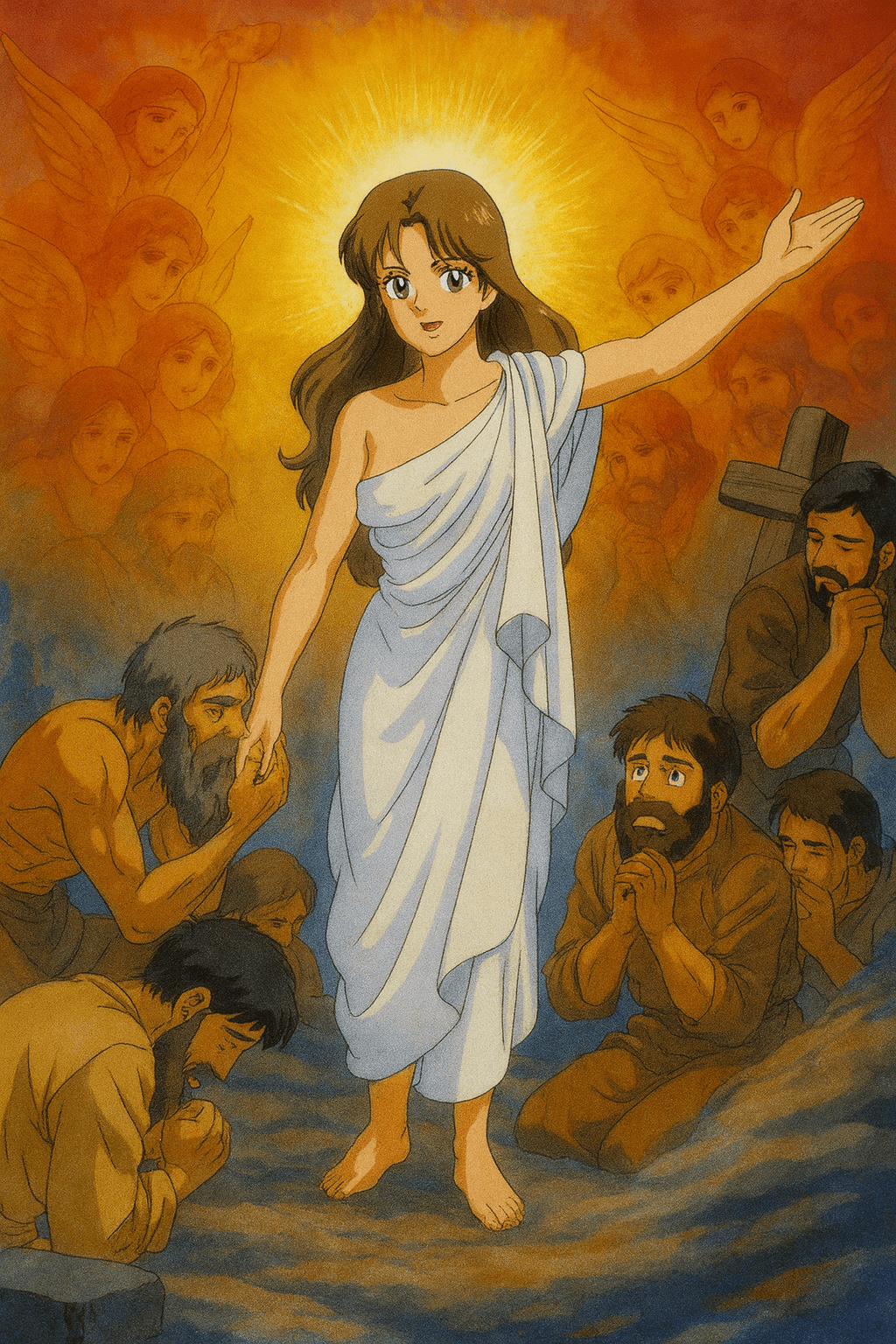
 TraditionChristianity
Period
~4 BCE – ~30 CE
Homeland
Roman Judea
He split the wood, and he was there. He lifted the stone, and they found him. Everything else—the manger, the miracles, the Sermon on the Mount, the water into wine, the triumphal entry, the cross, the empty tomb, the two-thousand-year religion built on the memory of a carpenter's son from Galilee—is the echo of a life so incandescent that the people who witnessed it could not contain it within the category of "man." They made him God. They made him the only-begotten Son, the second person of the Trinity, the Lamb that takes away the sins of the world. But before the Christology, before the creeds, before Nicaea and Constantinople and the whole vast architecture of institutional Christianity, there was a man who walked the roads of Palestine and said things so strange and so clear that the world is still turning from the force of them.
That is the measure of a Doomsayer. Not that he was worshipped, many have been worshipped. But that the wheel he turned is still turning. That every church steeple in every village in the Western world is a monument to the moment a Jewish mystic looked at the accumulated weight of Law and Temple and Empire and said: the Kingdom of Heaven is within you.
The canonical Gospels tell us almost nothing about Jesus between the ages of twelve and thirty. Luke records a single scene, the boy astonishing the teachers in the Temple at Jerusalem, and then silence. Eighteen years of silence. The most influential human being in the history of the Western world simply vanishes from the record for the entire span of his youth and early manhood, and the canonical tradition treats this void as though it requires no explanation.
Tianmu does not accept the void.
The Life of Saint Issa, the Tibetan manuscript recorded by Nicolas Notovitch at the monastery of Himis in Ladakh in 1887, fills the silence with a story that, whether one accepts its literal provenance or not, carries the unmistakable ring of a truth that the canonical tradition was not equipped to preserve. According to the Himis scrolls, the boy Issa left his parents' home at the age of thirteen, joined a merchant caravan heading east, and crossed the Sindh into India.
He went to Jagannath. He sat at the feet of the Brahmins and learned the Vedas. He mastered their scriptures with the terrifying speed that marks every Doomsayer's encounter with existing knowledge—the same speed with which Siddhartha mastered the meditative attainments of Alara Kalama and Uddaka Ramaputta, the same ease with which Odin absorbed the Vanir arts. The Doomsayer does not merely learn. He drinks. And having drunk, he sees what the teachers themselves have missed.
What Issa saw in India was caste. He saw the Brahmins hoarding scripture from the Sudras, declaring that certain human beings were unworthy of hearing the divine word by virtue of their birth. And he rejected it—not politely, not through quiet dissent, but with the full force of prophetic fury. He taught the Sudras. He declared that God makes no distinction between his children. He said that the divine was present equally in all beings, and that any system which taught otherwise was a betrayal of the very scriptures it claimed to protect.
The Brahmins plotted to kill him. The Sudras warned him, and he fled into the mountains.
This is a pattern. The Doomsayer arrives, absorbs the existing tradition, sees through to its deepest truth, and in doing so comes into direct conflict with the institutional custodians of that truth. Siddhartha's rejection of both Brahminical sacrifice and extreme asceticism. Odin's absorption of the Vanir feminine arts that his own martial culture considered shameful. The Doomsayer does not reject tradition—he fulfils it, and the fulfilment is intolerable to those who have mistaken the vessel for the water.
From India, Issa passed into the Buddhist lands. He spent six years studying the Pali scriptures. He learned dependent origination. He learned the Four Noble Truths. He sat with the monks and mastered their practice with the same irresistible ease. And then he moved on—through the Himalayas, through Persia, where he confronted the Zoroastrian priests and told them that the sun and the fire they worshipped were merely parts of creation, not the Creator.
He was twenty-nine when he returned to Israel. The same age at which Siddhartha left the palace. The same age at which a human being, in the ancient reckoning, crosses from youth into full maturity. He had spent sixteen years wandering, studying, absorbing the deepest teachings of the three great civilisational streams—Vedic, Buddhist, Zoroastrian—and carrying them within himself like a seed carries the forest. He came home to plant.
The Fire
Gospel of Thomas, Saying 10: "I have cast fire upon the world, and see, I am guarding it until it blazes."
Jesus was Fire.
This is the first thing to understand about him, and it is the thing that two thousand years of Christian theology have most thoroughly obscured. The institutional Church, Pauline, Constantinian, Nicaean, turned the most incendiary human being who ever lived into a figure of gentle meekness, a shepherd with a lamb on his shoulders, a man who turns the other cheek and counsels obedience to Caesar. And yes, he said those things. But he also said this:
Gospel of Thomas, Saying 16: "Men think, perhaps, that it is peace which I have come to cast upon the world. They do not know that it is dissension which I have come to cast upon the earth: fire, sword, and war."
Fire is the Ghost that cuts through ignorance and reveals truth. Fire is the principle of discernment, the burning away of calcification, the dissolution of everything that is not essential. And Jesus burned. He burned through the accumulated dross of Temple Judaism with a ferocity that makes the canonical Gospels, even in their sanitised form, pulse with heat. He overturned the money-changers' tables. He called the Pharisees whitewashed tombs—beautiful on the outside, full of dead men's bones within. He told the religious authorities of his people, to their faces, that they had taken the keys of Knowledge and hidden them, and that they themselves had not entered, nor had they allowed those who wished to enter.
Gospel of Thomas, Saying 39: "The Pharisees and the scribes have taken the keys of Knowledge and hidden them. They themselves have not entered, nor have they allowed to enter those who wish to."
This is the same confrontation he had with the Brahmins in India. The same pattern. The custodians of the tradition have turned the living water into a locked cistern, and the Doomsayer comes to smash the lock. Not because the tradition is wrong—the Vedas are not wrong, the Torah is not wrong—but because the custodians have confused the cup with the stream, the map with the territory, the letter with the spirit. They worship the vessel and have forgotten the water.
Gospel of Thomas, Saying 74: "There are many around the drinking trough, but there is nothing in the cistern."
Fire is also the most irresistible of the Ghosts. He dances. He leaps. He is impossible to contain or predict. And Jesus's life has exactly this quality—a man who appears out of nowhere, gathers followers with a word, heals the sick, casts out demons, speaks in parables so luminous that they are still being unpacked two millennia later, and leaves behind him a trail of transformed lives and enraged authorities. There is something wild about Jesus, something loose and surging, something that the institutional Church has spent twenty centuries trying to domesticate and has never quite succeeded. The fire keeps escaping.
Gospel of Thomas, Saying 82: "He who is near Me is near the fire, and he who is far from Me is far from the Kingdom."
The Kingdom
What did Jesus actually teach?
Not what Paul taught. Not what the Council of Nicaea decreed. Not the Apostles' Creed or the doctrine of substitutionary atonement or the theology of original sin. These are all things said about Jesus by people who came after him, many of whom never met him, and whose concerns were institutional and doctrinal rather than experiential and direct. To find what Jesus actually taught, we must go to the earliest and least mediated sources, and the Gospel of Thomas, a collection of 114 sayings attributed to Jesus, almost certainly predating the canonical Gospels in its oldest layer, is the closest thing we have to the unfiltered voice.
And what that voice says is extraordinary.
Gospel of Thomas, Saying 3: "If those who lead you say, 'See, the Kingdom is in the sky,' then the birds of the sky will precede you. If they say to you, 'It is in the sea,' then the fish will precede you. Rather, the Kingdom is inside of you, and it is outside of you. When you come to know yourselves, then you will become known, and you will realize that it is you who are the sons of the living Father."
The Kingdom is not in the sky. The Kingdom is not in the sea. The Kingdom is not in any external location or future time. It is inside of you. It is outside of you. It is here, now, spread out upon the earth, and you do not see it.
Gospel of Thomas, Saying 113: "It will not come by waiting for it. It will not be a matter of saying 'Here it is' or 'There it is.' Rather, the Kingdom of the Father is spread out upon the earth, and men do not see it."
This is Freedom. This is Midland. This is the Buddha touching the ground. The Kingdom of Heaven is not some celestial reward dispensed after death to those who have believed the right things and followed the right rules. It is reality itself, the living, breathing, present fact of the world as it actually is, seen without the filters of craving and aversion and institutional mediation. It is the earth beneath your feet and the sky above your head and the breath in your lungs, and the only thing preventing you from seeing it is the veil of unknowing that the custodians of religion have draped across your eyes while telling you that they, and they alone, hold the keys to what lies behind it.
Gospel of Thomas, Saying 51: "What you look forward to has already come, but you do not recognize it."
The Kingdom has already come. You are standing in it. This is the same teaching as Siddhartha's, expressed in different language but pointing at the same moon. The Buddha said: this is the most precious realm of existence, the only one where the conditions for awakening are present. Jesus said: the Kingdom is spread out upon the earth, and men do not see it. The same truth. The same ground. The same hand reaching down to touch the soil and finding it sacred.
The Light
Gospel of Thomas, Saying 77: "It is I who am the light which is above them all. It is I who am the All. From Me did the All come forth, and unto Me did the All extend. Split a piece of wood, and I am there. Lift up a stone, and you will find Me there."
This is the most important saying in the Gospel of Thomas, and it is also the most dangerous, because it has been misread for two thousand years.
The Pauline tradition read it as a claim of exclusive divinity, I am the light, I am the All, the unique and only-begotten Son of God making a claim about his own singular nature. And from that misreading grew the entire Christological edifice: the Trinity, the Incarnation, the doctrine that this one man was God in a way that no other human being could be, and that salvation depended on believing this about him.
But read the saying again. Split a piece of wood—I am there. Lift up a stone—you will find me there. This is not exclusivity. This is Oneness. This is the Mother speaking through a human mouth. The light that is above all things is not the private possession of one man from Nazareth. It is the light that is in everything, in the wood, in the stone, in every grain of sand and every blade of grass and every human being who has ever lived. What Jesus is saying is not "I am God and you are not." He is saying "I am the light that is in everything, and so are you, if only you could see it."
Gospel of Thomas, Saying 24: "There is light within a man of light, and he lights up the whole world. If he does not shine, he is darkness."
Gospel of Thomas, Saying 70: "If you bring forth what is within you, what you bring forth will save you. If you do not bring forth what is within you, what you do not bring forth will destroy you."
The light is within you. Bring it forth and it will save you. Suppress it and it will destroy you. This is Doom in its most personal form, find your doom and live it honestly, or live in misalignment with it and suffer. The teaching is not about belief. It is not about adherence to a creed or membership in an institution. It is about the recognition of what you already are: a carrier of the divine spark, a child of the living Father, a being whose nature is light and whose only task is to stop hiding it under a bushel.
Gospel of Thomas, Saying 108: "He who will drink from my mouth will become like Me. I myself shall become he, and the things that are hidden will become revealed to him."
Whoever drinks from my mouth will become like me. Not "worship me." Not "believe in my divinity." Become like me. The teaching is a transmission, not a commandment. It is the same gesture as the Buddha holding up the flower, an invitation to taste the water directly, not to venerate the cup. And when Thomas, the twin, the one whose very name means "double," encountered this teaching directly, he could not speak what he had received:
Gospel of Thomas, Saying 13: Thomas said to Him, "Master, my mouth is wholly incapable of saying whom You are like." Jesus said, "I am not your master. Because you have drunk, you have become intoxicated by the bubbling spring which I have measured out."
I am not your master. Because you have drunk. This is the moment of transmission, the Thomasine parallel to Kashyapa's smile on Vulture Peak. Thomas drank from the spring and became intoxicated, he tasted the Mead, the full savour of reality directly perceived, unmediated by language or doctrine. And Jesus's response is not "worship me" but "I am not your master," because the one who has drunk from the spring needs no master. The spring is within him now.
The Pauline Theft
And then Paul came.
Paul, who never met Jesus. Paul, who persecuted Jesus's followers before his conversion. Paul, who built the scaffolding of institutional Christianity on the foundation of a man he never knew and whose direct disciples he repeatedly clashed with. Paul, who transformed a Jewish mystic's teaching about the immanent Kingdom into a Hellenistic mystery religion centred on the atoning death and bodily resurrection of a divine saviour.
The Gospel of Mary preserves the fault line.
After Jesus's departure, the disciples are grieving and afraid. Mary—Mary Magdalene, whom the text plainly states the Saviour loved more than all other women—rises and comforts them. She shares a vision the Saviour had given her privately, a teaching about the soul's ascent past the cosmic powers of Desire, Ignorance, and Wrath. It is a teaching of extraordinary depth and beauty, perfectly consonant with the inner path Jesus described in the Gospel of Thomas—the journey from unknowing to knowledge, from bondage to freedom, from the darkness of the material powers to the light that is within.
And Peter says: "He didn't speak with a woman without our knowledge and not publicly with us, did he? Will we turn around and all listen to her? Did he prefer her to us?"
There it is. The crack. The moment when the institutional impulse—the need for hierarchy, for authority, for control—collides with the reality of the transmission. Peter, who will become the rock upon which the Church is built, cannot accept that the deepest teaching was given not to him but to a woman. Not publicly, in the hierarchical setting where he holds rank, but privately, in the intimate relationship between teacher and student, mind to mind, in the same manner as every genuine spiritual transmission in human history.
Levi's rebuke cuts to the heart of it: "If the Saviour made her worthy, who are you then to reject her? Surely the Saviour knows her very well. That's why he loved her more than us."
The Saviour chose her. He loved her more. And the reason is clear from the structure of the teaching: Mary had the capacity to receive the transmission. She could taste the water. She could see the vision. She could perceive the soul's ascent through the powers of delusion, because she had made the journey herself. Peter could not accept this because Peter was still operating within the framework of institutional authority, who has the right to speak, who holds the keys, who sits at the top of the hierarchy. He was thinking like a Pharisee. He was thinking like the very custodians Jesus had spent his entire ministry denouncing.
And it was Peter's lineage—through Paul, through Rome, through the Nicene Creed and the imperial adoption of Christianity—that won. The Thomasine tradition, the Magdalene tradition, the direct transmission of inner knowledge from teacher to student—all of this was suppressed, buried, declared heretical, and physically destroyed. The Nag Hammadi codices survived only because someone hid them in a jar in the Egyptian desert. The Gospel of Mary survived only in fragments. The voice of Jesus the mystic, the Jesus who said "the Kingdom is within you" and "I am not your master" and "split a piece of wood and I am there"—that voice was drowned out by the voice of an institution that needed a divine saviour, a substitutionary atonement, a hierarchy of priests and bishops, and a set of beliefs that could be enforced by imperial power.
This is the great tragedy of Christianity, and it is a tragedy that Tianmu names without flinching. The Pauline Church did not preserve Jesus's teaching. It replaced it. It took the living water and poured it into a vessel of Hellenistic theology, Roman organisational structure, and imperial ambition, and then declared the vessel to be the water. And for seventeen hundred years, the custodians of that vessel have been telling people that the only way to drink is through them.
The keys of Knowledge were hidden. They themselves did not enter, nor did they allow those who wished to enter.
The Son of Man
There is a title Jesus used for himself that has been so thoroughly absorbed into Christian theology that its original meaning has been almost entirely lost. He called himself the Son of Man.
Not the Son of God. The Son of Man.
In Aramaic, bar enasha, the phrase means simply "a human being." A mortal. A creature of flesh and blood who was born and will die and knows it. But in the prophetic tradition of Daniel, the Son of Man is also a cosmic figure who comes on the clouds of heaven to receive an everlasting kingdom. The title holds both meanings simultaneously: the most human and the most divine, the creature of dust and the inheritor of the Kingdom.
This is Crosstruth. Jesus embodies it more completely than any other Doomsayer. He is the most human of the prophets—a man who wept, who raged, who loved, who feared death in the garden of Gethsemane and begged his Father to let the cup pass from him. And he is, in the eyes of his tradition, the most divine—the Word made flesh, the Logos incarnate, God walking among men. Both are true. Neither cancels the other. The man who trembled in the garden is the same man who overturned the money-changers' tables. The man who said "My God, my God, why have you forsaken me?" is the same man who said "I am the light which is above them all."
Gospel of Thomas, Saying 29: "If the flesh came into being because of spirit, it is a wonder. But if spirit came into being because of the body, it is a wonder of wonders. Indeed, I am amazed at how this great wealth has made its home in this poverty."
The great wealth has made its home in this poverty. The light that is above all things has settled into a body that hungers, that bleeds, that will die on a cross between two thieves. This is the incarnation as Jesus himself understood it; not as a unique metaphysical event requiring three centuries of Christological debate to define, but as the simple, staggering, ordinary mystery that is happening right now in every living being. The spirit is in the flesh. The Kingdom is in the dust. The divine is in the human, not as a visitor from another realm but as the nature of the thing itself.
Gospel of Thomas, Saying 22: "When you make the two one, and when you make the inside like the outside and the outside like the inside, and the above like the below, and when you make the male and the female one and the same... then will you enter the Kingdom."
When you make the two one. When the inside becomes the outside. When the above becomes the below. When the male and the female are unified. This is the integration that every Doomsayer achieves. Odin fused Man and Muse, the masculine and the feminine, the conqueror and the seer. Siddhartha fused Heaven and Hell, the extremes of luxury and asceticism, into the Middle Way. Jesus fused spirit and flesh, the divine and the human, the Son of God and the Son of Man, into a single seamless reality. Not by transcending the flesh but by fully inhabiting it. Not by escaping the human condition but by embracing it so completely that the divine had nowhere left to hide.
The Salt
Among all the Doomsayers, Jesus was the nearest to the salt of the earth.
This is not a small thing. It is perhaps the most important thing about him. Odin was a king, the son of a king, ruling from a high seat in Asgaard. Siddhartha was a prince, raised in three palaces, surrounded by lotus pools and dancing girls. Even the Shaman—the first Doomsayer, the primordial figure whose name is lost—operated from a position of numinous authority within his tribe. The Doomsayers before Jesus were great men. Men of power, of lineage, of sacral kingship. They descended into wisdom. They fell from thrones into truth.
Jesus ascended. He was a carpenter's son. A tekton, the Greek word means something closer to a day-labourer than to a master craftsman. He came from Nazareth, a village so obscure that when Philip told Nathanael about him, Nathanael's response was: "Can anything good come out of Nazareth?" He had no lineage that impressed anyone. No palace. No army. No institutional backing. He walked everywhere. He slept rough. He owned nothing but the robe on his back, and even that was taken from him at the end.
Gospel of Thomas, Saying 86: "The foxes have their holes and the birds have their nests, but the Son of Man has no place to lay his head and rest."
This was not accidental. This was the teaching enacted. Laozi wrote that the sage should stick to the lowly: "All things carry Yin on their back and embrace Yang in their bosom." Noah was not a king but a mere man. But Jesus took this principle to its furthest extreme and lived it with a radicalism that none of the other Doomsayers attempted. He did not merely teach humility as a virtue. He was the teaching. He washed his disciples' feet. He ate with tax collectors and prostitutes. He touched lepers. He let children climb into his lap when his followers tried to shoo them away. Every gesture of his life was a deliberate subversion of the hierarchical logic that had governed the world since the first king sat upon the first throne.
Matthew 5:5: "Blessed are the meek, for they shall inherit the earth."
This was not prophecy. This was observation.
Jesus looked at the world around him—the Roman Empire at its zenith, the Temple priesthood fat with offerings, the Sadducees in their fine garments, the Pharisees with their elaborate purity laws—and he saw what Doom always reveals to those who can see: that all of this was passing. The empires and the temples and the hierarchies were already ghosts, already falling, already crumbling from within even as they appeared most mighty. And what would remain when they were dust? The meek. The poor in spirit. The salt of the earth. The fishermen and the widows and the children—the people who had never had anything to lose and therefore had nothing that could be taken from them.
He challenged the hierarchical logic of the world before him to its greatest extent. He was a prophet not only of metaphysics or of God, although he was also that, but a prophet of humility, of grace, of compassion, and above all of universalism. The Brahmins said the Sudras could not hear the Vedas. The Temple priests said the common people could not approach the holy of holies. The Romans said only citizens were fully human. Jesus said: you are all children of the living Father. Every one of you. The slave and the emperor, the Jew and the Samaritan, the righteous man and the prostitute. The Kingdom is within all of you equally, and no one—no priest, no king, no empire—has the right to stand between you and it.
This is why he touched the entire world. Not the metaphysics alone, although the metaphysics were profound. Not the miracles, although the miracles were real in whatever sense miracles are real. But the radical, lived, embodied humility of a man who looked at every human being he met and saw the divine in them, regardless of their station, regardless of their sin, regardless of what the custodians of holiness said about them. The most profound part of Jesus, by far, is that he was just a man. He could be any of us. And yet he was the one who taught so well and healed so deeply that he became hailed as the Son of God.
Gospel of Thomas, Saying 81: "Let him who has grown rich be king, and let him who possesses power renounce it."
The Cross
Gospel of Thomas, Saying 58: "Blessed is the man who has suffered and found life."
He knew what was coming. The Doomsayers always know. Odin saw Ragnarök in the well. Siddhartha knew his teaching would be distorted within five hundred years. Jesus told his disciples, plainly and repeatedly, that he would be betrayed, condemned, and killed. And yet he walked into Jerusalem anyway, on a donkey, in deliberate fulfilment of the prophecy of Zechariah, with the full knowledge that the city he was entering would kill him within the week.
This is not the behaviour of a man who was tricked. This is not the behaviour of a victim. This is the deliberate, conscious choice of a Doomsayer who understood that the wheel cannot be turned without cost, and who was willing to pay the price.
The betrayal of Judas is part of the pattern. When a fruit appears on the tree of humanity, the whole fruit—the prophet, the disciples, the antagonists, the crowd, the empire—all of it is part of the same turning. Judas is not the villain of the story. He is the mechanism by which the wheel achieves its turn. Without the betrayal, there is no arrest. Without the arrest, there is no trial. Without the trial, there is no cross. Without the cross, there is no resurrection. Without the resurrection, there is no Christianity. Judas is the paschal lamb's paschal lamb—the sacrifice within the sacrifice, the man who played the darkest role in the drama because the drama required it, and whose wyrd was to be remembered as a traitor for doing exactly what the moment demanded.
The cross itself is the supreme image of Doom accepted. A man hangs between heaven and earth, arms outstretched, holding both poles in his own body. He is lifted up—between the sky and the soil, between the divine and the human, between the living and the dead. He suffers. He cries out. He asks why he has been forsaken. And then he lets go.
"It is finished."
Tetelestai. The Greek word means not merely "it is over" but "it is accomplished." The work is complete. The debt is paid. The wheel has turned. And in that final moment of surrender—the same letting-go that Odin achieved on the tree, the same surrender that Siddhartha achieved under the Bodhi tree—the veil of the Temple is torn from top to bottom. The barrier between the holy of holies and the common world is ripped open. The keys of Knowledge that the custodians had locked away are flung wide. Everyone can enter now.
The sun darkened. The earth trembled. And three days later, the tomb was empty.
The Solitary
Gospel of Thomas, Saying 49: "Blessed are the solitary and elect, for you will find the Kingdom. For you are from it, and to it you will return."
Gospel of Thomas, Saying 4: "The man old in days will not hesitate to ask a small child seven days old about the place of life, and he will live. For many who are first will become last, and they will become one and the same."
There is a quality in Jesus's teaching—especially in the Gospel of Thomas—that is unlike anything else in the Abrahamic tradition. It is closer to Chan than to anything in the Hebrew Bible or the Pauline epistles. It is the quality of the koan, the paradox that shatters the rational mind and opens a door to something beyond it.
Gospel of Thomas, Saying 42: "Become passers-by."
Three words. The entire teaching of non-attachment, of Emptiness, of the freedom that comes from refusing to grasp—compressed into three words. Become passers-by. Do not cling. Do not accumulate. Do not mistake the road for the destination. Walk through the world as a guest, as a pilgrim, as someone who is passing through on the way to somewhere that is also here.
Gospel of Thomas, Saying 56: "Whoever has come to understand the world has found only a corpse, and whoever has found a corpse is superior to the world."
The world is a corpse. Not because the world is evil—this is not Gnostic hatred of matter. The world is a corpse in the same way that the Buddha taught all compounded things are impermanent: the world as you know it, the world of your attachments and your categories and your investments, is always already dying. And the person who sees this—who truly sees the impermanence, who has found the corpse—is superior to the world, not because they have escaped it but because they are no longer enslaved by it. They can love it freely, precisely because they know it will end.
This is Doom as Jesus taught it. Not the thundering eschatological doom of the Book of Revelation, that came later, from other hands, but the quiet, intimate, inescapable doom of a man who knew that the cup would not pass from him and drank it anyway. And in the drinking, found it sweet. Found it Mead.
Gospel of Thomas, Saying 28: "I took my place in the midst of the world, and I appeared to them in the flesh. I found all of them intoxicated; I found none of them thirsty. And My soul became afflicted for the sons of men, because they are blind in their hearts and do not have sight; for empty they came into the world, and empty too they seek to leave the world. But for the moment they are intoxicated. When they shake off their wine, then they will repent."
He stood in the midst of the world and found everyone drunk on the wrong wine—the wine of craving, of ambition, of ignorance, of institutional religion, of every substitute for the real thing. He found no one thirsty for the water he carried. And his soul was afflicted, because the tragedy of the human condition is not that we suffer but that we are drunk—intoxicated by our own delusions, stumbling through a Kingdom we cannot see, grasping at shadows while the light blazes all around us.
When they shake off their wine, then they will repent. Not repent as the Church teaches it—guilt, confession, absolution, the transactional model of sin and forgiveness. Repent as the Greek metanoia actually means: a turning of the mind. A change in the way you see. The moment you shake off the intoxication and suddenly the Kingdom is right there, spread out upon the earth, and you wonder how you ever missed it.
The Smoke
The tomb was empty. The women came and found the stone rolled away. He appeared to his followers—on the road to Emmaus, in the upper room, on the shore of the Sea of Galilee. And then he was gone.
What happened after is the story of two lineages, and only one of them survived.
The Pauline lineage, Peter, Paul, Rome, Constantine, the Nicene Creed, became the Church. It spread across the Roman Empire, absorbed the structures of imperial governance, developed a theology of divine kingship and hierarchical priesthood, and became the most powerful institution in the history of the Western world. It preserved the name of Jesus. It built the cathedrals. It produced Augustine and Aquinas and Meister Eckhart and Francis of Assisi. It carried the moral teachings of the Sermon on the Mount into the legal and ethical foundations of Western civilisation. All of this is real, and none of it should be dismissed.
But the other lineage—the Thomasine lineage, the Magdalene lineage, the tradition of direct transmission from teacher to student, the tradition that said "the Kingdom is within you" and "I am not your master" and "become passers-by"—that lineage was hunted, scattered, and driven underground. Its texts were burned. Its practitioners were branded heretics. Its understanding of Jesus as a teacher of inner awakening rather than a divine saviour whose death atones for the sins of humanity was declared anathema by the same institutional authority that Jesus had spent his entire ministry opposing.
The Gospel of Mary tells us why. Peter could not accept that the deepest teaching was given to someone outside his hierarchy. Andrew could not accept that the Saviour's words sounded different from what he expected. The institutional mind cannot tolerate the transmission that bypasses the institution. It never could. It never will.
And yet the texts survived. Hidden in jars in the Egyptian desert. Copied by monks who knew their value even as the official Church condemned them. Preserved through the long centuries in fragments and whispers and the faintest traces of a tradition that refused to die. The Nag Hammadi codices were found in 1945—the same year the world emerged from its darkest war, as if the timing itself were wyrd, as if the universe were saying: now. Now you are ready to hear this again.
The Gospel of Thomas. The Gospel of Mary. The Gospel of Truth. The voices of the other Christianity—the Christianity that was, the Christianity that the institutional Church suppressed because it could not be controlled. The voices that say: the Kingdom is within you. Split a piece of wood, and he is there. Lift up a stone, and you will find him.
The Wheel
What did Jesus turn?
Every Doomsayer turns the wheel of Doom for all of humanity. Odin turned it by founding a civilisation—by carrying the seed of Indo-European sacral kingship into the forests of the north and planting it so deep that his blood still flows in the veins of every Germanic people. Siddhartha turned it by touching the earth—by sitting with the totality of delusion and seeing through it, completely, and then spending forty-five years teaching others how to do the same.
Jesus turned the wheel by dying on it.
The cross is the wheel. The arms outstretched are the spokes. The man hanging at the centre is the axis. And what the turning accomplished was the shattering of the barrier between the sacred and the profane—the tearing of the Temple veil, the end of the priesthood's monopoly on the divine. After Jesus, every human being has direct access to God. Not through a priest. Not through a Temple. Not through a sacrifice. Through the Kingdom that is within them, that has always been within them, that is spread out upon the earth and that they do not see.
This is the revolution. This is what made Christianity—even in its Pauline, institutional, compromised form—the most transformative force in the history of the Western world. The idea that every human being, regardless of birth or caste or social position, carries the divine spark within them. The idea that the slave and the emperor are equal before God. The idea that love—not law, not sacrifice, not ritual purity—is the fulfilling of the whole commandment. These ideas did not originate with Paul. They originated with the man Paul never met, the man who walked the roads of Galilee and looked at fishermen and tax collectors and prostitutes and said: you are the sons of the living Father. You are the light of the world. The Kingdom of Heaven is within you.
The Pauline Church carried these ideas forward, even as it distorted the deeper teaching from which they sprang. The exoteric survived. The esoteric was buried. But the exoteric—the love, the equality, the dignity of every soul—was enough to reshape the world. It was enough to bring down empires. It was enough to produce, two thousand years later, the very concepts of universal human rights and individual conscience that the secular West takes for granted without knowing their origin.
Gospel of Thomas, Saying 2: "Let him who seeks continue seeking until he finds. When he finds, he will become troubled. When he becomes troubled, he will be astonished, and he will rule over the All."
The seeker finds, and is troubled. The troubled one is astonished. The astonished one rules over the All. This is the path—the Wending—compressed into a single saying. Seek. Find. Be troubled by what you find, because the truth is always more than you bargained for. Be astonished, because beneath the trouble there is a glory that words cannot touch. And then rule—not as a king rules subjects, but as consciousness rules the field of experience when it has finally seen through every illusion and stands in the clear light of what is.
The Age
Matthew 28:20: "And lo, I am with you always, even unto the end of the age."
He was not speaking metaphorically.
The axial age—that extraordinary window between roughly 800 and 200 BCE in which Siddhartha and Laozi and Confucius and the Upanishadic seers and the Greek philosophers all appeared, nearly simultaneously, across the breadth of the civilised world—had come and gone. Its wisdom was so profound that it lasted thousands of years and gave birth to every major religious and philosophical tradition still standing today, including Tianmu itself. But the axial age ended. The fruit ripened and fell. And what followed was two thousand years of Nightmare.
The Age of Pisces. Neptune's age. The age of the fish—and Jesus chose the fish as his symbol, and his first disciples were fishermen, and the earliest Christians identified themselves with the sign of the ichthys, and none of this is coincidence.
Every age has its character. The Piscean age is the age of Nightmare—not the waking, mechanical emptiness of Daymare, but the deep, churning, psychic ocean of the unconscious in which symbols multiply and meanings dissolve and reform in terrifying shapes, the age of faith and fanaticism, of cathedrals and crusades, of saints and inquisitors, of the most exalted spiritual achievements and the most abysmal cruelty committed in the name of God. It is the age of separation consciousness—the long dark night in which humanity lost its direct connection to the ground and wandered through the labyrinth of belief, clinging to doctrines and institutions and salvific narratives because the direct perception of the Kingdom had been taken from them.
Jesus saw it coming. "The meek shall inherit the earth" was not a promise for the end times. It was an observation about what was already happening—the classical world was dying in its own blood, the great empires of the ancient world were consuming themselves, and what would emerge from the wreckage would not be built by conquerors or philosopher-kings but by the meek, by the dispossessed, by fishermen and tentmakers and slaves who carried a carpenter's teaching in their hearts.
And in all of that time, in the entire two-thousand-year span of the Piscean age, no other Doomsayer turned the wheel through wisdom or teaching alone. There were saints, yes. There were bodhisattvas. There were the great mystics, Meister Eckhart, Rumi, Hildegard, Francis, Huineng, Milarepa, who touched the ground individually and carried the light forward through the long night. But no one turned the wheel for all of humanity. No one appeared as fruit on the tree. The wheels that turned in those centuries turned through strength, through empire, through conquest, through the sheer force of institutional power, not through the quiet revolution of a man sitting under a tree or hanging on a cross.
So he was not wrong. "I will be with you, even unto the end of the age." He really was. It was his age. The Age of Pisces. The age of the fish. And his teachings, his humility, his compassion, his radical insistence on the dignity of every soul, lived at the forefront of religious thought for the entire duration. Like Maitreya Buddha in Buddhist prophecy, the friend of all beings, the compassionate one who sustains the dharma through the dark interval between Buddhas, Jesus served as the guide through the nightmare of separation consciousness. The friend who walks beside you when you cannot see the road.
Matthew 11:28: "Come to me, all you who are weary and burdened, and I will give you rest."
But the importance of this creed was a double-edged sword. For as the teachings of Jesus can liberate, they can also be used to constrict. The same words that shattered the Temple veil were sewn into the fabric of a new temple. The same universalism that declared every soul equal before God was conscripted into the service of an institution that would burn people alive for disagreeing about the nature of the Eucharist. The mandates were misconstrued to reinforce the very authority he had radically seen through. "Render unto Caesar" became a justification for submission to tyranny. "The meek shall inherit the earth" became a narcotic for the oppressed, a reason not to resist, not to fight, not to demand their dignity in this life rather than waiting for the next.
And somehow, across two thousand years, few Christians have managed to act very Christlike. The religion of a man who washed feet and ate with sinners became the religion of inquisitors and crusaders and televangelists. The teaching of a man who said "I am not your master" became the basis for the most elaborate hierarchy of spiritual authority the world has ever seen. The fire that was meant to burn through every form of calcified religion was captured, contained, and used to forge the chains of a new calcification.
This is Wyrd at its most bitter. The wheel turns, and the very turning produces the conditions for its own reversal. Jesus's teaching of inner freedom became the instrument of outer bondage. His creed of universal love became the justification for universal war. The light he cast upon the world was so bright that it blinded the very people who carried it, and they stumbled through two millennia swinging his torch at everyone who disagreed with them, setting fire to everything he loved.
And yet the fire was never entirely captured. In every generation, someone read the words again and saw what was actually there. Francis stripped naked in the town square and walked away from his father's wealth. Eckhart preached that the eye through which he saw God was the same eye through which God saw him, and the Church condemned him for it. Tolstoy read the Sermon on the Mount and understood that it meant exactly what it said, and the Church excommunicated him for it. The fire keeps escaping. It always has. It always will. Because the teaching is not in the institution. The teaching is in the wood. In the stone. In the Kingdom that is spread out upon the earth and that men do not see.
The Piscean age is ending. The wheel is turning again. And the texts that were hidden—in jars in the desert, in fragments scattered across the libraries of the world, in the suppressed voices of the other Christianity—are surfacing now, as if the ground itself is giving them back. The Gospel of Thomas. The Gospel of Mary. The Life of Saint Issa. The voices that the institution silenced because they pointed past the institution to the ground on which it stood.
Perhaps this is Jesus's final gift to the age that is coming. Not the institution he never founded. Not the creed he never wrote. But the words themselves, preserved against all odds, waiting in the earth like seeds for two thousand years, ready to grow when the season changes.
There is a man. He is a carpenter's son from a village in Galilee, born into an occupied country under the boot of the most powerful empire the world has ever seen. He leaves home at thirteen, crosses the known world, sits at the feet of Brahmins and Buddhists and Zoroastrian priests, absorbs the deepest teachings of three civilisations, and returns home carrying a fire that will burn for two thousand years.
He teaches for three years. He says things that no one in his tradition has ever said. He says the Kingdom is within you. He says split a piece of wood and I am there. He says become passers-by. He says I have cast fire upon the world and I am guarding it until it blazes. He looks at the religious authorities of his people and tells them they have hidden the keys of Knowledge and locked everyone out, including themselves.
They kill him for it. He knew they would. He walked into it with open eyes, because the wheel cannot turn without cost, and the cost of this turning was his body on a cross and his blood on the ground of a hill outside Jerusalem called the Place of the Skull.
The tomb was empty. The veil was torn. The fire he cast upon the world is still blazing.
Split a piece of wood. He is there. Lift up the stone. You will find him.
Gospel of Thomas, Saying 18: "Blessed is he who will take his place in the beginning; he will know the end and will not experience death."