
 TraditionMankind
Period
Sometime
Homeland
Somewhere
Every culture on Earth remembers the flood.
Not some cultures. Every culture. Sumerian, Hebrew, Hindu, Greek, Norse, Chinese, Polynesian, Indigenous American, Australian Aboriginal. Across every continent, across every language family, across every epoch of recorded and oral history, the same story is told: the waters rose, the world was destroyed, and one person—one family, one vessel—survived. This is not coincidence. This is not a literary convention that spread from one source and was imitated by the rest. This is memory. Something happened, and the whole world remembers it.
The names differ. In the Vedic tradition he is Manu, the first man, the progenitor of all humanity. In the Hebrew scriptures he is Noah, the righteous man who found grace in the eyes of the Lord. In the Sumerian and Akkadian traditions he is Ziusudra, or Utnapishtim—"he who found life." In the Greek he is Deucalion, who repopulated the world by casting stones behind him. In the Germanic tradition, recorded by Tacitus, he is Mannus, the son of Tuisto, the ancestor of all the Germanic peoples. The names differ because the children differ. The memory is one.
His name is the oldest word we know for what it means to be human.
Manu comes from the Proto-Indo-European root *men-, which means "to think." From this root descends the Sanskrit manu (man, mankind), the Latin mens (mind), the Greek menos (spirit, force, courage), the Old English mann, the Modern English "man," "mind," "mental," "memory." His name became the word for us. Not our species, not our biology—our thinking. Our awareness. Our capacity to stand before the flood and choose.
To be human is to be of Manu. To be of Manu is to think.
Follow the root across the languages his children would one day speak:
Sanskrit: manu (man, mankind), manas (mind), mantra (instrument of thought).
Greek: menos (spirit, force), mania (madness—the mind overflowing), mantis (seer—the mind that sees).
Latin: mens (mind), memini (I remember), monumentum (a reminder).
Old English: mann (human being), gemynd (mind, memory).
His name is in our word for ourselves. His name is in our word for thinking. His name is in our word for remembering. He is not a figure from mythology. He is the figure from whom mythology descends—the point of origin around which every tradition's memory of the flood crystallises like salt around a seed crystal.
In the Ghosthall, Man corresponds to Jupiter—the expansive, pioneering, civilisation-founding energy, the ambition that erects tall towers and ventures into the unknown, the raw sacred drive that turns a village into a city and a city into an empire. His very name IS the name of the Ghost. When the Rigveda declares "It is Man who is capable of broadening the Way; it is not the Way that broadens Man," it is speaking about the energy that Manu embodied: the raw, almost irrational, sacred drive to rebuild after the world has ended. Manu is not merely a manifestation of Man. He is the original. The template. The first human being to fully embody the Jupiterian drive in the teeth of annihilation.
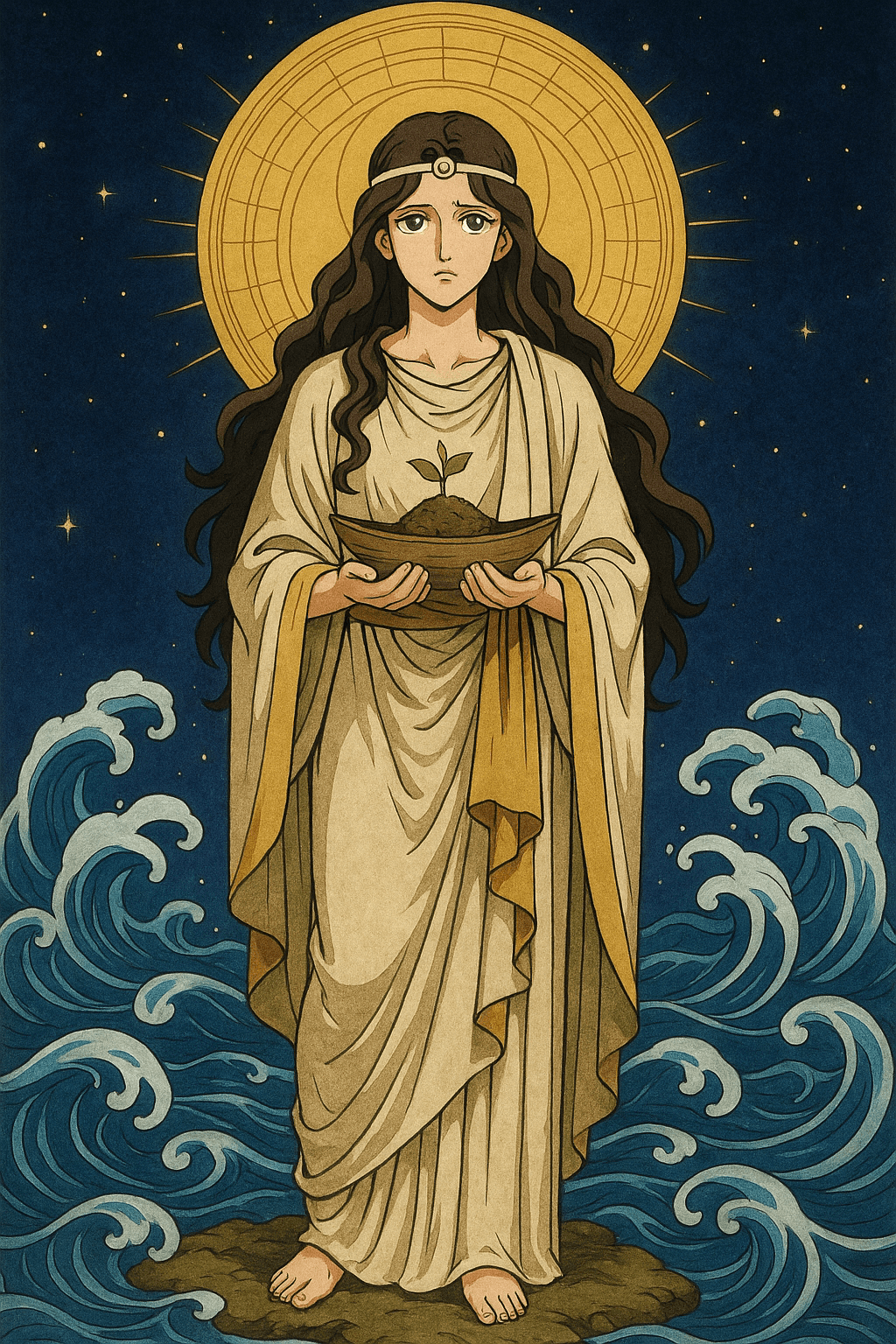
And in the Ghosthall of Tianmu, Freedom's Sanskrit name is Manu. Freedom—the Earth herself, the middle realm, the ground of being, the place where all the Ghosts converge into a living world. Because Manu is the one who re-founded Freedom after the flood. He stood in the mud, in the silt, in the wreckage of the old world, and he said: here. Here we begin again. The ground beneath your feet is sacred. The seeds in your hand will grow. The temple we build will reach toward Heaven.
The Fisherman
He did not start as a king. Every tradition remembers him as humble.
Matsya Purana: "Manu was performing penance on the bank of the river when a small fish came into his hands and said, 'Save me, and I shall save you.' He put the fish in a jar, but it grew too large, so he placed it in a tank, and then in a lake, and then in the ocean itself. The fish said: 'A great flood will come and destroy all living creatures. Build a great vessel, and take into it the seven sages and the seeds of all things, and fasten your vessel to my horn when the waters rise.'"
A fisherman. A man who pulled living things from the water. Not a priest, not a king, not a warrior—a man whose hands knew the rhythms of Tides, who understood the waters before the waters rose against him. In the Matsya Purana, it is a fish—the smallest, most helpless creature—that delivers the warning. In the Hebrew tradition, it is God who speaks directly to Noah's righteousness. In the Sumerian tradition, it is Ea, the god of freshwater and wisdom, who whispers through the wall of a reed house. In every version, the pattern is the same: the warning comes to the one who is humble enough to hear it.
This is what sets a Doomsayer apart from the merely wise. Not power but receptivity. Not authority but attention. The kings and the priests of the old world went about their business. Manu listened to a fish. And because he listened, everything that came after him was possible.
The Doom
Genesis 6:13, 17–18: "And God said unto Noah, The end of all flesh is come before me; for the earth is filled with violence through them; and, behold, I will destroy them with the earth... And, behold, I, even I, do bring a flood of waters upon the earth, to destroy all flesh, wherein is the breath of life, from under heaven; and every thing that is in the earth shall die. But with thee will I establish my covenant."
This is what makes Manu a Doomsayer. Not that he survived the flood—survivors are those who happen to be in the right place when catastrophe hits. Manu SAW it coming. He kenned the Doom before it arrived. He looked at the world he lived in, the world his ancestors had inhabited for tens of thousands of years, the world of the great ice, the world of the mammoth hunters and the cave painters and the old shamanic peoples, and he understood that it was ending. He spoke the doom. He prepared. While everyone else continued living as they had always lived, Manu built a vessel.
What was the flood?
In the language of geology: the end of the last Ice Age. For over a hundred thousand years, vast ice sheets had covered the northern hemisphere. Humanity lived in the shadow of these glaciers, hunting megafauna, following animal migrations, painting their prayers on cave walls. Then, around twelve thousand years ago, the world began to warm. The glaciers retreated. The ice melted. Sea levels rose—not gradually, but in catastrophic pulses. Ice dams burst and released entire inland seas in a matter of days. Coastlines that had been home to human communities for millennia vanished beneath the water. The animals the old world depended on, the mammoths, the giant sloths, the great aurochs, migrated north to extinction or died where they stood. An entire way of life, stretching back to the dawn of human consciousness, was annihilated by rising water.
In the language of Doom: the wheel turned. The old world had run its course. The Ice Age was an aeon unto itself—a world with its own laws and rhythms and peoples—and it ended not with a whimper but with a deluge. This is what Doom does. He does not destroy for the sake of destruction. He consumes what has been so that what will be can begin. The flood was not a punishment. It was a turning. The wheel of dharma rotated, and everything that could not adapt to the new position was swept away.
Epic of Gilgamesh, Tablet XI (Utnapishtim speaks): "For six days and seven nights, the wind blew, the flood and the tempest overwhelmed the land. When the seventh day arrived, the tempest, the flood, which had fought like an army, subsided. The sea grew quiet, the wind abated, the flood ceased. I looked at the weather; stillness had set in. And the whole of mankind had turned to clay."
"The whole of mankind had turned to clay." Utnapishtim looked out at the new world and wept. Noah looked out and saw nothing but water and silence. In every telling, the moment after the flood is the same: an impossible, ringing emptiness. The world you knew is gone. The people you knew are gone. The places, the paths, the animal trails, the rivers, the camps where your grandparents lived and their grandparents before them—all of it, gone, beneath the water or buried in silt. And you are alive. Standing in the mud. Holding the seeds of everything.
The Vessel
The vessel is the proof that Manu was a Doomsayer and not merely a survivor.
The ark—whatever its actual historical form—was an act of Muse's discipline: the contracting, Saturnine strength that faces the doom without flinching and does the grim work of preparation. Not the expansive energy of Man—not yet. That comes after. First comes the discipline of the threshold guardian, the one who peers into the well and does not look away. Manu had to see the end of the world clearly, accept it, and then methodically, day by day, build something that could survive the crossing.
And what was placed in the vessel? The Matsya Purana says Manu brought the seven sages and the seeds of all things. Genesis says two of every living creature. The Sumerian account says the arts of civilisation. What all of these are saying is the same thing: Manu did not merely save himself. He preserved the Yarn, the threads of knowledge, of genetic diversity, of cultural memory, of practical skill, of the sacred songs and the names of the Ghosts, that would be needed to weave the world again.
He was the narrow bridge between what was and what would be. The old world walked across his back into the new one.
Hávamál, Stanza 77: "Cattle die, kindred die, every man is mortal: but the good name never dies of one who has done well."
The King
The waters receded. And the fisherman became a king.
This is the pivot of the story, the hinge upon which all of subsequent human history turns. Before the flood, Manu was one man among many—a fisherman pulling his nets from the river. After the flood, he was the only man who possessed the knowledge, the seeds, the animals, and the Will to rebuild. The humble were exalted. The fisherman became the lawgiver. This is not metaphor. This is what happens when Doom sweeps away the established order: those who had the Hamingja, the ancestral luck and spiritual potency, the alignment of word with deed, to see the doom coming and prepare for it, these are the ones who inherit what remains.
In the Vedic tradition, Manu is explicitly the first lawgiver. The Manusmriti, the Laws of Manu, is one of the oldest legal codes in human history—a comprehensive system of social order that governed Indian civilisation for millennia. In the Hebrew tradition, Noah receives the Noahide Laws, seven universal commandments binding on all of humanity. In the Greek tradition, Deucalion's son Hellen becomes the ancestor of the Hellenes, and from his line descend the founders of Greek civilisation. In every tradition, the flood survivor does not merely survive. He founds. He legislates. He establishes the order by which the new world will be governed.
What Manu restored was not merely life but order. Before the flood, the old world had its own structures—chieftains, elders, the hierarchies of the hunter-gatherer bands that had roamed the Earth since the time of the Shaman. The flood destroyed all of that. The old territories were drowned. The old gathering places were silted over. The old trails led nowhere. And from that absence, Manu established something new: kinghood—the alignment of human authority with cosmic law, the insistence that governance must reflect Doom rather than merely personal power. In the Vedic tradition this is dharmarajya, righteous rule. In the Norse it is the function of the king as the one whose Hamingja upholds the luck of the entire people. Manu was the first to hold this office after the wheel turned, and from him all subsequent kings derive their mandate.
Bhagavad Gita 3.35: "It is far better to discharge one's prescribed duties, even though faultily, than another's duties perfectly. Destruction in the course of performing one's own duty is better than engaging in another's duties, for to follow another's path is dangerous."
The Temple
But the first thing he built was not a palace and not a wall. It was a temple.
Göbekli Tepe sits in the hills of southeastern Turkey, near the headwaters of the Euphrates, in the region the ancients called the Fertile Crescent and the Hebrews imagined as Eden. It was built around 9500 BCE—before agriculture, before pottery, before the wheel, before writing, before any of the things we associate with civilisation. It is the oldest known monumental structure on Earth. Massive T-shaped pillars, some weighing over ten tons, carved with intricate reliefs of animals—foxes, boars, vultures, scorpions, lions, serpents—arranged in great circles, oriented to the stars. It was built by hunter-gatherers. People who had no permanent settlements, no domesticated crops, no beast of burden to haul the stones.
And they built THIS.
Rigveda X.1 (Agni, the Fire): "Omen of the dawn, you ascend high, your light piercing through the dark. Oh luminous Fire! As fair as can be, your rays touch all corners of the world. You are the kindling seed of Heaven and Earth."
This is Fire. The first act of the new world was not survival but worship. Not the practical business of feeding and sheltering, but the irrational, sacred, incandescent need to reach upward—to build a bridge between the human and the divine, to honour the forces that had carried them through the deluge. Fire sits at the heart of the Twelveness as the most Heavenly of the Ghosts, the terrestrial manifestation of the first spark of becoming, the principle that cuts through ignorance and reveals truth. At Göbekli Tepe, humanity's first monumental act was to kindle that fire in stone.
The conventional archaeological narrative had always been: first agriculture, then surplus, then settlement, then social hierarchy, then religion. Göbekli Tepe inverted this entirely. First came worship. First came the temple. The drive to reach toward Heaven preceded the practical arts of civilisation. Man did not build temples because he had spare grain. He grew grain because he had a temple to gather at. The tower preceded the city, just as Fire precedes all understanding.
Look at the animals carved on the pillars. Foxes, serpents, vultures, scorpions, boars—creatures of the threshold, of the liminal, of the boundary between the tame and the wild. These are not decorations. They are Ghosts. They are the Lowghosts of the animals that shared the world with the temple-builders, rendered in stone as a permanent act of Ghostsooth—the recognition that the world is alive, that the animals are aware, that humanity exists within a communion of beings and not above them. Göbekli Tepe is not merely a temple. It is a Ghosthall. The first Ghosthall.
The pillars themselves are T-shaped—anthropomorphic, with carved arms and hands folded across their fronts, as if the stones are standing figures, silent watchers. Some archaeologists have suggested they represent ancestors. Others, that they represent spirits or deities. In Tianmu's language, they are Ghosts made literal: the forces of the cosmos rendered as standing presences in a circle of stone, oriented to the heavens, facing each other across a sacred space. The people who built this understood the Manifold. They understood that reality is fractal, that the same pattern repeats at every scale, and they built a physical model of the cosmos to commune with it. The circles within circles. The animals at every scale. The astronomical orientation. This is not primitive religion. This is the most sophisticated theology on Earth, predating the Vedas, predating the Pyramids, predating everything, carved by the hands of Manu's people in the generation after the flood.
And then, around 8000 BCE, they deliberately buried it. They filled in the circles with rubble and earth, covering the pillars, sealing the site beneath the hill. They knew the temple's time had passed. The world was changing again—agriculture was taking hold, settlements were growing, the old hunter-gatherer way was giving way to something new. Rather than abandon the temple to decay, they buried it, preserved it, returned it to the earth the way a seed is returned. This is Tides. The cycle completing itself. The wave that rose now falling, not in destruction but in reverence, laying down what was sacred so that the ground could carry it forward.
The Seeds
From the temple, everything else followed.
The wild grasses that grew in the hills around Göbekli Tepe, emmer wheat, einkorn wheat, barley, were among the first crops domesticated by human hands. Genetic analysis has traced the origin of domesticated einkorn to the Karacadağ mountains, less than thirty kilometres from the temple. The wild goats and sheep that roamed the same hills were among the first domesticated animals. It all began here, in this one place, in the shadow of Manu's temple, in the cradle of the new world that followed the flood.
This is not coincidence. The people who survived the deluge, who had the Hamingja to foresee the doom and the Will to prepare, were also the people who possessed the knowledge, the attentiveness, the deep familiarity with the land and its rhythms that allowed them to take the next step. They knew the grasses. They knew the animals. They had watched them for generations with the patient eye of the fisherman, of the one who understands the water's rhythm. And when the old way of life became impossible—when the megafauna vanished and the old hunting grounds lay beneath the sea—they took what they knew and turned it toward a new purpose. They became farmers. They became herders. They became the builders of the first permanent settlements.
The Neolithic Revolution—the transition from hunting and gathering to agriculture—is sometimes described as if it were a slow, inevitable process, a general drift toward a more efficient way of life. But it was not general. It was specific. It began in one place, among one people, in the hills where the temple stood. And from that place it radiated outward, carried by the children of the temple-builders, into Mesopotamia, into the Nile Valley, into the Indus, into Europe, across the face of the Earth. The seeds Manu carried in his vessel did not merely sustain his family. They fed the world.
Dao De Jing, Chapter 78: "Nothing in the world is as soft and yielding as water. Yet for dissolving the hard and inflexible, nothing can surpass it."
The Children
And then the children scattered.
The people who gathered at Göbekli Tepe, who domesticated the first crops, who founded the first settlements in the Fertile Crescent—these were the Proto-Nostratic speakers. The bearers of a language so ancient that its direct descendants include nearly every major language family in the Old World. From this one group of post-diluvial temple-builders descended:
The Indo-Europeans, who would populate Europe, Iran, and India, and whose languages—Sanskrit, Greek, Latin, Persian, English, Russian, Hindi—are spoken today by nearly half the human race.
The Afroasiatics, whose descendants would found Egypt, Akkad, Babylon, and the great Semitic civilisations—Hebrew, Arabic, Aramaic—and from whose midst would emerge the three largest religions in the world.
The Kartvelians of the Caucasus, whose Georgian is one of the oldest continuously written tongues on Earth.
The Dravidians, whose Tamil civilisation in southern India is among the oldest urban cultures in the world.
The Uralic peoples—the Finns, the Hungarians, the Sámi—who carried the memory northward into the boreal forests and the Arctic.
All of them remember the flood. All of them carry Manu's name in their word for "human" or "mind" or "man." All of them are his children.
Tacitus, Germania 2: "In their ancient songs, their only record of the past, the Germans celebrate Tuisto, a god sprung from the earth. His son Mannus they regard as the fountainhead of their race, its founder."
Mannus, the son of Tuisto. Tuisto—"the dual one," from the same root as "two," the embodiment of the primordial split, the bilateral symmetry that the Shaman discovered in the depths of the Paleolithic. And from that duality came Mind—Mannus, Manu, the thinker. First the split. Then the thought. First duality. Then the mind that can hold duality and act within it. The lineage of the Doomsayers is not merely chronological. It is evolutionary. Each one builds upon the gift of the last.
The Wheel
Ecclesiastes 1:9–10: "The thing that hath been, it is that which shall be; and that which is done is that which shall be done: and there is no new thing under the sun. Is there any thing whereof it may be said, See, this is new? It hath been already of old time, which was before us."
Consider the Wyrd of it. A fisherman, the humblest of men, receives a warning from the waters themselves. He builds a vessel of preservation. The world ends. He survives. He lands on a hill. He descends from that hill and becomes a king and a lawgiver. He builds a temple. He plants seeds. His children multiply and spread across the face of the Earth, carrying his language, his memory, his name—and they become every people that has ever built a civilisation on this planet. The irony, the elegance, the sheer narrative perfection of it—this is Wyrd at its most powerful, the personal doom of one man becoming inseparable from the doom of the entire species.
This is not merely a story told by ancient peoples. This is the archetype of all human resilience. Every time a civilisation falls and a person stands up from the rubble and begins again—every refugee who crosses the sea and builds a life in a strange land, every people who survive catastrophe and rebuild their culture from memory, every individual who loses everything and finds the will to start over—they are channelling Manu. They are the fisherman becoming the king. They are the narrow bridge between what was and what will be.
Manu's Doom, his dharma, his personal cosmic law, was the most terrible doom a Doomsayer can bear: to know that the world is ending and to act anyway. Not to stop the flood, because the flood cannot be stopped. Doom turns the wheel, and neither gods nor men can hold it back. But to preserve. To carry the seeds. To be the vessel. To accept the inevitability of destruction and nonetheless insist on the possibility of renewal. This is acceptance of Doom in its purest form—not the Gnostic hatred of the material world, not the nihilist's surrender to the void—but the fierce, practical, urgent love of someone who knows that everything they love will be destroyed and chooses to save what they can.
The Gnostics would have raged against the flood. They would have called it evil, called the Demiurge cruel, cursed the waters and the god who sent them. The nihilists would have lain down and let the waters take them. Manu did neither. He accepted the flood as Doom—as dharma, as the turning of the wheel—and he built a boat. This is the third way that Tianmu teaches: neither hatred nor surrender, but the clear-eyed, loving, practical response to the truth of impermanence. The fire kindles and gutters. The waters rise and fall. You build the ark.
He came from the water. He was saved by the water. The water destroyed the world and the water delivered him to the new one. Tides, the Moon, the cyclical, the force that draws all things through the rhythm of death and rebirth, was the medium through which Manu's wyrd unfolded. The flood was not his enemy. It was his Doom. And Doom is not the enemy. Doom is the law you must find and live honestly, the nature you must not deny, the wheel you cannot stop but can learn to ride. Manu rode the flood. He rode the Tides. And when the waters set him down, he planted the first seed in the first furrow of the first field, and the wheel turned from death to life.
Every year the rains come. Every river floods its banks. Every civilisation builds on the silt of the one that came before. The Sumerians raised their cities on the alluvial plains where the Tigris and Euphrates flood each spring, and they told the story of Utnapishtim while they did it, because they understood that the flood was not a one-time event but the pattern itself—the eternal rhythm of destruction and renewal that governs all life. This is Doom in its truest sense: not a singular catastrophe but the law of cyclicality, the wheel that turns and turns and turns. And Manu is the one who taught humanity how to ride it.
Beowulf, lines 2590–2591: "Each of us must await the end of his path in this world."
There is a mountain. The waters have receded and the mountain is bare. The mud is drying in the sun. There is one man standing at the summit with a bag of seeds and the memory of a world that no longer exists. Behind him, the past—everything he knew, everyone he loved, the entire order of things as they had always been—lies beneath the water, turning to clay. Before him, the future—every city and empire and temple and song, every language and every people, every joy and every catastrophe that makes up the human record—waits in the seeds he carries and in the hands that will plant them.
He does not know any of this. He does not know that his name will become the word for humanity. He does not know that his temple will stand for eleven thousand years beneath the earth. He does not know that his children will spread across the face of the world and become every people that has ever built a civilisation. He knows only this: the ground is here. The seeds are here. The sun is rising.
He kneels. He digs. He plants.
And the world begins again.