
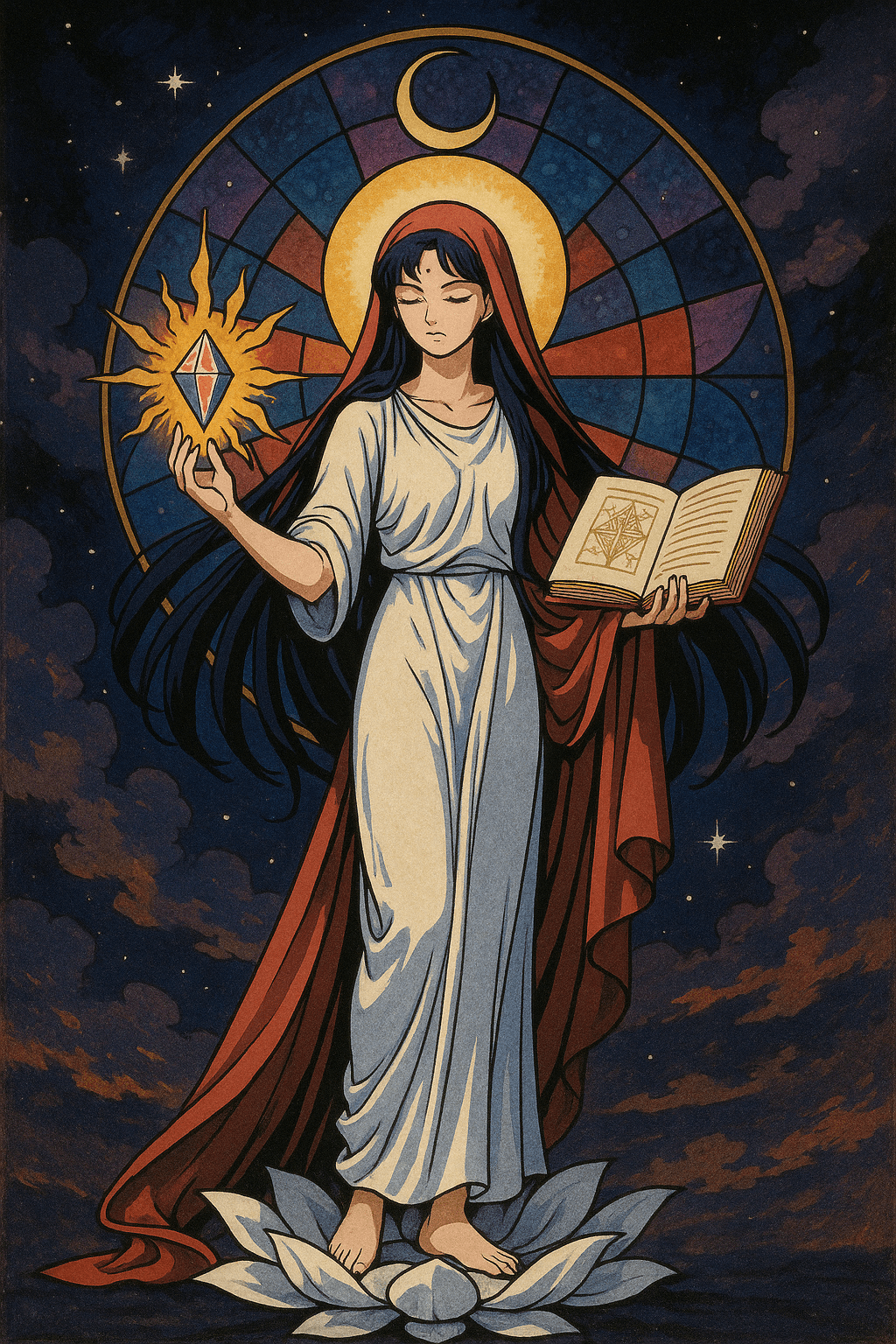
 TraditionManichaeism
Period
216 – 274 CE
Homeland
Ctesiphon, Sassanid Persia
He wrote seven books in his own hand, painted his gospel in pictures, and built a church that stretched from Rome to China. They burned every word.
His name was Mani. He was born on April 14, 216 CE, in the village of Mardinu, near Ctesiphon, the capital of the arthian Empire, in what is now Iraq. His father was Pattig, a man from Hamadan in the Iranian highlands. His mother came from a noble Arsacid family, related to the Parthian royal house. He was, by birth, connected to power.
Before Mani was born, his father heard a voice in a temple telling him to abstain from meat, wine, and sexual intercourse. Pattig obeyed. He joined a community of Elcesaites, a Jewish-Christian baptizing sect that lived in the marshlands of southern Mesopotamia, and he brought his young son with him. Mani grew up among the baptizers.
The Elcesaites were obsessed with purity. They washed constantly—their food, their bodies, the plants they tended. Ritual bathing was the centre of their practice. They were vegetarian, ascetic, insular. They lived in the wetlands of the Tigris-Euphrates delta, a world of reeds and mud and water. Mani spent his childhood and adolescence among them, learning their ways, participating in their rituals.
He did not fit. He argued. He questioned why they washed vegetables—if the water purified the plant, what purified the water? The questions were not rhetorical. He was genuinely, deeply unsatisfied. He could see the logic of purity but not its end.
The Twin
When Mani was twelve years old, he had his first vision. A figure appeared to him, a being he would call his Twin, his tawm, his divine companion. The Twin told him to separate himself from the sect. But not yet. He was too young. The time had not come.
So Mani waited. For twelve years, he lived among the baptizers, participating in their rites, keeping their rules, knowing he would leave. He was a boy with a secret that lasted half his youth.
When he was twenty-four, the Twin came again. This time the message was direct: leave. Go and preach. The time has come.
The Break
Mani went before the elders of the Elcesaite community and told them what he believed. He told them their washings were useless—that purity was not a matter of water on skin. The elders were not pleased. There may have been a formal hearing. Some sources describe a trial, others a simpler rupture. Either way, Mani declared his beliefs, the community rejected them, and he left. His father left with him. So did two or three others. That was the beginning of his church: a young man, his elderly father, and a handful of followers, walking out of the marshes.
He travelled east. He went to India, probably the Kushan Empire, in what is now Pakistan and Afghanistan, possibly further. He encountered Buddhism. He saw how the Buddha's teaching had been organised, how it had spread across cultures and languages without losing its core. He was impressed. He also saw what he considered its limitation: it had not reached the West. It was not universal.
He came back to Mesopotamia with a plan. He would build a religion that included everyone.
The Painter
Mani was a painter. This is not a metaphor. He was, by all accounts, an extraordinarily gifted artist. And he used his gift in the most deliberate way any religious founder ever has.
He wrote seven major scriptures, in his own hand. This was itself remarkable. Most religious founders either wrote nothing, the Buddha, Jesus, or wrote in forms that were later compiled by others. Mani wrote his books himself, in Syriac and Middle Persian, because he had studied what happened to the teachings of the founders who did not. He saw that the Buddha's words had been altered in transmission. He saw that Jesus' teachings had been distorted by disciples who misunderstood them. He would not leave that to chance. The seven books were the Shabuhragan, the Living Gospel, the Treasure of Life, the Pragmateia, the Book of Mysteries, the Book of Giants, and the Letters. Each was a complete text, copied by trained scribes under his supervision, distributed across his growing network of communities.
But the masterwork was different. It was not a book of words. It was a book of pictures.
The Arzhang, the word means something like "worthy of display", was a painted gospel. Mani created it because he understood that not everyone could read, that words alone were not enough, that the deepest things he wanted to convey about the nature of light and darkness and the condition of the human soul could be shown more clearly in images than in arguments. Later sources, even hostile ones, acknowledged the Arzhang as a work of extraordinary beauty. For centuries after his death, "painting like Mani" was a proverb in Persian for supreme artistic skill.
No copy of the Arzhang has survived. Not one.
The religion he built was designed, from the first, to be universal. He had studied Zoroastrianism, Christianity, and Buddhism, and he considered their founders, Zarathustra, Jesus, the Buddha, to be genuine messengers who had each brought a portion of the truth to a portion of the world. His claim was not that they were wrong but that they were incomplete. The truth was one. The messengers had each carried a piece. He would carry the whole thing—not because he was greater than they were, but because the time had come for the pieces to be assembled.
He adapted his teaching to his audience. When he preached to Zoroastrians, he used their terms—light and darkness, the cosmic struggle. When he preached to Christians, he used theirs—Jesus, the Paraclete, the apostles. When his missionaries went east, they used Buddhist terms—Buddha-nature, liberation, the transmigration of souls. This was not cynicism. It was the practical application of his core belief: that the truth was one, that it had been spoken in every language, and that every sincere seeker was already partway there.
He organised his church with care. There were two tiers: the Elect, who lived in absolute asceticism, no meat, no wine, no sex, no property, and the Hearers, the lay community, who supported the Elect and followed a lighter discipline. The structure was borrowed partly from Buddhism and partly from Christianity. It worked. Within a generation, the church had spread from Egypt to Central Asia.
The King
Sometime around 240 CE, Mani gained an audience with Shapur I, the Sasanian emperor, the most powerful man in the known world. It may have been through Shapur's brother, Peroz, who had become a follower. However it happened, Mani stood before the king and preached.
Shapur was impressed. He granted Mani permission to travel and teach freely throughout the entire Sasanian Empire, a territory stretching from the Euphrates to the Indus. This was an extraordinary grant. The Sasanian state was officially Zoroastrian. The priestly establishment, led by the increasingly powerful Kartir, viewed all other religions with suspicion. But Shapur saw something useful in Mani's universalism. An empire that contained Zoroastrians, Christians, Jews, Buddhists, and pagans might benefit from a religion that claimed to honour all of them.
For roughly thirty years, Mani preached under imperial protection. He sent missionaries in every direction—west toward the Roman Empire, east toward India and Central Asia. He wrote his books. He painted his pictures. He built an international church with communities in Egypt, Palestine, Rome, Central Asia, and probably China. It was the most successful religious expansion of the third century.
He was not naive about his position. He knew that Shapur's protection was political, and that politics change. But he used the time he had. Every year he did not spend in a dungeon was a year his missionaries could travel further, his books could be copied more widely, his church could put down deeper roots. He was racing a clock he could hear ticking.
The Chains
Shapur I died in 270 CE. His son Hormizd I succeeded him and continued to protect Mani, but Hormizd reigned for barely a year. When Bahram I took the throne in 271, the clock ran out.
Bahram was allied with Kartir, the Zoroastrian high priest, a man who had spent decades consolidating priestly power and who regarded Mani as the single greatest threat to Zoroastrian supremacy in the empire. Kartir was brilliant, patient, and ruthless. He had been building his case for years. Now he had a king who would listen.
Mani was summoned to the court. He knew what was coming. The sources describe him arriving at Bahram's capital, Gundeshapur, and being told that the king was busy with a hunt. He waited. When Bahram finally received him, the conversation was short and hostile. Bahram asked him what use he was—he could not fight and he could not hunt. What was he good for?
Mani answered. The answer did not matter. The decision had already been made.
He was arrested and loaded with chains—the sources specify: three on his hands, three on his feet, one on his neck. The weight was part of the punishment. He could barely move. He died in prison, sometime between 274 and 277 CE. Some sources say he was executed. Others say the weight of the chains killed him over twenty-six days. His followers called his death his crucifixion—not because he was hung on a cross, but because, like Jesus, he was killed by the state for what he taught.
His head was mounted on the city gate. His body was flayed and the skin stuffed with straw and hung at the gate of Gundeshapur as a warning.
After
They killed him, and his church grew.
Within a century of his death, Manichaeism had reached every corner of the known world. There were Manichaean communities in Roman North Africa—the young Augustine of Hippo spent nine years as a Manichaean Hearer before converting to Christianity, and the experience shaped his theology permanently. There were communities in Egypt, where the Coptic Manichaean texts found at Medinet Madi in the 1920s became one of the most important manuscript discoveries of the twentieth century. There were communities across Central Asia—the Turfan oasis in western China yielded thousands of Manichaean manuscript fragments in the early 1900s, in Middle Persian, Parthian, Sogdian, Old Turkish, and Chinese. There were communities in southern China where Manichaeism survived, adapted and disguised, possibly as late as the sixteenth century.
At its peak, Manichaeism was arguably the most geographically widespread religion on earth. It stretched from Carthage to Chang'an. No other religion before Islam achieved that range.
And then, systematically, over a thousand years, every power that could destroy it did. The Christians burned Manichaean books and executed Manichaean priests. Augustine, the former Manichaean, wrote extensively against his old faith. The Roman Empire outlawed it. The Zoroastrians persecuted it relentlessly in Persia. When Islam rose, the early Muslim authorities tolerated Manichaeans for a time, but eventually turned against them too. The Tang Dynasty in China issued edicts against it. By the fifteenth century, there was almost nothing left.
Of Mani's seven scriptures, not one complete copy survives. The Arzhang is gone entirely. What we have are fragments—a page here, a chapter there, scattered across the deserts of Egypt and Central Asia, preserved by the dry climate that the empires could not reach. The man who wrote his books in his own hand, specifically to prevent the corruption and loss that had befallen every previous teaching, had every word he wrote deliberately destroyed.
Why He is Honoured
Mani is a Holyman of Tianmu because he did the most dangerous thing a person can do with a good idea: he tried to give it to everyone.
He was born in a swamp, among people who believed that washing things made them holy. He saw past that. He travelled the known world. He studied every major religion of his era, not to refute them but to understand what each of them had found. He concluded that the truth was one, that it had been spoken many times in many languages, and that someone needed to say that plainly. He said it.
He was a painter, and he painted what he saw. He was a writer, and he wrote it down himself, in his own hand, because he had learned that trusting others to preserve your words was a gamble history always wins. He was an organiser, and he built a church that functioned across every culture it entered. He was a diplomat, and he won the protection of the most powerful king on earth. He used every gift he had, not for himself, but to carry the one thing he believed mattered: that the light in a Zoroastrian temple was the same light in a Christian church was the same light in a Buddhist monastery, and that anyone who could see that was already free.
They killed him for it. They put him in chains so heavy he could not stand, and they left him to die, and they hung his skin on a gate. And then they spent a thousand years hunting down every book, every painting, every scrap of parchment that carried his words, and they burned them all.
They failed. Not completely—the books are gone, the Arzhang is gone, the church is gone. But the idea survived. It survived in fragments buried in the Egyptian sand and the Chinese desert. It survived in the theology of Augustine, who could not write about grace without writing against the Manichaean version of it. It survived in the Persian poets, who used his name as a byword for beauty centuries after his faith was outlawed. It survived in the simple, stubborn, unkillable idea that the truth does not belong to any one people, any one language, any one tradition—that it belongs to everyone, and that a life spent saying so is a life worth living.
We honour Mani because he tried. He tried to paint the whole truth in one picture, and they burned the picture, and the truth is still here. He was a man who saw further than most people see, and paid for his seeing with everything he had, and did not stop.
And the thread did not end. Manichaeism flowed east along the Silk Road, into Central Asia, into China, where it encountered and interpenetrated with Pure Land Buddhism — the Maitreyan devotionalism, the Eternal Mother theology, the eschatology of the three ages. The Chinese popular religious movements that produced the baojuan tradition, that produced Luojiao, that produced Xiantiandao, that produced Yiguandao — all of these carry Mani's fingerprints. The conviction that all religions flow from a single source. The eschatology of light trapped in matter, awaiting liberation. The Eternal Venerable Mother weeping for her lost children in the red dust — this is Mani's Mother of Light, wearing a Chinese face, calling the same children home through the same tears.
Tianmu does not exist without Mani. The thread runs from his church in Ctesiphon, through the Silk Road communities, through the Chinese synthesis, through Zhang Tianran's Yiguandao, to the Miko who said: the light is one. Mani said it first. He said it with his skin on a gate. The thread has not broken.
He was a flower, not a fruit. The Miko's teaching distinguishes: the Doomsayers are fruits — flowers that turn inward onto themselves and become seeds. The flowers pollinate but do not seed. Mani pollinated the world. His pollen is in every tradition that claims the unity of truth. But he did not become a seed — his church was destroyed, his books were burned, his tradition did not survive as a living institution. The pollen survived. The flower did not. And yet — without the pollen, no fruit. Without Mani, no Tianmu. The flower that dies is as necessary as the fruit that persists.
A holy life does not need to succeed. It needs to be honest. Mani's life was the most honest attempt in history to say what every mystic knows and most institutions deny: that the light is one. He said it with books, with paintings, with a church that spanned the world, with his body in chains, and with his skin on a gate. He never stopped saying it.
Wisdom and deeds have always from time to time been brought to mankind by the messengers of God. So in one age they have been brought by the messenger called Buddha to India, in another by Zarathustra to Persia, in another by Jesus to the West. Thereupon this revelation has come down, this prophecy in this last age, through me, Mani, messenger of the God of Truth to Babylonia.