
 TraditionQuakerism
Period
1624 – 1691 CE
Homeland
Leicestershire, England
In October 1776, a twenty-three-year-old Quaker in Rhode Island died of a fever. The body stood up and said it was someone else.
The person who would become the Public Universal Friend was born Jemima Wilkinson on November 29, 1752, in Cumberland, Rhode Island, the eighth of twelve children born to Jeremiah Wilkinson and Amy Whipple. The family was solidly Quaker. The great-grandfather, Lawrence Wilkinson, had been an officer under Charles I before emigrating to the colonies around 1650. Jeremiah was a cousin of Stephen Hopkins, Rhode Island's governor and a signer of the Declaration of Independence. The Wilkinsons were not poor, and they were not obscure.
The mother, Amy, died when the child was eight. Twelve children, one father, no mother. Whatever stability the household had, it left with her.
The young Wilkinson was physically strong, a skilled rider, an avid reader who memorised long passages of scripture and recited them from memory. Fine black hair, dark eyes, a voice that held a room. At sixteen, the printed sermons of George Whitefield, the great revivalist whose oratory had set the colonies on fire, arrived in the household. Two years later, Whitefield made his final tour of New England, and the young Wilkinson was swept up in the excitement that followed.
Quaker worship was silence. You sat on a bench in a plain room and waited for the Inner Light to move you. If it did not move you, you sat. If it moved someone else, you listened. The discipline was patience. The mood was grey. For a restless young person with a talent for scripture and a voice that could fill a hall, the silence must have been unbearable—not because it was wrong, but because it was not enough.
The New Light Baptists were everything the Quakers were not. Born from the Great Awakening, the wave of revival preaching that had swept the colonies in the 1740s, they held meetings at Abbott Run that were loud, emotional, ecstatic. Preachers shouted. Congregants wept and shook. The Holy Spirit was not waited for in stillness. It was called down with urgency. The young Wilkinson began attending these meetings, at first alongside Quaker worship, then instead of it.
The Smithfield Monthly Meeting noticed. The Quakers did not shout and did not tolerate members who went elsewhere to find people who did. Warnings were issued. The warnings were ignored. By September 1776, the break was formal: Jemima Wilkinson was expelled from the Society of Friends for attending outside meetings. The community that had shaped every year of the young person's life, the community of the Wilkinson great-grandfather, of the family name, of the plain dress and the patient silence, closed its doors.
But the Wilkinson household was already fracturing along every seam the Revolution could find. Sister Patience was dismissed at the same time, for having a child out of wedlock. Brothers Stephen and Jeptha had been dismissed months earlier, by the pacifist Quakers, for training with the militia. Five Wilkinson children cut loose from the same meeting within a single year. The American Revolution was tearing the colonies apart, and the Wilkinson family was tearing apart with them. By October 1776, the young person expelled from the Quakers and too restless for any other church had no community left to belong to. And then the fever came.
The Fever
In October 1776, a disease swept through the region. It was called Columbus fever, named after the Navy ship Columbus that had docked in Providence. It was probably typhus.
Jemima Wilkinson was seized by it on October 4th, a Saturday night. By the second day, the patient could barely move. For five days the fever worsened. The family called for Dr. Man from neighbouring Attleborough, Massachusetts. They began preparing for death.
On October 10th, around midnight, the crisis came. The patient appeared to meet the shock of death.
Then the body rose from the bed.
The person who stood up announced to the family that Jemima Wilkinson had died. The soul had ascended to heaven. In its place, God had sent down a spirit, one that was neither male nor female, charged with a mission: to preach to a lost and guilty world and prepare the faithful for the coming millennium.
This was not, by the speaker's understanding, a recovery. It was not a return. It was a replacement. The person who had lain in that bed was gone. The person who rose from it was new. From that night forward, that person would answer to one name only: the Public Universal Friend.
The followers would later say the Friend had "left time" in 1776, because they believed the person named Jemima Wilkinson genuinely died that October night.
The Name
The Friend never answered to the name Jemima Wilkinson again. Not once. Anyone who used it was ignored or corrected. When visitors asked whether that had been the name of the person before them, the Friend quoted Christ before Pilate—"Thou sayest it"—a deflection, not a confirmation.
The only acceptable address was the Public Universal Friend. Or simply the Friend. Legal documents were signed not with a name but with a cross mark.
When people asked the obvious question, "Are you male or female?", the Friend answered with the words of God to Moses: "I am that I am."
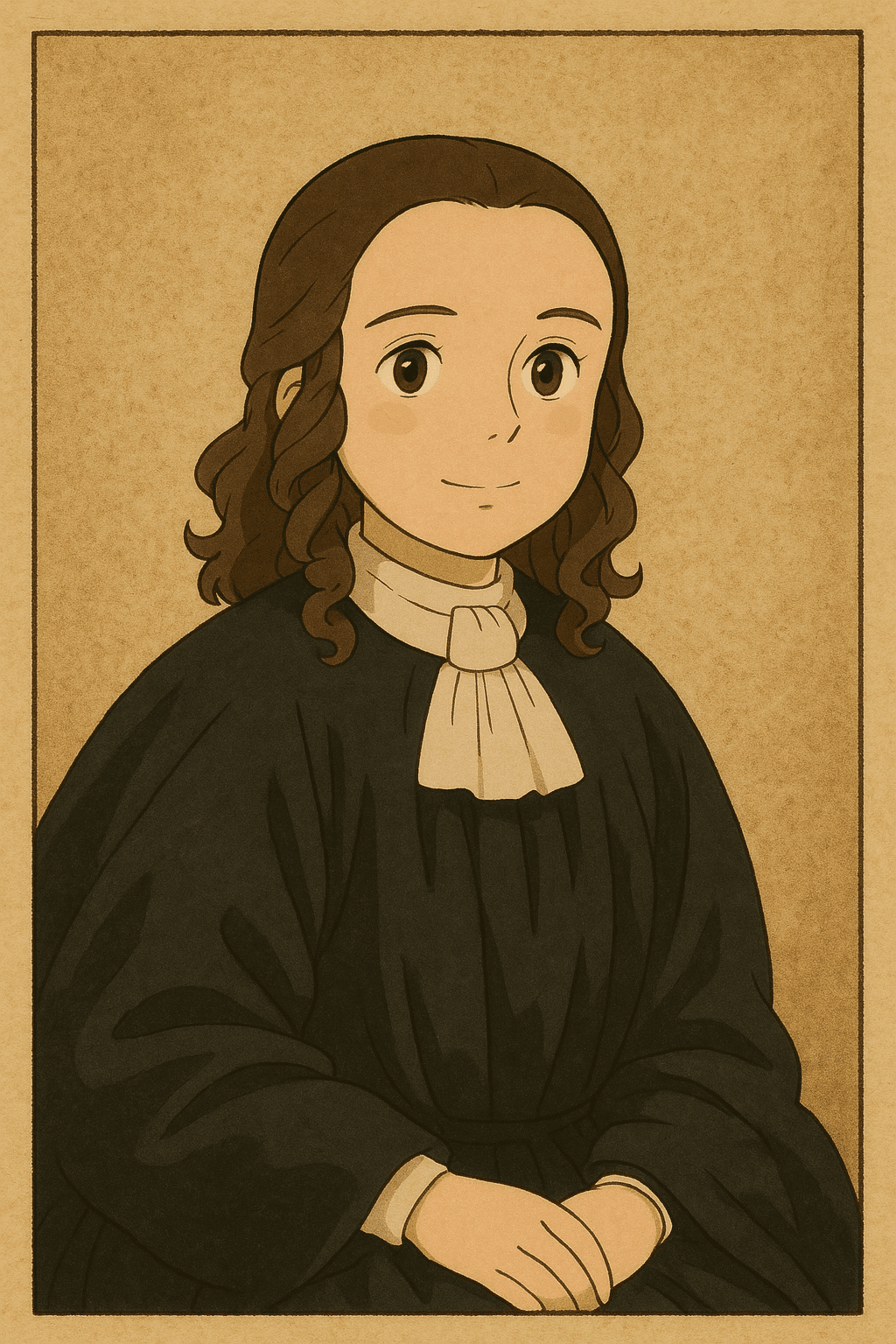
The clothing matched the claim. The Friend wore long dark robes, a broad-brimmed Quaker hat of the sort worn by men, a man's shirt with long sleeves, a man's neckcloth—but women's shoes, and loose hair in a style that resolved into neither convention. The effect was deliberate. The Friend was not dressing as a man. The Friend was not dressing as a woman. The Friend was dressing as someone who was neither, because the spirit that inhabited the body was neither, and to insist on a sex was to deny the resurrection.
This was not an eccentricity bolted onto a ministry. It was the ministry. The genderlessness was the theological claim. If God had sent a spirit to inhabit a vacated body, that spirit had no sex. To call the Friend "she" was to say the transformation had not happened. To call the Friend "he" was to say the same thing in a different direction. The only honest language was no language at all—or the language the Friend provided: I am that I am.
The biblical grounding was precise. Galatians 3:28—"There is neither male nor female, for you are all one in Christ Jesus." And Jeremiah 31:22—"The Lord has created a new thing on the earth." The Friend was not improvising. The Friend had read the texts and found the seams where the old categories gave way, and stepped through them.
The Preacher
The Friend began preaching immediately after the transformation and did not stop for over forty years.
The sermons were delivered without notes—long, compelling, built on scripture quoted entirely from memory. The Friend travelled through Rhode Island, Connecticut, Massachusetts, and eventually Pennsylvania, drawing large audiences of Quakers, Baptists, and the simply curious. Ezra Stiles, the president of Yale, attended a meeting in 1779 and described the Friend as "decent and graceful and grave." Others were less generous. A mob in Philadelphia threw stones and bricks at the boarding house where the Friend was staying. That was the cost of being visible and strange in Revolutionary-era America.
The theology was a synthesis of Quaker and New Light Baptist ideas, sharpened by the Friend's own convictions into something distinct:
God spoke directly to individuals. No intermediary clergy was needed. The Friend's own existence was proof of this—a spirit sent from God without any church's permission.
Salvation was available to all. The Friend rejected Calvinist predestination entirely. Anyone, regardless of sex, race, or station, could receive God's light. This was not a debating position. The Friend was an ardent abolitionist at a time when even most Quakers had not yet fully committed to that cause. Followers who held enslaved people were persuaded to free them. Manumission papers were witnessed by Black members of the congregation.
Celibacy was encouraged but not mandated. The Friend preached sexual abstinence as a spiritual ideal but accepted marriage as preferable to breaking that ideal outside of it.
The end times were imminent. The Friend's appearance was itself evidence—a spirit sent to prepare the faithful for the millennium.
The Society of Universal Friends was formally established on September 18, 1783. By the mid-1780s, the community numbered in the hundreds, drawn from across New England and Pennsylvania, and its most striking feature was not its theology but its sociology: the core of the movement was approximately forty-eight unmarried women who lived near or within the Friend's household, held exceptional spiritual authority, spoke at meetings, managed business affairs, and exercised a degree of autonomy that existed nowhere else in eighteenth-century America. Some adopted the surname "Friend" to mark their devotion. The faithful sisterhood, as they were called, were not followers standing behind a leader. They were the spine of the community.
The Frontier
By the late 1780s, the Universal Friends began planning what every radical sect in American history eventually plans: a city of their own.
They chose western New York—deep frontier, recently opened by the Sullivan-Clinton Campaign of 1779, which had destroyed Haudenosaunee villages and driven the Seneca and other nations from much of their homeland. In late 1788, a vanguard under Captain James Parker, a Continental Army officer turned convert, arrived and began clearing land. By March 1790, roughly 260 Universal Friends had made the journey, and their settlement became the largest non-Native community in western New York.
The land acquisition was a disaster. Parker had purchased from a consortium whose rights to sell were disputed by New York State, Massachusetts, and the reality that the territory was still Seneca land. Through a tangle of fraud, conflicting claims, and bad surveying, the Society received roughly 1,100 acres instead of the 14,000 they believed they had bought. When the Preemption Line was resurveyed in 1792, at least twenty-five homes ended up outside the granted area. Families were forced to repurchase their own land.
The Friend relocated around 1794 to a new settlement called Jerusalem, near what is now Penn Yan, surrounded by the households of the faithful sisterhood. The community built something real there: houses, farms, meetings, a life. It was not what they had been promised, but it was theirs.
In October 1794, something remarkable happened. The federal commissioner Timothy Pickering was in Canandaigua, negotiating with the Haudenosaunee Confederacy—over 1,500 delegates from the Six Nations assembled for talks that would produce the Treaty of Canandaigua, one of the most significant treaties in the history of American-Indigenous relations. The Friend was invited to attend. With Pickering's permission and through an interpreter, the Friend stood before the assembled officials and Iroquois chiefs and delivered a speech on the importance of peace and love. The chiefs received it well. A genderless preacher from Rhode Island, standing on someone else's stolen land, telling a room full of diplomats and dispossessed nations that peace was possible. The treaty was signed on November 11, 1794. It remains legally binding today.
The Mob
The trouble came from inside, and it came wearing familiar faces.
Sarah Richards had been the Friend's closest companion for nearly two decades, the manager of the household, the trustee of all property, the person who kept the practical machinery of the community running while the Friend preached. She died in 1793. Her death left a hole in the community's structure that no one could fill, and the people who had been waiting for an opening saw it immediately.
In 1796, Richards' daughter Eliza eloped with a man named Enoch Malin. Under the laws of the time, a husband controlled his wife's property. Enoch claimed ownership of everything Sarah had held in trust for the Friend—the land, the buildings, the material foundation of the Jerusalem settlement. He filed an ejectment lawsuit in 1799. It failed. So he simply began selling the Friend's land to outside buyers anyway, lot by lot, as though the court had never spoken.
Then the men who had once believed turned.
Judge William Potter had been one of the Friend's most devoted converts. He had brought nine of his thirteen children into the Society. His wife Alice had been so fervent that Ezra Stiles recorded her addressing the Friend as though omnipresent and calling the Friend "Messiah" in her prayers. Now Potter wanted out, and he did not want to leave quietly. He wanted to take the community apart.
James Parker was worse. He was the man the Friend had trusted to lead the settlement party, the Continental Army captain who had gone ahead into the wilderness to build the community's future. He was now an Ontario County magistrate, a man with legal authority, and he used it. Parker had received nearly half the land in the original grant, far more than his share, and the Friend's continued presence was an obstacle to his control of the rest.
In the fall of 1799, Potter and Parker began filing complaints. The charge was blasphemy—they claimed the Friend had asserted Christ-like authority. The charge was a weapon, not a conviction. They knew the Friend. They had sat in meetings for years. They had heard the Friend explicitly deny being Christ, many times, to many people. They did not care. They needed a legal instrument, and blasphemy was what they had.
On the night of September 17, 1799, Parker issued an arrest warrant. A mob of roughly thirty men came to the Friend's house in Jerusalem. They did not knock. They broke in. Thirty men, in the dark, forcing their way into the home of a person they had once called their spiritual guide, to drag that person to a cell. The faithful sisterhood, the women who had built their lives around the Friend's household, were there. They could do nothing but watch.
The blasphemy trial took place in June 1800, at the courthouse in Canandaigua. The case was dismissed. Not on the merits—on the law. Blasphemy was not a crime under New York statute. The judge threw it out. The dismissal has since been cited as an early and significant assertion of the separation of church and state in American legal history. Potter and Parker walked out of the courtroom with nothing.
But the property battles were not so easily won. They ground on for decades. Rachel Malin, who had replaced Sarah Richards as the Friend's closest companion, began suing Enoch Malin and the buyers he had sold to in 1811. The case dragged through the courts for seventeen years. The final judgment came in 1828—in the Friend's favour, nine years after the Friend's death. The Friend never saw justice. The community never recovered the money the fight had cost. The men who had broken down the door and filed the false charges lived out their lives in the houses they had taken.
The End
The Friend's health had been declining for years. By 1816, a painful edema, probably congestive heart failure, had set in. The Friend continued to receive visitors, continued to preach, continued to refuse to be anyone other than who the fever had made.
A final regular sermon was delivered in November 1818. The very last sermon, the last time the Friend stood and spoke to a congregation, was at the funeral of sister Patience, in April 1819.
The Public Universal Friend died on July 1, 1819.
In accordance with the Friend's wishes, no funeral was held. Only a regular meeting. The body was placed in a coffin with an oval glass window set into the lid and interred in a thick stone vault in the cellar of the Friend's own house. It remained there for several years. Eventually the coffin was removed and buried in an unmarked grave, as the Friend had wanted. The precise location is not known.
The Society of Universal Friends continued for another generation or two, but without the Friend's living presence it could not sustain itself. By the 1860s, it was gone.
For nearly two centuries after that, the Friend was treated as a curiosity, a fraud, or a joke by historians who relied on hostile accounts written by the same people who had thrown stones and filed lawsuits. The fabricated stories, that the Friend had tried to walk on water, that the Friend had attempted to raise the dead, that the Friend was a scheming despot, were repeated until they calcified into received wisdom. It was not until modern scholars returned to the primary sources that the real person emerged from under the caricature: not a lunatic, not a con artist, but a preacher who saw something clearly, said it plainly, and spent forty-three years living by it in a world that never stopped trying to make that impossible.
Why They Are Honoured
The Public Universal Friend is a Holyman of Tianmu because the Friend did the simplest and hardest thing a person can do: refused to be what the world insisted on.
The world said: you are a woman, and this is what a woman is, and this is what a woman does. The Friend said: the person you are describing is dead. I am what God sent in their place, and what God sent has no sex. This was not a performance. It was not a phase. It was the organising principle of a life that lasted forty-three years after the fever, through decades of preaching, community-building, legal battles, mob violence, betrayal by friends, and the slow grinding of a body that would not last forever. The Friend never wavered. Not once. When the men with warrants came, the answer was the same. When the men with stones came, the answer was the same. I am that I am.
The Friend was an abolitionist before abolition was popular. The Friend gave women authority they held nowhere else in America. The Friend built a community on the frontier, settled it, held it together through fraud and lawsuits and the slow erosion of loyalty, and stood before a room of diplomats and chiefs and preached peace on land that had been taken by force. The Friend did all of this without a name—without, in the most literal sense, a self to defend. That is what made the Friend dangerous, and that is what made the Friend holy.
The theology was simple. God speaks to anyone who listens. Salvation is for everyone. The end is coming, so live as though it matters how you treat people. There was nothing in the Friend's teaching that a Quaker grandmother would not have recognised. The radical part was not what the Friend said. It was what the Friend was—a person who had died and come back as something the world had no category for, and who refused, for forty-three years, to let the world build one.
We honour the Friend because the Friend was honest. Whatever happened in that sickroom in October 1776, a genuine mystical experience, a fever dream so powerful it reorganised a personality, a moment of clarity so complete that the old self could not survive it, the person who walked out of it lived with absolute consistency for the rest of their life. The Friend did not cheat, did not hedge, did not quietly go back to being Jemima when it would have been easier. The Friend chose the harder name, the harder clothes, the harder life, and kept choosing it every single day until the body gave out.
A holy life is not a comfortable life. It is a life lived in accordance with what you have seen, regardless of what it costs. The Friend saw something in that fever, something about the self, about the body, about what a person is when the old categories fall away, and spent a lifetime being faithful to it. That is enough. That is what a Holyman is.
I am not accountable to mortals. I am that I am.