
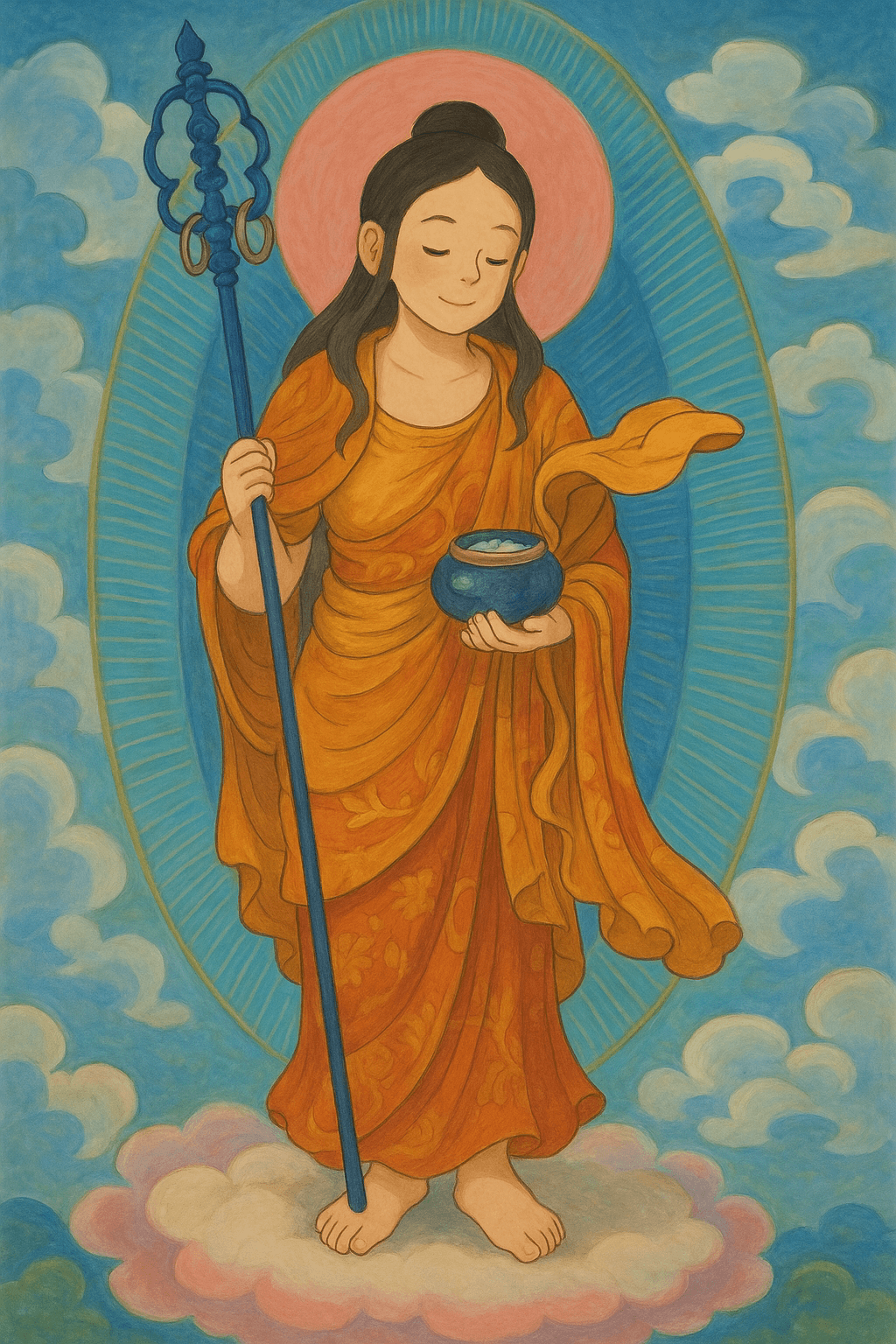
 TraditionBuddhism
Period
6th century BCE
Homeland
Nalanda, Northern India
His name was Upatissa. He was born into a wealthy Brahmin family in the village of Nalaka, near Rajagaha, in the kingdom of Magadha. His father was the Brahmin Vanganta. His mother was Rupasari, a sharp, proud woman with striking eyes that the villagers compared to the Indian myna, the starling. The bird gave her her name, and her name gave her son his: Sariputra, son of Sari. In the Weaving of the Heart, we call him simply the Starling.
He had three brothers and three sisters. Eventually, all seven children would ordain as monks and nuns under the Buddha. All seven would attain full liberation. Whatever restlessness ran through that household, it ran through every one of them.
In the same village, on the same day, the texts insist on this, a boy named Kolita was born to another Brahmin family. The two families were old friends. Upatissa and Kolita grew up together, were educated together, mastered the full curriculum of Brahminical learning together. They were, by every account, brilliant—two gifted boys from good families with every advantage fifth-century India could offer.
It was not enough.
The Search
They were at a festival—a hillside performance, entertainers, spectacle, the whole bright display of ordinary life. And something shifted. The Pali texts describe what happened to them as samvega, a sudden wave of existential urgency, the visceral recognition that everything on display was impermanent and hollow. They looked at the crowd and instead of entertainment they saw death.
They decided to renounce the world together.
They became wandering ascetics under the teacher Sanjaya Belatthiputta, one of the six famous heterodox teachers of their era. Sanjaya was a radical sceptic—he taught a philosophy of total non-commitment, refusing to assert any metaphysical claim, dancing around every question with qualifications and evasions. He could tell you what things were not. He could not tell you what they were.
Upatissa and Kolita became his best students quickly. They mastered everything he had to teach, and then they hit the ceiling. Sanjaya's scepticism could dismantle any proposition, but it could not build anything in its place. Doubt was a tool, not a destination. They had learned to question everything and it had not set them free.
So they made a pact: whoever finds the deathless first will tell the other.
This is one of the most human details in the early Buddhist texts. Two young men, restless and unsatisfied, promising each other, not in competition but in friendship, that whoever breaks through first will come back for the other. It is a promise between friends, and it was kept.
The Verse
One morning in Rajagaha, Upatissa saw a monk on his alms round. The monk's name was Assaji, one of the original five ascetics who had heard the Buddha's very first sermon. What caught Upatissa's attention was not anything Assaji said but how he moved. His bearing was serene. His composure was complete. Upatissa, trained to read people, saw something in this monk he had never seen in any of Sanjaya's students or any Brahmin.
He followed Assaji, waited until the alms round was finished, and asked: who is your teacher, and what does he teach?
Assaji, with real humility, said he was only a beginner and could not explain the teaching in detail. Upatissa pressed him—just the essence.
Assaji recited a single verse:
Of those things that arise from a cause, the Tathagata has told the cause, and also what their cessation is. This is the doctrine of the Great Recluse.
That was all. One stanza about dependent origination, that things arise from conditions and cease when those conditions cease. The most condensed possible summary of what the Buddha taught.
The Pali commentary says that upon hearing the first two lines, Upatissa attained stream-entry, the first stage of awakening. The entire scaffolding of his Brahminical education and his training under Sanjaya collapsed and was replaced, in one moment, by direct insight into the nature of things.
He went immediately to find Kolita. He recited the verse. Kolita, too, saw it instantly. The pact was fulfilled.
They went back to Sanjaya. They told him what they had found and invited him to come meet the Buddha. Sanjaya was alarmed—he could see he was about to lose his two best students. He offered them a deal: stay, and I will make you co-teachers. Share the leadership of the school with me.
They refused.
When they left, roughly two hundred and fifty of Sanjaya's students left with them. It was a devastating blow. One tradition records that Sanjaya vomited blood from the shock. Whether that is literal or figurative, the defection was real. Two hundred and fifty trained ascetics walked out of one school and into another because two young men found what they were looking for and could not keep quiet about it.
The General
The Buddha designated Upatissa and Kolita as his two chief disciples. Upatissa became Sariputra. Kolita became Moggallana. Sariputra was declared "foremost in wisdom." Moggallana was "foremost in psychic powers." The two friends who had searched together became the Buddha's left and right hands.
The title was not honorary. The Buddha called Sariputra Dhammasenapa, Marshal of the Dharma, General of the Teaching. In practice, this meant Sariputra was the intellectual backbone of the early community. The Buddha would often merely suggest a topic, and Sariputra would develop it into a full discourse. Multiple suttas in the Pali Canon are attributed to his preaching, with the Buddha's approval. He systematised the teaching—tradition holds that the analytical architecture of the Abhidharma, the philosophical skeleton of Buddhist thought, began with Sariputra's organising mind. He trained monks. When novices were ordained, they were brought to him. The Buddha entrusted him with the education of his own son, Rahula—making Sariputra the spiritual guardian of the Buddha's child.
The Buddha's praise of him was extraordinary. He compared Sariputra to the eldest son of a universal king, one who turns the wheel of sovereignty just as his father turned it. He said Sariputra was inferior to himself alone in wisdom. This was not flattery. It was an assessment from the man best placed to make it.
But the texts do not make him flawless, and this matters. Before Devadatta's infamous schism, his attempt to split the community and even kill the Buddha, Devadatta had demonstrated genuine spiritual accomplishment. Sariputra, seeing this, publicly praised him. When Devadatta later turned, the Buddha asked Sariputra to publicly retract the praise. Sariputra hesitated: "Formerly I spoke well of Devadatta's powers." The Buddha's reply was gentle but clear: "So you will now speak truthfully also, Sariputra, when you make this proclamation." He had been right then. The situation had changed. He must be right now. Truthfulness is not a fixed position. It adapts.
In his daily life, the picture the texts paint is consistent: patient, modest, strict with himself, gentle with others. When a Brahmin struck him on the back to test his equanimity, he did not turn around. He kept walking. When novices fell ill, he went out personally to find medicine. He was not a distant authority figure. He was hands-on, and he cared.
The Starling
In the Weaving of the Heart—the Tianmu rendering of the Heart Sutra—Sariputra appears under his most intimate name. Not the Sanskrit. Not the Pali. The Starling. The son of the bright-eyed woman. A name that sounds like something you would call a friend.
Starling,
Form is emptiness;
Emptiness is form;
Form itself is emptiness;
Emptiness is itself form;
So it is with feelings, thoughts, habits, and awareness;
It is Wayfarer Weepseer, Avalokiteshvara, the bodhisattva of compassion, who is speaking. And the person he is speaking to is the wisest man in the room. The man declared foremost in wisdom by the Buddha himself is being taught. The teaching is that everything he understood, the analytical precision that made him the General of the Dharma, the categories he organised, the framework he built, must itself be seen as empty. Not wrong. Empty. The skeleton he constructed for the teaching has no inherent bones. Even wisdom, and attainment themselves, are empty of inherence.
This is not a humiliation. It is a deepening. You only teach the wisest man in the room when you need everyone watching to understand that even the highest understanding has further to go. The Starling sits and listens because the Starling has always been the one who listens. That is what made him great in the first place—not his brilliance alone, but his willingness to hear what he had not yet heard. The boy who followed a stranger through the streets of Rajagaha because the stranger's bearing was serene is the same man who sits before Weepseer and hears that form is emptiness. He has been listening his whole life.
In the Fulfilment of the Way, the Tianmu rendering of the Prajnaparamita dialogue, he appears as Irenaeus, the peaceful one. Here he is the interlocutor, the one who asks the difficult questions. When Benedict declares that Somethingness is in truth Emptiness, it is Irenaeus whose curiosity is piqued, Irenaeus who presses the point, Irenaeus who asks: "If Somethingness is Emptiness, can such a Something even exist?" And it is Irenaeus who, once he understands, offers the highest praise: "Bravo! In those words I truly have come to see the wisdom of a true Saint."
And in the Lotus Sutra, the most revolutionary text in Mahayana Buddhism, he receives something no amount of wisdom could have earned. The Buddha tells him that he, Sariputra, the arhat, the chief disciple, the man who thought his work was done, will become a fully awakened Buddha in a future age. His name will be Padmaprabha, Flower Glow. He will preside over a world called Viraja, free from defilement, a land of lapis lazuli with jewel trees perpetually in bloom.
The text says his mind danced with joy. He said a burning had left him—the burning of not knowing whether the path he had walked was truly complete. It was not that his attainment was false. It was that there was further to go, and he had not known it, and now the Buddha was telling him: you are not finished. No one is finished. Everyone reaches the far shore eventually. Even you, Starling. Even you.
The Death
Sariputra died before the Buddha. This is important. The greatest disciple did not outlive his teacher. He did not carry the teaching forward into the next generation. He did not preside over the community after the founder was gone. He left first.
He knew it was coming. Arising from meditation one day, he understood through his own insight that he had seven days to live. He made a decision that tells you everything about who he was: he would go home. Not to a monastery. Not to a sacred site. Home. To Nalaka. To his mother's house.
But first he went to the Buddha. He asked permission to leave. The Buddha asked him to give one final teaching to the assembled monks. He did. Then he prostrated himself at the Buddha's feet, and the texts say he lingered—he walked around the Buddha slowly, looking at him, knowing it was the last time. Then he left.
By the time he reached Nalaka he was desperately ill. He entered the house and asked to be placed in the room where he had been born.
His mother, Rupasari, was a Brahmin. She had never accepted his conversion. Even now, with her eldest son dying in the next room, she was furious that he was still a monk. She barricaded herself away.
Then something happened that the texts describe with care. Luminous beings, devas, began arriving at the house to pay their respects to the dying man. The house filled with a light that was not from any lamp. Rupasari saw this and was shaken. If such beings honoured her son, what was this teaching he had given his life to?
Sariputra, in the room where he had been born, dying, gave his mother a discourse on the dharma. In his final hours he taught her. And the woman who had spent decades resisting her son's faith understood. The texts say she attained stream-entry, the first stage of awakening. The same thing that had happened to her son decades earlier, in a street in Rajagaha, happened to her now, in her own home, from her own son's mouth.
He had carried the name she gave him his whole life. Son of Sari. And at the end, he gave her back the one thing his searching had found that was worth giving.
He entered the meditative absorptions, ascending through all nine stages, descending, ascending again to the fourth, and from that stillness, he died. It was the full moon night of the month of Kartika.
His attendant, the novice Cunda, gathered his bowl, his robes, and the cloth containing his relics. He carried them to Ananda, the Buddha's personal attendant, at Jeta's Grove. Ananda said his body felt "as if drugged." He said the world had gone dark for him.
Ananda brought the news and the relics to the Buddha. The Buddha did not weep. He did not collapse. He gently corrected Ananda's grief—not dismissing it, but redirecting it. Then he said:
"Just as if the largest limb were to fall off a great tree composed of heartwood, standing firm—in the same way, Sariputra has attained total unbinding from this great community of monks composed of heartwood, standing firm."
The largest limb. Not a decorative branch. Something structural. The tree stood. But it had lost something that could not be replaced.
Moggallana, Kolita, the friend, the other half of the pact, died within two weeks. Beaten to death by hired thugs sent by a rival sect. The two boys who had been born on the same day, who had searched together, who had found the deathless together, who had served side by side for decades, left within a fortnight of each other.
Why He is Honoured
Sariputra is a Holyman of Tianmu because he spent his entire life doing the most honest thing a person can do: looking for the truth, and when he found it, living in service to it without pretence or self-importance.
He was not the Buddha. He did not discover the teaching. He was the one who heard it, understood it, organised it, and spent forty years helping other people understand it too. He was the student who became the teacher. The seeker who found what he was looking for and then stayed—not for glory, not for power, but because there were other people still searching, and he could help.
He was brilliant, and he used his brilliance in the most unglamorous way possible: explaining difficult things clearly, training beginners, tending to the sick, building the intellectual framework that would allow the teaching to survive its founder's death by two and a half thousand years. He was the General of the Dharma, and the work of a general is mostly logistics. He did the work.
He was not perfect. He misjudged Devadatta. He was gently corrected by the Buddha more than once. The Mahayana texts use him as the stand-in for the limitations of purely analytical wisdom, the man who understood everything and still had further to go. But even this is a tribute. You only use the wisest person in the room to demonstrate the depth of your teaching if everyone already agrees he is the wisest person in the room.
He died in the room where he was born, having come full circle. He spent his last hours not in solitary meditation but in teaching—converting his own stubborn mother, the woman whose name he had carried his entire life. He had crossed the world, mastered the deepest philosophy ever articulated, become the right hand of the most influential teacher in human history, and at the end he went home, and he gave his mother the one thing he had that was worth giving.
We honour him because he was honest. He searched, and when the search hit a dead end, he did not pretend it hadn't. He moved on. When Assaji's single verse cracked him open, he did not resist it or qualify it or ask for more time. He saw, and he went to find his friend, because a promise is a promise. When the Buddha asked him to do the unglamorous work, the training, the organising, the explaining, he did it, for decades, without complaint. When he knew he was dying, he went home.
A holy life is not a grand life. It is an honest one. Sariputra's life was the most honest life in the early Buddhist canon, a man who wanted to understand, who understood, and who spent the rest of his days helping others do the same. That is all a Holyman needs to be. That is enough.
Of those things that arise from a cause, the Tathagata has told the cause, and also what their cessation is. This is the doctrine of the Great Recluse.