
 TraditionBuddhism
Period
6th century BCE
Homeland
Shravasti, Northern India
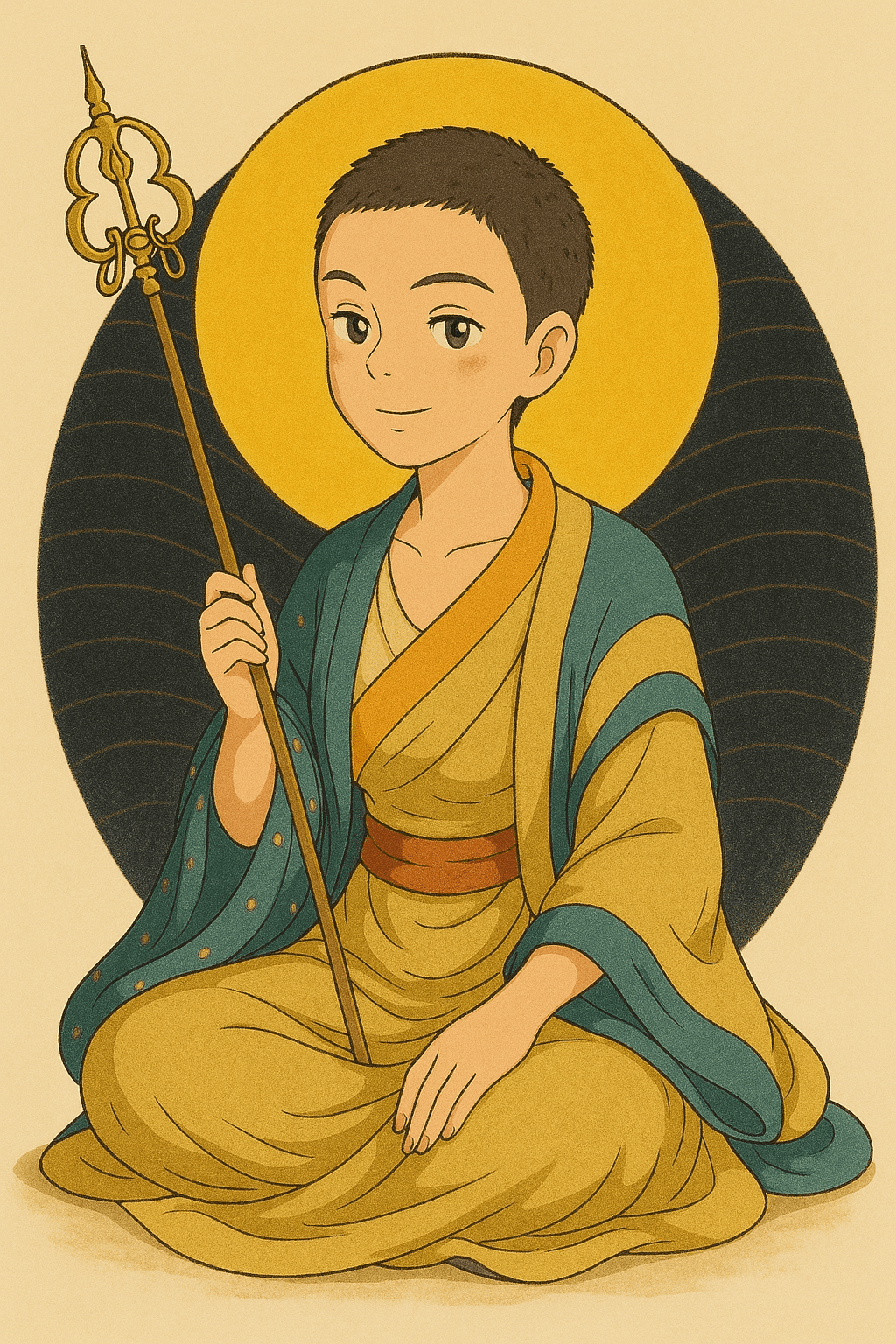
His name was Subhuti. He was born into one of the wealthiest families in Savatthi, the capital of the kingdom of Kosala. His father was the merchant Sumana. His brother, or his uncle depending on which tradition you follow, was Anathapindika, the most famous lay patron in Buddhist history, the man who purchased Jeta's Grove for the Buddha by covering its grounds in gold coins. Subhuti grew up in the household that would become the material foundation of the early sangha. He was born rich, connected, and comfortable.
The northern tradition preserves the story of his birth. On the day he arrived, the storerooms emptied. Every piece of gold, every piece of silver—gone. The family panicked and consulted a seer, who told them it was a good omen. Seven days later, the wealth reappeared. The child received several names on account of this: Born Empty, for the disappearing; Good and Auspicious, for the seer's reassurance; Good Manifestation, for the return. Buddhist commentators have read this story as a sign of his spiritual destiny ever since—the man who would understand emptiness more deeply than anyone else was announced at birth by an experience of it. Everything vanished, and then it came back, and nothing had actually changed.
The other thing the texts preserve about the young Subhuti is less flattering. He had a terrible temper. He was sharp, intelligent, gifted—and angry. Irritable and contentious, difficult to be around. The gentle monk who would one day sit so still that flowers fell from the sky began as a young man who could not control his rage.
He was present at the dedication of Jeta's Grove, when the Buddha came to the monastery his family had paid for. He heard the Buddha teach. Something in the teaching reached him, and he ordained on the spot. After ordination, he withdrew to the forest and practised loving-kindness meditation, metta, until the anger that had defined him was completely gone. Not suppressed. Not managed. Eliminated. The man who could not stop fighting became the man who could not be provoked. The Buddha would later declare him foremost among those who dwell in peace.
That transformation, from rage to stillness, from contention to transparency, was not a miracle. It was work. It took years. And it was the foundation of everything that followed.
The Alms
The Buddha gave Subhuti two titles, and neither was the one history would remember him for:
The first: foremost among those who dwell in peace. This meant what it sounds like. He had eliminated the internal agitation, the ego-defence, the need to be right, the need to be recognised, that creates conflict between people. He moved through the world without friction because there was, in a practical sense, nothing left in him to be offended or to give offence. This was not passivity. This was the absence of the machinery that produces argument.
The second: foremost among those worthy of gifts. This is the stranger title, and the more revealing one. It meant that of all the Buddha's disciples, offerings given to Subhuti generated the greatest benefit for the person giving them. The reason was specific: before accepting food at each household on his alms round, Subhuti would enter into meditative absorption and suffuse the donor with loving-kindness. He did not merely receive the meal. He transformed the act of giving. The donor's mind was purified and elevated by his meditation before the food even left their hands. He sanctified generosity itself.
There is a story about Subhuti and rain. When he travelled to Rajagaha, King Bimbisara heard of his arrival and promised to build him a shelter. Then the king forgot. Subhuti was left to meditate in the open air, and the texts say that for as long as he sat unsheltered, the rain refused to fall. A drought settled over the region. When someone finally built him a simple leaf hut, the rain came immediately. His own verse in the Theragatha, the very first poem in that entire collection, refers to this: my hut is well-thatched, pleasant, sheltered from the wind; my mind is well-concentrated and released; so rain, sky, as you please.
Whether the drought was literal or figurative, the verse works on two levels. The well-thatched hut is his realisation. The invitation to rain is fearlessness. He has nothing left to protect from the weather.
The Flowers
This is the story that defines him, and it is very short.
Subhuti was sitting under a tree. He was not teaching. He was not meditating on any particular subject. He was simply sitting in a state of emptiness—not thinking about emptiness, not contemplating it, not framing it in words. Abiding in it. The way water abides in a river.
Flowers began to fall around him.
The gods whispered to him that they were praising his discourse on emptiness.
Subhuti replied that he had not spoken of emptiness.
The gods said: you have not spoken of emptiness, and we have not heard emptiness. This non-speaking and non-hearing—this is true emptiness.
The flowers continued to fall.
That is the whole story. A man sits under a tree and does not speak, and the silence is so complete that it becomes the teaching. The deepest understanding of emptiness is not a lecture about emptiness. It is the direct, wordless, non-conceptual fact of sitting in it without grasping. Subhuti was not performing anything. He was not demonstrating anything. He was simply there, and the thereness was enough.
The Diamond
The Diamond Sutra is one of the most important texts in Mahayana Buddhism. It has been recited, copied, chanted, and studied continuously for nearly two thousand years. The oldest dated printed book in the world, a Chinese scroll from 868 CE, is a copy of the Diamond Sutra. The text that generated it is a conversation between the Buddha and Subhuti.
The setting is almost aggressively ordinary. The Buddha has finished his alms round in Savatthi. He has eaten his meal, washed his feet, and sat down. There is no cosmic stage, no mountaintop, no great assembly of celestial beings. A man finishes lunch and sits. And then Subhuti rises and asks the question that produces the entire sutra:
"World-Honoured One, if a good man or good woman has resolved to attain supreme enlightenment, how should they abide, and how should they subdue their mind?"
This is not an abstract philosophical inquiry. It is the most practical question a seeker can ask: I have committed to this. Now what do I actually do? How should I hold my mind? The Buddha's answer unfolds across the entire text—a sustained, relentless dismantling of every concept the mind tries to stand on. Merit is empty. Teaching is empty. The dharma is empty. The Buddha himself is empty. Everything the mind reaches for is gently, firmly removed from beneath it, until there is nothing left to grasp and the grasping itself falls away.
Subhuti is the one who asks because he is the one who can receive the answer without flinching. This is not an introductory teaching. It requires someone who already understands emptiness deeply enough to follow the Buddha into territory where every handhold is removed. The quiet man who sat under a tree and said nothing was the only one in the room who could hear this without breaking.
And then he breaks anyway. After hearing the teaching, Subhuti weeps. He wipes his eyes and says: "How rare, World-Honoured One. The Buddha has spoken a sutra so profound. Since I attained the wisdom eye, I have never heard a teaching like this."
He is not weeping from confusion or grief. He is weeping because something has been understood that cannot be contained in understanding. He has known emptiness for years. He has sat in it, breathed in it, been praised by gods for it. But in this moment the teaching lands at a depth he has not previously reached. Even his understanding of emptiness was a kind of holding, and now even that is released. The tears are the body's response to a truth the mind alone cannot carry.
The Bowl
The Vimalakirti Sutra tells a story about Subhuti that he would probably rather not have remembered:
Vimalakirti was a layman, a wealthy householder in Vaishali, not a monk, who had attained an understanding so deep that none of the Buddha's disciples could match him in debate. When Vimalakirti fell ill, the Buddha asked each of his senior disciples to go visit him. One by one, they refused. Each had been humiliated by Vimalakirti before and did not want to go back.
When the Buddha asked Subhuti, he declined. He explained what had happened the last time. He had gone to Vimalakirti's house on his alms round, bowl in hand. Vimalakirti took the bowl, filled it with excellent food, and then, before handing it back, delivered a teaching so thorough that it took Subhuti apart.
Vimalakirti told him: if you can see all foods as equal, you can see all things as equal. To be truly worthy of receiving alms, you must see through the distinction between giver and receiver, between merit and non-merit, between the act of giving and the act of taking. All things in the world are phantoms. All words and pronouncements are no different from phantom forms. There is no giver. There is no gift. There is no one receiving.
Subhuti wanted to leave. Vimalakirti told him to pick up his bowl and not be afraid.
The teaching was not cruel, but it was complete. A layman—not even a monk, not even ordained—had shown the foremost disciple in emptiness that his understanding still had edges he could not see. Two hundred heavenly beings attained purification from hearing the exchange. Subhuti himself acknowledged afterward that he lacked the eloquence to teach what Vimalakirti had shown him.
The man who understood emptiness was shown that his understanding was still a kind of possession. The bowl in his hand, the simplest, most ordinary object a monk carries, became the site of his deepest lesson. He was holding it, and Vimalakirti asked him to see that even the holding was empty.
Why He is Honoured
Subhuti is a Holyman of Tianmu because he lived the quietest and most transparent life in the early Buddhist community, and the transparency itself became the teaching.
He did not have the sharpest mind. That was Sariputra. He did not have the most impressive powers. That was Moggallana. He was not the most disciplined ascetic, or the most devoted attendant, or the most charismatic speaker. He was the one who sat under a tree and said nothing, and the nothing was so complete that flowers fell from the sky.
He began with anger and ended in stillness. He practised loving-kindness until there was no one left inside to be unkind. He sanctified the act of giving by bringing his whole being into the moment of receiving. He asked the question that generated one of the most important texts in human history, and when the answer came, he wept—not because he did not understand, but because he finally did.
He was humbled by a layman with a rice bowl. He was taught by the silence of his own sitting. He was chosen to speak on behalf of the Buddha in the Prajnaparamita literature because his mind had become so transparent that the teaching could pass through him without distortion—the way light passes through clear water.
We honour him because he shows what emptiness looks like when it is not a philosophy but a life. Not a concept to be debated but a way of being in the world—without friction, without grasping, without the need to be anything other than what he was. A man sitting under a tree. Flowers falling. No teaching given, and none heard, and that was the teaching.
A holy life does not need to be loud. It does not need to be dramatic. It can be a man who started angry and became gentle, who gave more by receiving than most people give by giving, who wept once because the truth was larger than he thought, and who sat in silence while the gods praised what he did not say.
My hut is well-thatched, pleasant, sheltered from the wind; my mind is well-concentrated and released. So rain, sky, as you please.