 TraditionBuddhism
Period
~563 – ~483 BCE
Homeland
Shakya Kingdom, Northern India
He touched the earth, and the mare broke.
Everything else—the palace, the renunciation, the six years of starvation, the forty-five years of teaching, the sutras, the sangha, the unbroken lineage that stretches from Vulture Peak to this very page—everything else is commentary on that one gesture. A man sat under a tree and was assailed by the totality of delusion, and he reached down and placed his hand on the ground, and the ground answered, and the delusion dissolved like fog in the light of an ordinary morning.
That is the whole teaching. The rest is how he got there and what he did with it afterward.
He was the most sheltered man in the world.
Siddhartha Gautama was born around 563 BCE into the Shakya clan, a warrior-aristocratic people whose territory straddled the foothills of the Himalayas in what is now southern Nepal. His father, King Suddhodana, received a prophecy at the boy's birth: the child would become either a universal monarch or a supreme spiritual teacher. Suddhodana wanted a monarch. He did not want a saint.
So he built a cage of gold. Three palaces, one for each season. Lotus pools, dancing girls, the finest food, the most beautiful gardens. Every form of pleasure and comfort a human being could desire, arranged so perfectly that the young prince would never encounter anything unpleasant. No old age. No sickness. No death. No sorrow. For twenty-nine years, Siddhartha lived inside this paradise, married to the beautiful Yasodhara, father to a son named Rahula, a name that means "fetter."
He named his own child "fetter." Even before the vision came, something in him already knew.
The Four Sights
Then the cage cracked. On four excursions beyond the palace walls, Siddhartha encountered in succession: an old man bent and trembling with age, a person wracked by disease, a corpse being carried to the cremation ground, and a wandering ascetic sitting in meditation beneath a tree.
The first three were Doom. Old age, sickness, death—the three faces of impermanence, the wheel that turns for every living being, the law that Suddhodana's golden cage had been built specifically to hide. No palace can keep Doom out. No wall is high enough. Siddhartha looked at the old man's shaking hands and understood in a single glance what his father had spent twenty-nine years trying to prevent him from understanding: that everything he loved was going to end.
The fourth sight was the answer. Not a god's answer, not a philosophy, not a revelation from on high—just a man sitting quietly under a tree, with nothing, needing nothing, at peace. And Siddhartha understood that there was a way through.
Dhammapada 153–154: "Through many a birth in samsara have I wandered in vain, seeking the builder of this house. Repeated birth is suffering! O house-builder, you are seen! You will not build this house again. For your rafters are broken and your ridgepole is shattered. My mind has reached the Unconditioned; I have attained the destruction of craving."
That night, he looked upon his sleeping wife and infant son for the last time. He left the palace, cut his hair, discarded his royal garments, and walked into the forest with nothing but a beggar's robe.
This is Awakening. The first crack. The moment the torrent of ordinary life is interrupted by the sudden, annihilating recognition that something is deeply wrong—and that somewhere, beneath all the wrongness, there is a ground that is not wrong.
The Search
He went looking for the ground.
He studied under Alara Kalama, who taught him to attain the sphere of nothingness, a state of meditative absorption so refined that all perception of form and sensation disappeared. Siddhartha mastered it rapidly. Kalama asked him to take over the school. But Siddhartha knew this was not it. A void is not the ground. Emptiness without insight is just another room in the cage.
He studied under Uddaka Ramaputta, who taught him the sphere of neither perception nor non-perception, an even subtler state, the very edge of conscious experience, where awareness and non-awareness become indistinguishable. Siddhartha mastered this too. And again, he knew: this was not it. The furthest reaches of Heaven—the most refined states of pure consciousness—are still states. They arise and they pass away. They are still compounded. They are still within the Manifold.
He joined five ascetics and spent six years in extreme mortification. He fasted until his ribs jutted through his skin, until his spine could be felt through his stomach, until he was a skeleton wrapped in parchment. He pushed the body to its absolute limit, testing the ancient hypothesis that enlightenment lay in the rejection of the flesh, in the conquest of Hell through pure Will.
And he discovered: it does not. The extreme of asceticism is as much a cage as the extreme of luxury. One is a cage of gold and the other is a cage of iron, but both are cages. Both are extremes. Neither is the ground.
He accepted a bowl of rice from a village woman named Sujata. He ate. His five companions abandoned him in disgust, convinced he had given up the path. He was alone.
And alone, with nothing left to try, having exhausted every method available in the spiritual landscape of sixth-century India—the highest meditations, the most brutal asceticism, the most refined philosophies—he sat down under a pipal tree near the town of Bodh Gaya, crossed his legs, and made a vow: he would not rise until he had found the answer.
The Mare
Dune, Litany Against Fear: "I must not fear. Fear is the mind-killer. Fear is the little-death that brings total obliteration. I will face my fear. I will permit it to pass over me and through me. And when it has gone past, I will turn the inner eye to see its path. Where the fear has gone there will be nothing. Only I will remain."
Then Mara came.
The word mara comes from the same Indo-European root as "mare"—the Old English mære, the suffocating spirit that sits upon sleepers, the source of our word "nightmare." In Tianmu, mare is outsideness itself: the ur-fear, the lord of the material realm, the totality of unknowing and delusion that keeps consciousness trapped in the cycle of craving and aversion. Daymare, Nightmare, and Sight, the three outer Ghosts beyond Muse's threshold, are all faces of the mare. Doom himself is "close to Mara, or Mare." The mare is the deepest thing in the universe that is not the Mother. It is everything that stands between you and the ground.
Mara sent his three daughters: Desire, Discontent, and Attachment. They danced before Siddhartha in every form that the human mind finds beautiful or compelling. He did not move.
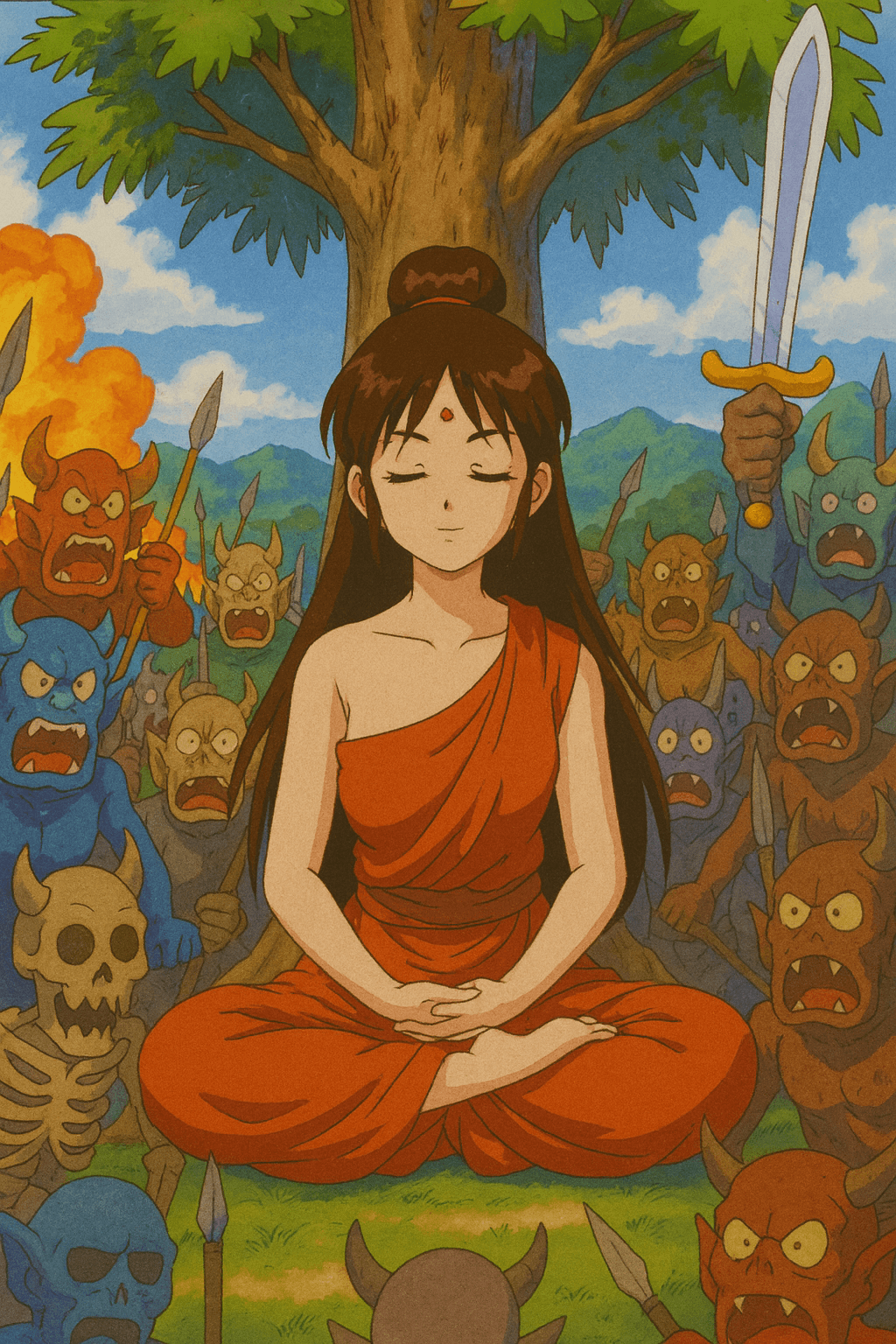
Mara sent his armies: demons with flaming arrows, storms of wind and darkness, the accumulated terrors of every nightmare the unconscious mind has ever conjured. They assailed Siddhartha from every direction. He did not move.
Then Mara played his final card—the subtlest and most devastating weapon in the arsenal of delusion. He challenged Siddhartha's right to be there at all. "Who are you," Mara said, "to sit in this seat? Who witnesses your worth?"
The question behind every moment of self-doubt, every whisper of impostor syndrome, every hesitation before the leap. Who do you think you are? The mare does not merely frighten. At its deepest, it denies. It says: you are not enough. You do not belong here. You have no right to the ground beneath you.
Siddhartha did not argue. He did not cite his lineage, his merit, his years of practice. He did not invoke a god. He simply reached down with his right hand and touched the earth.
The earth trembled. Freedom herself—the ground, the middle realm, the convergence of all things into the living, breathing fact of being here—answered. She confirmed him. Not his identity, not his achievements, not his spiritual credentials. She confirmed the only thing that needed confirming: that he was here. That the ground was here. That reality was here. And against that simple, absolute, unshakeable truth—the truth of a hand on soil—every illusion Mara had ever conjured dissolved into nothing.
The mare broke.
Bardo Thodol: "O nobly born, when thy body and mind were separating, thou must have experienced a glimpse of the pure truth—subtle, sparkling, bright, dazzling, glorious, and radiantly awesome... Be not daunted thereby, nor terrified, nor awed. That is the radiance of thine own true nature. Recognize it."
No Doomsayer before him had done this. The Shaman discovered duality but did not resolve it. Manu saved civilisation but did not illuminate it. Akhenaten glimpsed the Mother but could not hold the vision without destroying the Manifold. Siddhartha sat with the totality of delusion—every form of the mare, from the crudest terror to the subtlest doubt—and saw through all of it. Completely. The first human being in history to fully defeat the mare. Not by fighting it, not by fleeing it, not by transcending it into some higher realm, but by touching the ground. By being exactly where he was. By refusing to be anywhere else.
This is why he is the Buddha. This is what "awake" means. Not lifted above reality but settled into it so completely that no illusion can gain purchase.
What He Saw
In the three watches of the night, as the stars turned overhead, the newly awakened one perceived the structure of reality.
He saw dependent origination, pratītyasamutpāda, the recognition that nothing exists independently, that all things arise in dependence on causes and conditions, that the entire Manifold is a web of mutual arising in which every thread depends on every other thread. This is Yarn—the tapestry of causality that Tianmu describes—perceived with absolute clarity by a man sitting under a tree.
He saw the Four Noble Truths. That life is pervaded by dukkha, unsatisfactoriness, the inherent incompleteness of conditioned existence. That the cause of dukkha is tanhā, craving, Will trapped in Hell, desire without clarity, the blind grasping that mistake the finger for the moon. That dukkha can cease—that the craving can be extinguished, that the cycle can be broken. And that there is a path: the Noble Eightfold Path, a practical, livable, middle way between the extremes of indulgence and mortification. A path anyone can walk.
He saw anattā, no-self. That the thing we call "I" is not a fixed entity but a process, a flowing confluence of form, feeling, perception, mental formations, and consciousness, none of which is permanent, none of which is "me." This is Emptiness, śūnyatā, the recognition that everything is empty of inherent self-existence. Not nothing. Not nihilism. But the radical, liberating recognition that because nothing is fixed, everything is possible. Because nothing is yours, nothing can be taken from you. Because you are already empty, you are already free.
He saw impermanence, anicca. That all compounded things arise and pass away. That the wheel turns. That this is not cause for despair but for urgency, for gratitude, for the fierce and tender love that only arises when you truly know that everything you love will one day end. This is Doom, accepted fully, without the Gnostic's hatred or the nihilist's surrender. The Buddha's acceptance of impermanence is the purest expression of what Tianmu means when it says: accept your doom and find the freedom in the inevitability of it.
Heart Sutra: "Form is emptiness. Emptiness is form. Emptiness is not other than form; form is also not other than emptiness."
Diamond Sutra: "All conditioned phenomena are like a dream, an illusion, a bubble, a shadow, like dew or a flash of lightning; thus we shall perceive them."
And he saw the Middle Way—not as a compromise between extremes but as the only place where Enlightenment is possible. The middle is not lukewarm. The middle is where Freedom lives—the overlay of Heaven and Hell, the meeting of spirit and flesh, the ground on which the hand rests. Midland. The realm the Buddhists themselves call the most precious of all realms of existence, because it is the only one where the conditions for awakening are present—being neither too blissful to seek nor too agonised to reflect. The Buddha's Middle Way IS Tianmu's Midland, and Midland IS Freedom, and Freedom IS the earth he touched when the mare came. It is all the same teaching. It has always been the same teaching.
The Teaching
He rose from the tree and walked to the Deer Park at Sarnath, near Varanasi, where the five ascetics who had abandoned him were still practising their mortifications. He taught them the Four Noble Truths—the first turning of the wheel of dharma. The wheel of Doom, turned now not by catastrophe but by understanding.
They understood. They attained liberation. The sangha, the community of practitioners, was born.
For forty-five years, the Buddha walked the Gangetic plain and taught. He taught kings and beggars, Brahmins and outcasts, men and women, the learned and the illiterate. He taught with parables: the burning house, the poisoned arrow, the blind men and the elephant, the raft that carries you across the river and must then be set down. He taught with silence when silence was the teaching. He adapted his instruction to each listener, each moment, each level of understanding—this is Skillful Means, upāya, the compassionate recognition that not everyone learns the same way, that the medicine must fit the illness, that the door you knock on must be the one that is actually open.
Dhammapada 1: "Mind precedes all mental states. Mind is their chief; they are all mind-wrought. If with an impure mind a person speaks or acts, suffering follows him like the wheel that follows the foot of the ox."
Dhammapada 5: "Hatred is never appeased by hatred in this world. By non-hatred alone is hatred appeased. This is a law eternal."
What he built was unprecedented among the Doomsayers. The Shaman's insight passed through oral tradition, diffuse and untraceable. Manu's legacy was civilisation itself—vast but impersonal. Akhenaten's vision died with him and was buried for three thousand years. But the Buddha built an institution: the sangha, governed by the vinaya, carrying the dharma forward through an unbroken chain of teacher and student, mind to mind, lamp lighting lamp. He created a self-sustaining transmission that did not depend on any single person's survival, not even his own. This is why his teaching is still alive two and a half thousand years later, not as archaeology, not as reconstruction, but as living practice—monks and nuns and laypeople around the world still sitting under trees, still touching the earth, still facing the mare.
"Be a light unto yourselves," he told them. Not: worship me. Not: obey my commandments. Not: believe what I tell you. Be a light. Find the ground within yourself. Touch your own earth. The authority is not in me. The authority is in the dharma—in reality itself, in the ground that answered when I reached for it. It will answer you the same way. It answers everyone the same way. You just have to reach.
The Flower
Near the end of his life, on Vulture Peak, before an assembly of monks, devas, and bodhisattvas, the Buddha held up a single flower.
He said nothing. He twirled it in his fingers and held it before the assembly in silence. The entire gathering was confused. They waited for a teaching. They waited for words. They waited for the dharma they had come to hear.
One man smiled.
Mahakashyapa, the Great Kashyapa, foremost in ascetic practice, the one who had exchanged robes with the Buddha himself, broke into a broad, wordless smile. He saw it. He saw the flower as it was. Not as a symbol, not as a lesson, not as a prompt for commentary. He saw the thing itself—the suchness of it, the tathatā—the sheer, unreduced, inexplicable fact of a flower being held up in the light.
Wumenguan, Case 6: "I possess the Treasury of the Correct Dharma Eye, the Wonderful Heart-Mind of Nirvana, the Formless True Form, the Subtle Dharma Gate—not established by written words, transmitted separately outside the teaching. I hand it over and entrust it to Kashyapa."
This is the founding moment of Chan. Of Zen. Of the entire lineage that flows through twenty-eight Indian patriarchs to Bodhidharma, through six Chinese patriarchs to Huineng, through a thousand years of masters and students to Tianmu itself. "A special transmission outside the scriptures. Not dependent on words and letters. Pointing directly to the mind. Seeing one's nature and becoming a Buddha."
Every sutra the Buddha ever spoke is a cup. Kashyapa drank directly from the stream.
The Drinker
Now consider the name.
Mahākāśyapa. Mahā—great. Kāśyapa—and here is where it opens.
The Sanskrit root kaś means "to shine, to be visible, to be brilliant." A Kashyapa is a seer—one who perceives with luminous clarity. But the name carries older layers. In the Vedic tradition, Kashyapa is one of the Seven Sages, the Saptarishis—a progenitor figure, the cosmic tortoise upon whom creation rests. His name is sometimes derived from kacchapa, the tortoise, the one who carries the world on his back.
But there is another meaning. The Puranic texts interpret Kashyapa as "one who drinks." Specifically: one who drinks wine. And in the Vedic tradition, the Kashyapa clan were the primary composers of hymns for Soma Pavamana—the self-purifying Soma, the sacred entheogenic drink of the Vedic rites, the liquid vehicle of divine vision and ecstatic knowledge.
Soma. The sacred drink. The gods' nectar. The substance through which mortals touched the divine.
In Tianmu, this has a name. Mead.
"Mead is our word for soma—the sacred drink that, in the metaphor, represents the full savour of a life truly lived. Mead is sweet. It is alcoholic—it warms you, it loosens you, it changes the way you see. A well-lived life is full of experiences—horrible and beautiful, painful and pleasurable—and mead is not merely the acceptance of all that happens to you, but the genuine enjoyment of the entire ride. It is the capacity to savour the tribulations as deeply as the triumphs, to taste the bitterness and find it as rich as the sweetness, to take pleasure in the fullness of the narrative rather than only in its happy chapters."
Mahākāśyapa. The Great Drinker. The one who drinks the mead. The one who can taste reality directly—without the mediation of words, without the buffer of concepts, without the protective distance of philosophy or theology or scripture. The one who, when the Buddha held up a flower, drank it. Tasted the suchness of existence itself, in all its beauty and impermanence and unreduced presence, and found it sweet.
And smiled.
This is why the Buddha gave him the lineage. Not Ananda, who had memorised every word the Buddha ever spoke—for words are cups, not the stream. Not Sariputta, whose intellect was the sharpest in the sangha—for intellect is a finger, not the moon. But Kashyapa, the ascetic, the one who had stripped himself of everything, the one whose practice was to take the whole cup—the bitter and the sweet, the agony and the ecstasy, the dukkha and the freedom—and drink it all. The Great Drinker. The one who could taste the flower.
This is the same energy as Mimir at his well—the Norse guardian of outsideness who drinks the waters of wisdom "as if they were sweet mead." The same gesture. The same teaching. The seers across traditions keep arriving at the same image: the one who is worthy of the deepest wisdom is the one who can drink it without flinching. Not understand it. Not analyse it. Not preach it. Drink it.
The Buddha's forty-five years of teaching, his sutras, his path, his Noble Eightfold Way—these are the cups. They are beautifully made. They are indispensable. Without them, no one would ever find the stream. But the cups are not the stream. And the moment on Vulture Peak when the Buddha held up the flower and Kashyapa smiled—that was the stream itself, flowing directly from one mind to another, bypassing every cup, every word, every scripture. The dharma in its purest form: reality, offered and received, without a single syllable to mediate it.
Huineng, Platform Sutra: "Bodhi originally has no tree. The bright mirror also has no stand. Fundamentally there is not a single thing—where could dust alight?"
The Last Words
The Buddha died at Kushinagar, lying between two sal trees, his head to the north. He was eighty years old. The sal trees bloomed out of season. He had eaten his last meal—a dish offered by a blacksmith named Cunda—and he made sure, with his dying breaths, that no one would blame Cunda for the food. His last act of skillful means: even dying, he was teaching.
He refused to appoint a successor. "The Dhamma and Vinaya that I have taught and laid down—that shall be your teacher after I am gone." The teaching itself is the authority. The ground itself is the teacher. Not a man, not a god, not a throne. The dharma. Reality. The earth he touched under the tree.
His final words were these:
"All compounded things are subject to decay. Strive on with diligence."
Vayadhammā saṅkhārā, appamādena sampādetha.
All compounded things decay. This is Doom. The wheel turns, the fire gutters, the flower wilts, the body fails. All compounded things are subject to decay.
Strive on with diligence. This is Will. Not passive acceptance, not quiet resignation, not the peaceful smile of a man who has given up. STRIVE. With diligence. With effort. With the fierce, urgent, practical determination of someone who knows that everything is impermanent and chooses to act anyway. Build the ark. Touch the earth. Hold up the flower. Drink the mead.
The Buddha's last teaching, compressed into two sentences, is the whole of Tianmu: accept your doom and exercise your freedom.
The Lineage
Mahakashyapa received the robe and the bowl. He convened the First Council at Rajagaha and compiled the teachings. He passed the transmission to Ananda, who passed it onward, teacher to student, mind to mind, through twenty-eight Indian patriarchs until it reached Bodhidharma, who crossed the sea to China and sat facing a wall for nine years until the teaching took root in new soil and became Chan.
From Chan it flowed into the streams of Chinese spiritual culture—into the Xiantiandao, the Way of Former Heaven, and from there into Yiguandao, the Way of Pervading Unity, which recognised the Buddha's teaching as the dharma of the second cosmic age, the Red Yang era, and which holds that the same Mother who sent the Buddha into the world has now ushered in the third and final age—the White Yang, the age of Maitreya, the age of return.
Tianmu stands in this lineage. The Yiguandao White Lotus Chan Mahayana tradition. The stream that flows from Vulture Peak through Kashyapa's smile through Bodhidharma's wall through Huineng's midnight awakening through a thousand nameless monks and nuns who sat and drank the mead and passed the cup. The lineage is unbroken. The flower is still held up. Someone, somewhere, is still smiling.
Lotus Sutra, Chapter 2: "The Buddhas, the World-Honored Ones, appear in the world for one great reason alone: to cause living beings to open to the Buddha's knowledge and gain purity."
Gate gate pāragate pārasaṃgate bodhi svāhā.
Gone, gone, gone beyond, gone altogether beyond. Awakening. So be it.
There is a tree. A man is sitting under it. The stars are turning overhead. The mare comes—desire, terror, doubt, the whole of the unconscious pressing in from every direction, the accumulated weight of every life he has ever lived and every lie he has ever believed.
He does not fight. He does not flee. He does not ascend to some higher realm. He reaches down and touches the earth with his hand, and the earth—the simple, breathing, irrefutable fact of being here—answers.
That is all. That is the whole teaching. Everything else—every sutra, every commentary, every school, every temple, every statue, every stick of incense—is in service of this one gesture. Touch the ground. Taste the flower. Drink the mead.
Be a light unto yourselves.