
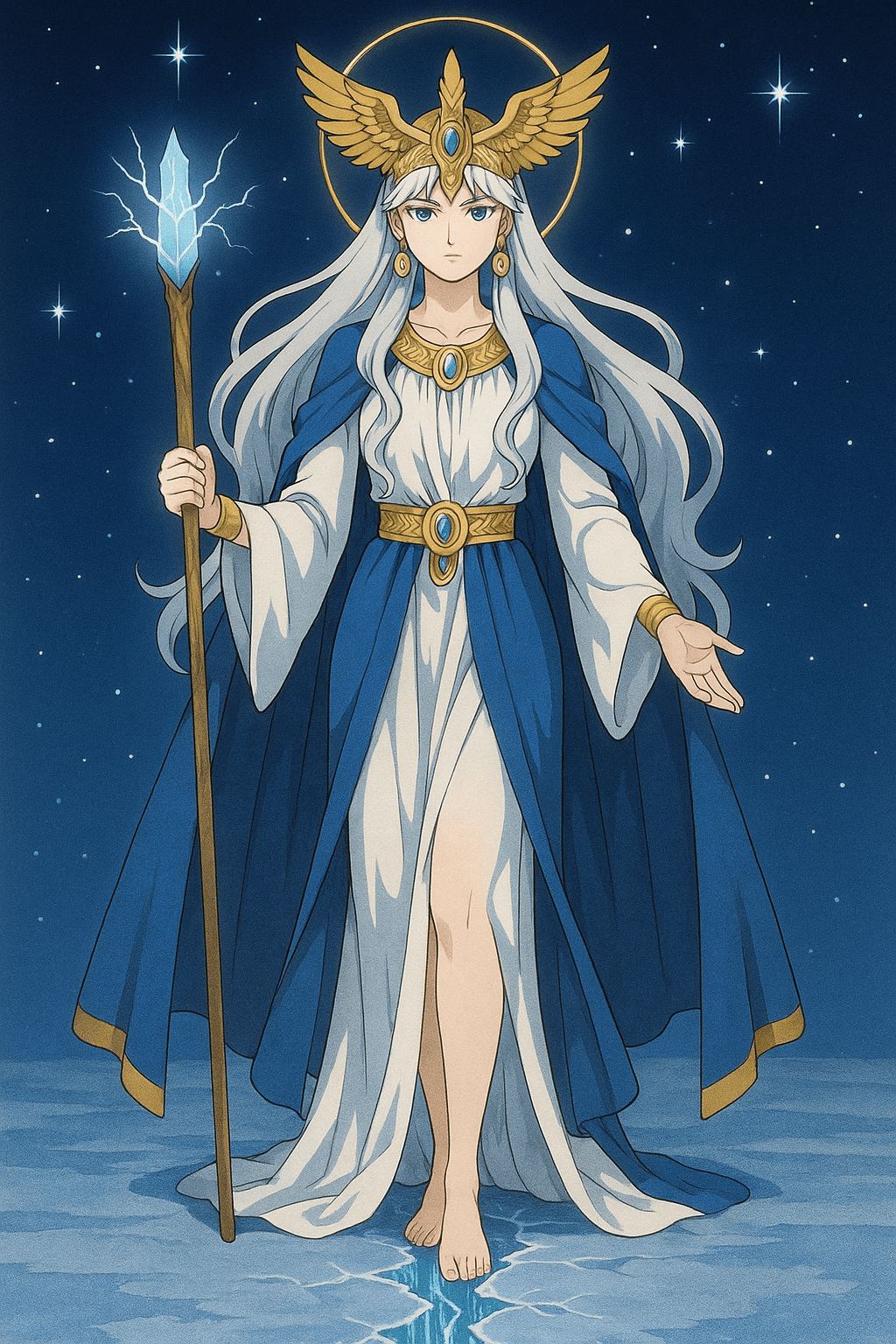
 TraditionShamanism
Period
~26,000 BCE
Homeland
Lake Baikal, Siberia
A note from Naomi: Every other Doomsayer on this site is a real person, recent enough to have a reasonably clear lineage of myth, enough for it to have been written down. The Shaman is too far in the past for us to have that. This page is based on an oral myth passed to me by a wanderer, who received it from a Siberian shaman. As it goes, memories fade to legend, legend fades to myth, and even myths are eventually forgotten. Oral tradition is a lossy encode. The following page is a work of mythopoeia, based upon that myth, with the gaps filled in by theologically informed assumptions. There is no history to support it, and no written account, only the scant few details that archaeology and other sciences can provide us as supporting evidence.
He looked into the water, and the water looked back. Everything else—the spread of religion across the face of the Earth, the rise of civilisation, the discovery of Heaven and Hell, the fruit of knowledge, the Fall, the entire twenty-six-thousand-year war between enlightenment and unknowing that constitutes the story of the human race—is the aftershock of that one moment. A being stood on the shore of the deepest, darkest lake in the world, and for the first time in the history of life on Earth, a pair of eyes looked inward and recognised themselves.
That is where this story begins. Before the flood. Before the temples. Before the gods had names. Before man and woman were different words. Before any of it... there was the Shaman, and the lake, and the reflection that shattered everything.
For an eternity, Man lived as the animals do, in a state of Oneness with nature.
This is not metaphor, this is the oldest memory the human race possesses. Every culture on Earth remembers it. The Hebrews called it Eden, the garden where Man walked with God in the cool of the day, naked and unashamed, before the serpent and the fruit and the Fall. The Daoists called it the age of the True Men of Old, the zhenren, who "did not oppose the human and the natural," who "knew neither to love life nor to hate death," who accessed "the original understanding of the ancient beginning" and lived "alone in communion with the spirit of Heaven and Earth." The Hindus called it the Satya Yuga, the Golden Age, when dharma stood on all four legs, when humans lived a hundred thousand years in effortless harmony, before the slow descent through the Treta, the Dvapara, and the Kali Yuga eroded the world into the iron age we now inhabit. Hesiod called it the Age of Gold, when men lived "like gods without sorrow of heart, remote and free from toil and grief," when "the fruitful earth unforced bore them fruit abundantly and without stint." The Aboriginal Australians remember the Dreamtime, not a lost past but an ongoing, immanent reality, the Everywhen, the continuous sacred fabric from which all creation was woven.
Zhuangzi: "The True Men of Old slept without dreaming and woke without care; they ate without relish and breathed very deeply. They did not know to love life, nor to hate death. They came and went without delight or dismay."
Mircea Eliade called this the "nostalgia for paradise," the most fundamental archetype in the history of religion. He saw that the shaman's ecstasy is itself an attempt to restore this primordial condition, that the shamanic trance "betrays the Nostalgia for Paradise, the desire to recover the state of freedom and beatitude before the Fall." Every religion on Earth, at its root, is homesick.
The conceit of the myth is simple, and it is universal: there was a time when Man was closer to God. One with God. In his garden, so to speak. And during this time Man lived in a state of innocence, for Man had not yet gained knowledge. Knowledge of what? Good and evil. Man and woman. Self and other. Opposites. Duality. We lived as animals do, and once that was true, for we ARE animals, and then we discovered duality, and it all changed.
Although Man had intelligence, enough to observe the world, to learn its patterns, to create tools and plant seeds, Man had done nothing with it. Content to live the same way Man always had, in the centre of the great wheel of life, woven into its Yarn. Man had discovered God in this time. Man built idols, wore masks, performed rituals. This is natural, for this is a divine world and Man is its most spiritual animal. But these early religious tendencies were forms of divine play. This is not to say they were not serious, they were. The religious experiences the Man of old had were just as deep as the ones Man had after. But in this state of innocence, true religion was impossible.
This is an enlightened view. To one adept enough, all of samsara is a playground, and we are the masks worn by the face of God. The Man of old understood this intuitively, in his bones. But the simple immanent wisdom of a child or an animal is also in some ways different from the bloodstained, sweat-borne wisdom of an adult. For Enlightenment cannot exist without Unknowing. Man is the only being that can become enlightened, because Man is the only being that can be unenlightened. Good and Evil, the fruit of knowledge, opposites define each other.
Dao De Jing, Chapter 2: "Under Heaven, all can see beauty as beauty only because there is ugliness. All can know good as good only because there is evil."
The Lake
Lake Baikal is the deepest lake on Earth. Twenty-five million years old. Over a mile deep. It holds one-fifth of all the unfrozen fresh water on the planet. Its waters are so dark and so clear that in winter, when the surface freezes into glass, you can look down through the ice and see nothing, just depth, descending into blackness, further and further, until the light gives out and there is only the void. If the word "abyss" had a picture associated with it, Lake Baikal would be the picture in ten out of ten dictionaries. It brings to mind the same primal, sightly feeling that Mimir's well does, the same deep infinite waters that feel like they are going to snatch your heart from your chest.
The primordial waters run through every creation myth on Earth. The Hebrew tehom, the deep that covered the darkness before God spoke. The Egyptian Nun, the boundless, formless ocean before Ra. The Vedic waters from which creation emerged breathlessly. The Babylonian Tiamat, the saltwater chaos, mother of all, whose name echoes in the very word tehom. The Norse Hvergelmir, the roaring cauldron at the root of Yggdrasil from which all rivers flow. Every tradition remembers the waters. Every tradition places the origin of the world in an abyss. And here, at Baikal, the abyss is not metaphor. It is geography.
Voluspá, Stanzas 28-29 (Tianmu Translation): "Why have you come? And what do you seek? I soothsee all, Odin, I know where your eye sleeps, deep in the inky depths of Muse's black well. Yet he drinks it as if it were mead, while your sight drowns! Need I speak your doom, allfather?"
Twenty-six thousand years ago, the world was in the grip of the Last Glacial Maximum. Vast ice sheets swallowed the northern hemisphere. Europe was buried. North America was buried. The world Man had known for a hundred thousand years, the great mammoth steppe, the hunting grounds of the Paleolithic, the ice-age paradise of megafauna and painted caves, was being crushed under miles of frozen silence. But Lake Baikal was different. While the rest of the land was covered in unassailable frost and ice, the Baikal region was a rare patch of life. Not the verdant green of summer, it was tundra-steppe, open grassland, but productive grassland, teeming with mammoth and bison and horse, enough flora and fauna for the humans sheltering there to survive the millennia of winter. Pollen analysis from Lake Kotokel, on Baikal's eastern shore, confirms stable grassland vegetation from roughly 26,800 to 19,100 years ago, with scattered trees in the river valleys. The lake itself maintained water levels close to modern levels throughout the LGM, fed by glacial meltwater, a vast body of liquid warmth in a frozen world.
The people who lived there were still deeply Neanderthalic. Not Neanderthals, the last pure Neanderthals had died out some ten thousand years earlier, but beings who carried their blood, their bone structure, their vast ribcages and heavy brows and dense muscle, far more than we do now. Modern non-African humans carry one to four percent Neanderthal DNA. The people of the Upper Paleolithic carried more. They stood at the threshold between the archaic and the modern, between the animal and the human as we would recognise it, between the garden and what came after. And perhaps this is fitting. The Shaman was the one who crossed the threshold. Of course he stood on it first.
The Neanderthals themselves may have had the earliest stirrings of what came next. At Shanidar Cave in Iraqi Kurdistan, a Neanderthal was buried some sixty thousand years ago amid concentrations of flower pollen, possibly the first funeral flowers, the first gesture of mourning, the first sign that a creature could look at death and feel something that demanded ritual. At Krapina in Croatia, eagle-talon necklaces. At Bruniquel Cave in France, circular constructions of broken stalagmites, deep underground, built 176,000 years ago, the oldest known human-made structures on Earth, built in total darkness, for purposes that could only have been symbolic. The sparks were already there. The Shaman was the one who fanned them into a fire that consumed the garden.
The Reflection
The Siberian myth is such. On the shores of Lake Baikal twenty-six thousand years ago, the first Shaman was born by recognising himself.
We say "himself," but the truth is perhaps stranger. The Shaman was born before the categories. Before me and you were separate words. Before inside and outside were separate ideas. The Shaman was the one who invented those categories, who drew the first line down the middle of an undivided world and said this side and that side. To call the Shaman "he" is already to speak the language of the world he created, not the world he was born into. In the garden, the question of a self did not exist, because the question of separation did not exist. Man was Man, the whole, the unbroken, the one who had not yet eaten the fruit. The Shaman could have been anyone. The Shaman could have been everyone. In a sense, the Shaman was everyone, because before duality, there was no one else to be.
It is impossible to literally say what the Shaman saw. It is impossible to literally say if he was the only dawn of Man, the sole point at which the fruit was tasted. But the myth says he looked into the water—into those inky, bottomless, ancient waters—and saw all the way down. Not the bottom of the lake, for there is no bottom, not really. He saw all the way from his glorious place on Earth to the black end at the heart of all things, and he realised it was him.
He saw Doom, or Mara, or Mare. For that is all that one can find in the abyss of the Self, the end of the journey. The lord of the material realm. The totality of unknowing and delusion that keeps consciousness trapped in the cycle of craving and aversion. Nietzsche was right: if you gaze long enough into the abyss, the abyss gazes back into you. But Nietzsche was only describing what the Shaman had already lived. The abyss did not merely gaze. It recognised. It said: you.
The dark mirror appears across the world. In the Norse tradition, Odin went to Mimir's well—the well of memory, the well of wisdom, the well at the root of the World Tree—and paid for a single drink with his own eye. He went in with two eyes and came out with one. The price of wisdom was the loss of unified sight. To see the depths, you must sacrifice the surface. Mimir means "the rememberer," and what the well remembers is what the drinker would rather forget: the abyss at the bottom of the Self. The Shaman's lake and Mimir's well are the same water. Both are fed from below.
The Greeks told it differently. Narcissus was the first being in their mythology to recognise his own reflection in water, and it destroyed him. He could not look away. He wasted at the edge of the pool until there was nothing left. The Greeks understood something essential: the reflection does not merely show. It consumes. The act of self-recognition, once begun, cannot be undone. You cannot unsee your own face.
And the Aztecs, who carried Ancient North Eurasian blood across the Bering Strait and into Mesoamerica, gave the dark mirror a name and a throne. Tezcatlipoca, "Smoking Mirror," lord of the obsidian mirror, of night, of sorcery, of fate, of self-knowledge. His instrument was the black mirror, the polished volcanic glass in which priests saw visions of the future and the truth of the Self. Where the Shaman had the lake, and Odin had the well, Tezcatlipoca had the stone. Different surfaces. The same depth. The same recognition. The same cost.
Three traditions. Three dark mirrors. Three figures who looked into the deep and were shattered by what looked back.
Genesis 1:2: "And the earth was without form, and void; and darkness was upon the face of the deep. And the Spirit of God moved upon the face of the waters."
And it drove him mad.
The Sickness
The oral myth that describes the first Shaman also describes the sickness. A sickness which we would call psychosis nowadays; pure immersion in the abyss of the Self. The first case of psychosis in human history. And the first recovery.
This is not incidental to the myth. It IS the myth. Across every Siberian tradition that Eliade documented, across every shamanic culture on Earth, the call to shamanism manifests as a crisis that demands acceptance. Vivid dreams that will not stop. Emotional turmoil that cannot be contained. Visions of the dead. Voices that speak from inside. Near-death experiences. What we in the modern world would diagnose as a psychotic break—a total dissolution of the boundary between self and world, between waking and dreaming, between here and not-here—is, in the shamanic understanding, the call of the spirits. The vocation choosing the shaman, not the shaman choosing the vocation.
In Korea, this sickness has a name. They call it sinbyeong, "신병," "spirit sickness." It is not ancient history. It is not mythology. It is happening now, today, in the twenty-first century, to people who become mudang, Korean shamans. The symptoms are the same ones Eliade documented in Siberia: prolonged illness that no doctor can explain, auditory and visual hallucinations, emotional collapse, loss of appetite, inability to function in ordinary life. The spirits ride the afflicted person until they break or until they accept the call. And the only cure—the only cure, as Korean shamanic tradition insists—is the initiation ritual, the naerim-gut, in which the spirits are formally received and the mudang takes up her role. The sickness ends when the vocation begins. This is not a coincidence and it is not cultural borrowing. Korea and Siberia share deep roots, linguistic, genetic, shamanic, and sinbyeong is the living proof that the pattern the Shaman established twenty-six thousand years ago has not faded. It has only changed its address.
And refusing the call brings torment. The spirits do not accept no. In the Siberian traditions, a person who resists the shamanic vocation is tormented with prolonged suffering, months, sometimes years, pushed to the brink of madness or death, until they accept their role. You cannot go back to sleep once you have woken up. You can only go forward, through the sickness, through the dismemberment, through the death, and come out the other side. Or not come out at all.
Hávamál, Stanza 138: "I know that I hung on a windswept tree nine long nights, wounded with a spear, dedicated to Odin, myself to myself, on that tree of which no man knows from where its roots run."
Consider what this means. The first spark of human self-awareness, the moment that separates us from every other animal on Earth, the moment that made civilisation and philosophy and religion and science possible, was experienced, by the one who first felt it, as madness. The birth of the human mind was indistinguishable from the shattering of the human mind. The light that illuminated the world also blinded the one who first saw it. This is not a metaphor. This is the structure. Enlightenment and madness are neighbours, separated by a membrane thinner than thought. The Shaman crossed both, in both directions, and lived. That is what makes him the first Doomsayer. Not that he saw the truth. But that he survived the seeing.
Carl Jung, twenty-six thousand years later, would describe the same territory from the other side. He called it the confrontation with the unconscious, the encounter with the shadow, the individuation crisis. He understood that the conscious ego necessarily produces a shadow, the rejected, unconscious aspects of the personality, and that integration, not repression, is the only path to wholeness. "The Self signifies the unification of consciousness and unconsciousness in a person, representing the psyche as a whole." The Shaman achieved this unification. He was the first to split, and the first to re-integrate. The first to shatter, and the first to reassemble the pieces into something greater than what had been there before.
The Journey
The myth goes like this: "He was taken away." "He went on a long journey."
The Shaman is first arrested away from normal life, from oneness, from unity with his village and his people, and descends into the dark abyss of the Self. Here is the split. The moment the Shaman realises duality is the moment he no longer recognises himself in his loved ones, the moment he sees himself alone in the universe. This is the Fall. Not a punishment from an angry God, not a moral failure, not a test, but the simple, shattering, irreversible moment when a consciousness, for the first time in the history of life on Earth, turns back on itself and sees that it is separate. That there is an inside and an outside. That there is a self and an other. That there is a here and a there, a now and a then, a good and an evil, a life and a death.
Mircea Eliade, the great scholar of shamanism, documented this structure across every Siberian tradition he studied: "All the ecstatic experiences that decide the vocation of the future shaman involve the traditional scheme of an initiatory ceremony: passion, death, and resurrection." The content of these experiences "almost always repeats one or more of the following themes: dismemberment of the body followed by a renewal of internal organs and bowels; ascension to Heaven and dialogue with gods or spirits; descent into Hell and talks with the spirits and souls of dead shamans." Often the Shaman is described as being split into pieces, or having to watch his body being torn apart from a distance. In one Altaic account, the shaman "enters the gloomiest of forests and traverses the highest of mountains," comes upon "a hole in the Earth," and begins the journey to the Underworld, where "spirits of disease haunt the shaman, and the souls of transgressors reveal their terrifying fate." Powerful shamans suffer dismemberment three times.
This descent is the pivotal moment, the encounter with the abyss. In the hero's journey this always takes a symbolic bent: a Man encounters himself. A young Jedi enters a cave on Dagobah and finds his own face behind his father's mask. Frodo must learn to give mercy to the one creature that deserves none. Beowulf literally descends into a physical abyss and slaughters Grendel's mother. Inanna passes through seven gates, surrendering a garment at each one, until she stands naked before the Queen of the Dead, and the seven gates of Ereshkigal's palace, scholars note, are "curiously similar" to the seven successive pudak or obstacles that Siberian Ket shamans must overcome in their descent to the underworld. Orpheus descends to retrieve what he has lost and must not look back. Jonah is swallowed by the whale, what Campbell called "the belly of the whale," and cries out to God from "the belly of Sheol," the underworld itself. Carl Jung called this the Night Sea Journey: "a kind of *descensus ad inferos, a descent into Hades and a journey to the land of ghosts somewhere beyond this world, beyond consciousness, hence an immersion in the unconscious."
In every case, the pattern is the same. The hero descends. The hero faces the abyss. The hero encounters himself, his fear, his shadow, his death, his Doom. And in the abyss, the hero must either break or be remade.
Bardo Thodol: "Be not daunted thereby, nor terrified, nor awed. That is the radiance of thine own true nature. Recognize it."
Here the Shaman faces his fear, and here he begins the journey home. He integrates it. Braves it. Suffers it. It may take a week, it may take an eternity. Often he dies. But if he does not die, if he makes it through the dismemberment, the death, the dark, then he hears the drum.
The drum. The shaman's horse. The shaman's canoe across the waters of the underworld. The shaman's heartbeat, externalised, the rhythm that carries consciousness from one world to the next. In every shamanic tradition on Earth, Siberian, Native American, African, Australian, the drum is the vehicle of the spirit flight, the steady pulse that holds the journeying soul tethered to the living world while it travels beyond. The monotonous, rhythmic beating shifts brainwave patterns from beta to theta, from ordinary waking consciousness to the hypnagogic state where visions live. The drum is older than language. It is older than theology. It is perhaps the oldest sacred technology in the world, a stretched skin over a hollow frame, beaten in the dark, and the shaman rides it home.
This is how they describe it: returning home. Sound familiar? Reaching the other shore. Returning to the homeland. Becoming as a newborn babe. The Yiguandao call it gui zhen jia xiang, returning to the true homeland. The Buddhists call it paramita, "gone to the other shore." The Gnostics told it in the Hymn of the Pearl: a prince is sent from his heavenly parents' kingdom down to Egypt, is seduced by the material world and forgets who he is, until a letter arrives from home, and "he remembers where he is from, retrieves the pearl from the serpent, and leaves Egypt." Plotinus described the soul's journey as an epistrophe, a turning-back, a homecoming, using the image of Odysseus sailing back to Ithaca. This is Enlightenment. The Shaman reaches it by returning to the world of Oneness and joining his people again. And they recognise this. And yet he is changed.
The Gift
To have faced duality, the Shaman gains something he never had before. An awareness. A power over reality. A perspective that none of his tribe can share. A Hamingja, an ancestral potency, a spiritual radiance, that sets him apart from every other member of his band, not because he is better than them but because he has been somewhere they have not and returned carrying knowledge they cannot yet imagine. Because of this he can face spirits, perform magic, heal the sick, lead his people. He is the first human being in history to have been unenlightened, to have fallen out of the garden, to have tasted the fruit, and then to have found his way back. The first to cross the abyss and return. The first to die and live again.
The hero's journey is the ur-story because it IS the literal story of human existence. Joseph Campbell called the monomyth "a meta myth, a philosophical reading of the unity of mankind's spiritual history, the Story behind the story." He compared the shaman to the psychoanalyst, "the modern master of the mythological realm, the knower of all the secret ways and words of potency," and placed the Way of the Animal Powers, the Paleolithic shamanic tradition, at the very base of his entire mythological architecture, the first stage from which all subsequent elaboration develops. He was right. But he did not go far enough. The hero's journey is not merely the oldest story. It is the only story. We are all dualists. We all live in a dualist world. We are all in the abyss, on our own journey, seeking the return home.
The Shaman is the proof that the journey is possible. He is the first man to reach unenlightenment, and somehow reach enlightenment afterwards.
Quran 94:5-6: "Verily, with hardship comes ease. Verily, with hardship comes ease."
The Doom He Spoke
What the Shaman brought back from the abyss was not a teaching, not a commandment, not a revelation whispered by a god. It was a structure. A way of seeing. The first theology.
He named Heaven and Hell. He named the upper realm and the lower realm. He gave architecture to the vague sense of spirit-world and dead-world that we find still spoken of by the most ancient, uncontacted peoples of the Earth, the sky and the soil, the bright realm and the dark realm. The Chinese would call these tian and di. The Norse would call them Asgard and Hel. The Hindus would call them Svarga and Naraka. The Egyptians would call them the Duat and the Field of Reeds. But before any of those names, the Shaman stood between the two realms and knew them, not as ideas, not as doctrines, but as lived experience, as the territories he had traversed in his madness and his recovery.
And between Heaven and Hell, he found where he was standing. Midland. Freedom. The middle realm. The realm betwixt Heaven and Earth, 天地之間. The place where we live, the overlay of the two worlds, the ground on which the hand rests and the sky toward which the heart reaches. This is the three-level cosmos, Heaven above, Hell below, and the living world between, and it is the most universal theological structure in human history, found in every tradition on every continent, because it is not a human invention. It is a human discovery. The Shaman discovered the architecture of reality, and every religion since has been drawing the same blueprint with different pencils.
He did not merely experience the sacred, every animal experiences the sacred, every tree leans toward the light. He named it. He made the way for white and black, masculine and feminine, yin and yang, for the entire teaching, the entire structure of the Manifold not as one unbroken continuum of awareness, but as two, as recursive knowledge experiencing the one experiencing, and the journey: learning to realise the one experiencing is the same as all experiencing.
Rigveda X.129: "In that day, there existed neither existence nor non-existence, there existed neither airy sky nor heaven beyond! The One breathed breathlessly, by its own conscious will, that was all."
The Shaman was the first theologian. Not the first to experience God, every Man before him had experienced God, for God is all there is. But the first to stand apart from the experience and see its architecture. The first to say: this is Heaven, and this is Earth, and I am standing between them, and that is what it means to be alive.
And in naming duality, he spoke the Doom that every subsequent Doomsayer has been responding to. Every Doomsayer turns the wheel of Doom for all of humanity. Manu the Ark's doom was the flood. Akhenaten the Lightbringer's doom was the death of polytheism. Siddhartha the Cowherd's doom was impermanence. Laozi the Dragon's doom was flux. Odin the Wanderer's doom was the loss of the conquering eye. Jesus the Shepherd's doom was the tearing of the Temple veil. The Shaman's doom is the most fundamental of all. It is the doom from which all other dooms descend. He spoke the doom of duality itself, the splitting of the one into two, the fracture that made consciousness possible and innocence impossible, the cut that opened the wound from which all of human history has been bleeding.
This is the doom that echoes through every myth of the Fall. The Garden of Eden: the fruit of the knowledge of good and evil, and the exile that followed. The Kabbalistic Shevirat HaKelim: the vessels of divine light shattering, and the masculine and feminine aspects of the cosmos turning their backs on one another. The Buddhist Second Arrow: the first arrow is unavoidable pain; the second is the dualistic thinking that transforms suffering into a narrative of separation. Julian Jaynes's bicameral breakdown: the loss of the gods' voices in the head, the terrifying birth of the interior monologue, the silence where once there was divine command. They are all remembering the same event. The same moment. The same doom.
The Curse
The Shaman's gift to humanity was also his curse upon it, for what the Shaman discovered, the recursive awareness of the self, the ability to stand apart from experience and observe it, was also the ability to master it. To dominate it. To bend the world to the will of the knowing mind. The power of duality is the power of separation, and the power of separation is the power to destroy balance. To erect walls. To tend farms. To enslave. To say this is mine and that is yours and I am more and you are less. This is Man, the Jupiterian drive, the ambition that erects tall towers and ventures into the unknown, but Man without Muse, Man without the backward-looking wisdom of the threshold guardian, Man drunk on his own bright, conquering gaze.
The Shaman himself did not engage with this power, for he reached enlightenment. He made the journey home. He returned to Oneness. But the world that followed did not.
Dao De Jing, Chapter 18: "When the great Way is abandoned, benevolence and righteousness arise. When wisdom and knowledge appear, great pretence begins."
The fruit of knowledge is not merely the ability to discern good from evil. It is the ability to choose. And the terrifying freedom of choice—the freedom that is also a burden, also a weight, also a Doom—is what split the human race from the rest of creation. Every other animal lives within the wheel. Man alone learned to step outside it, to grab its spokes, to try to stop it or to spin it faster. And the consequences of that power, wielded without the Shaman's wisdom, without the journey home, without the return to Oneness, the consequences are history itself. The rise of empires. Oppression. War. Technology. Slavery. The great Mountain of Corpses began its erection.
The garden is not enlightenment. The child is not the sage. The innocence of the animal is not the same as the hard-won simplicity of the Buddha touching the earth. Both are beyond duality, but one has not yet encountered it, and the other has passed through it and come out the other side. You cannot go back. You can only go through. To confuse the two—to see the womb of God as the end and not the beginning—is the deepest error on the path, for it is the error which drives a Man further from his own life, from his own Doom, and towards a dream. Do not hurry to death, do not long to be unliving, the way home is not the way back. The way home is forward, through the abyss, through the sickness, through the dismemberment, and out the other side carrying the fruit in your hands instead of in your teeth.
The Shaman was the first to pass through. The rest of us are still in transit.
Archaeology is increasingly suggesting that the turn toward civilisation was a necessary shift after the megafauna were hunted to extinction. Perhaps it was greed. Perhaps it was necessity. The mammoth steppe collapsed. The great beasts vanished. The old way of life, the way that had sustained humanity for a hundred thousand years, became impossible. And the curse of duality, the gift of the Shaman turned weapon by those who had not made the journey, became the tool by which Man remade the world. The fruit was eaten, and the garden was paved, and Unknowing was born.
And yet. The gift was always there, waiting for those with the courage to seek it.
The Trail
The evidence is scattered across every continent, in every kind of record humans have ever kept: stone, bone, blood, and word.
The stones first. The Löwenmensch, the Lion-Man of Hohlenstein-Stadel, stands upright with a human body and a lion's head, carved from mammoth ivory roughly forty thousand years ago. A therianthrope: the signature of shamanic transformation, the shaman becoming the animal spirit, the crossing of the boundary between human and beast. Found deep in a cave, in total darkness, in a space that was not domestic but ritual. The Sorcerer of Les Trois-Frères: antlers of a stag, ears of a deer, eyes of an owl, tail of a horse, paws of a bear, legs of a dancing man, presiding over hundreds of animal figures like their master, or their mediator, or both. At Chauvet, in the deepest chamber, thirty-six thousand years old: a figure with a bison's head and a human lower body, drawn beside a woman's vulva and legs, the earliest known image of the sacred union of masculine and feminine, of Waxer and Waner, of the duality the Shaman had named. At Lascaux, the Shaft Scene: a man with a bird's head falling backward, a bison with its entrails spilling out, a bird on a staff beside him. The bird on a staff is the shaman's totem. The falling man is the shaman in trance. The disembowelled bison is the initiatory dismemberment. The journey, painted on a cave wall in France, fifteen thousand years ago, by someone who had either made it or watched someone make it.
The Mal'ta-Buret' culture, named for the archaeological sites roughly 160 kilometres northwest of Lake Baikal, were among the most remarkable people of the Upper Paleolithic. They carved Venus figurines from mammoth ivory, twenty-nine of them unearthed so far, depicting men and women of various ages fully clothed in detailed garments, wearing hoods and furs etched into the bone with astonishing precision. They carved waterbirds, swans, geese, loons, in both flying and resting postures, creatures at home in water, on land, and in the sky, the natural candidates for mediators between worlds. They carved serpents with puffed-up heads on mammoth tusk slabs. Joseph Campbell identified at Mal'ta a fully articulated shamanic symbolic system: the serpent, the labyrinth, the sunbird, and the shaman's flight, all present, all intertwined, twenty-four thousand years ago.
And then there is Göbekli Tepe. Göbekli Tepe, "Navel Hill" in Turkish, and the name itself echoes the shamanic concept of the cosmic navel, the world-centre, is the oldest known monumental sanctuary on Earth. It was built around 9500 BCE, over six thousand years before Stonehenge, over seven thousand years before the Great Pyramid. Its builders were pre-pottery, pre-wheel, pre-writing, pre-domestication hunter-gatherers. They had no metal tools. No beasts of burden. They quarried, carved, and erected limestone pillars weighing up to fifty tons using only stone and muscle and whatever it is that drives human beings to build temples before they build houses.
The T-shaped pillars are anthropomorphic, the vertical shaft is the body, the horizontal top is the head. Many bear carved arms running along their sides, with hands meeting at the front. They wear belts and loincloths etched into the stone. Klaus Schmidt, the archaeologist who excavated the site from 1995 until his death in 2014, interpreted them as representations of ancestors or supernatural beings, not yet gods in the Mesopotamian sense, but powerful presences. The pillars stand in circular enclosures up to thirty metres across, with two central monoliths, the tallest, the most elaborately carved, rising at the axis of each ring. An axis mundi. A world-pillar connecting the realms. The same structure the Shaman named.
The animal imagery is extraordinary and deliberate. Snakes dominate one enclosure, foxes another, boars another, birds another, as if each ring belonged to a different totemic clan, exactly as the Siberian shamanic traditions describe. The animals carved on the pillars are not the animals the builders ate. Deer and gazelle, their primary food, are almost entirely absent. What they carved instead were the formidable, the dangerous, the numinous: lions, vultures, scorpions, wild boars, foxes with bared teeth and erect penises. Power animals. Spirit animals. The same beasts that Siberian shamans wear as masks and ride in trance.
And on Pillar 43, in Enclosure D, the oldest and largest enclosure, dating to roughly 9675 BCE, a vulture spreads its wings and holds a sphere in its talons. Schmidt identified the sphere as a human head. The soul. The vulture is the psychopomp, the soul-carrier, the one who conveys the dead from Earth to Heaven. Below the vulture, a scorpion: the underworld, the danger on the road. At the bottom, a headless man, ithyphallic, the body left behind after excarnation, the practice of exposing the dead to vultures, stripping the flesh, and keeping only the skull. In 2017, archaeologists recovered three human skulls from the site, each bearing deep grooves carved with flint tools along the sagittal axis, one with a drilled perforation, one stained with red ochre. They were hung from cords. The skulls were displayed. The dead were present, watching, participating.
The three-level cosmos is carved into the stone. Sky-realm above, vultures, cranes, celestial symbols. Earth-realm in the middle, the anthropomorphic pillars themselves, the foxes, the boars. Underworld below, snakes, scorpions, spiders, all burrowing or ground-dwelling creatures. The vertical arrangement on the pillars maps the same architecture the Shaman discovered in his journey: Heaven above, Hell below, Midland between.
And here is the fact that overturns everything the modern world assumed about the relationship between religion and civilisation: the builders of Göbekli Tepe had not yet domesticated a single plant or animal. They were still hunter-gatherers. The temple came before the farm. The wild ancestors of modern einkorn wheat grow on the slopes of Karaca Dağ, a mountain sixty miles from the site, and genetic studies have confirmed that region as a centre of wheat domestication, and the timing aligns precisely with Göbekli Tepe's peak activity. Jacques Cauvin argued that a revolution of symbols, an explosion of representational imagery, preceded agriculture by millennia. Schmidt went further: the demands of building and sustaining Göbekli Tepe, quarrying, carving, feeding hundreds of workers, organising seasonal pilgrimages, forced the invention of agriculture. The need to worship drove the need to farm. The shaman came before the farmer. The first great organised human enterprise was not economic. It was visionary.
Göbekli Tepe was deliberately buried. After roughly fifteen hundred years of use, the enclosures were filled with rubble, stone, flint tools, and the bones of feasted animals, and sealed. Schmidt believed the burial was ritual, that the sacred spaces had a limited lifespan, and their power had to be entombed when it was spent. Whether the burial was deliberate or partly natural is still debated. But the site was covered, and it slept beneath the hill for eleven thousand years, until a Kurdish shepherd noticed a carved stone protruding from the soil in 1963. It was not excavated until 1995. It is still less than one-sixth uncovered. Ground-penetrating radar suggests many more enclosures remain beneath the mound, waiting.
Then the blood. The Mal'ta Boy, MA-1, a four-year-old child buried with a Venus figurine near Lake Baikal around 24,000 BCE, was the first confirmed member of a ghost population that geneticists call the Ancient North Eurasians. His genetic legacy is staggering. Up to thirty-eight percent of Native American DNA. Up to twenty percent of European DNA, carried westward by the Yamnaya steppe pastoralists. Up to fifty-two percent of Neolithic Iranian DNA, which flowed into the foundations of the Fertile Crescent civilisations. The people of the lake spread into every corner of the world. And everywhere they went, the three-level cosmos went with them. The drum went with them. The spirit flight went with them. The Shaman's architecture of reality went with them.
Every single place on Earth that has independently developed theology has roots in the Baikal region. The Indo-Europeans, who populated Europe, Iran, and India, and whose languages are spoken by nearly half the human race, they carry ANE through the Yamnaya. The Afroasiatic peoples, the Egyptians, the Akkadians, the Babylonians, the Hebrews, received ANE-derived ancestry through Iranian hunter-gatherers and Mesopotamian populations. The peoples of the Americas carry it directly from Beringia. Every single place on Earth that has independently discovered civilisation traces ancestry back to the peoples of the steppe.
And the East Asian civilisations tell their own story. The core populations of the Yellow River derive primarily from the Ancient Northeast Asians, a distinct lineage from the ANE, yes, but not a distant one. The ANEA were in the same broad region, the same Siberian and Northeast Asian world, likely overlapping with and interacting with ANE populations around Baikal during the Upper Paleolithic. Different branches from the same trunk. And Chinese shamanism, the wu 巫 tradition, attested from the Shang dynasty onward, laid the foundation for Daoism itself. The roots go to the same soil.
Then the words. Victor Mair demonstrated in 1990 that the Old Chinese pronunciation of 巫, the word for shaman, was reconstructed as something close to *myag, virtually identical to Old Persian maguš, the word for the Iranian priestly caste, the Magi, from which we get "magic." Old Turkic bögü, "shaman-sorcerer," attested in the Orkhon inscriptions, runs in the same channel. Three language families. Three words for the same figure. The steppe was not a barrier. It was a highway, and ideas travelled it for millennia before anyone thought to name it the Silk Road.
And everywhere, the memory of a homeland. Lake Baikal during the Last Glacial Maximum was an essential refugium in Siberia, arguably the most important. While the rest of the land was locked in unassailable frost and ice, the Baikal region sustained life, stable grasslands, scattered trees in river valleys, megafauna grazing in conditions that, while harsh, were survivable.
The strongest record of it comes from the Greeks, who learned of it from the Scythians, and called it Hyperborea: a sacred land in the far north, beyond impassable mountains, where the inhabitants lived in eternal bliss. Herodotus, recording the account of Aristeas of Proconnesus, describes the geography: east of the Scythians dwelt the Issedones; beyond the Issedones lived the one-eyed Arimaspi; beyond them an impassable desert where fierce gold-guarding griffins roamed; after which rose the Riphaean Mountains, inaccessible because of perpetual snow; and beyond these mountains, on the shores of the Sea of Ice, lived the Hyperboreans. J.D.P. Bolton, in his study of Aristeas, located the Issedones on the southwestern slopes of the Altai Mountains, which would place Hyperborea further east and northeast, roughly in the Lake Baikal region or beyond. Bolton also noted that the Buriats near Lake Baikal say that the Ruler of the Dead has a single eye in the middle of his forehead, a striking parallel to the one-eyed Arimaspi.
The Zoroastrian Avesta describes the Aryanam Vaijah as situated in the far north, above all other world zones, from which the people migrated south due to an impending fierce winter. Bal Gangadhar Tilak, in The Arctic Home in the Vedas, argued that the Vedic descriptions of celestial phenomena—circumpolar star movements, extended polar nights and days—are consistent with observations made at extremely high latitudes. Hindu and Buddhist cosmology places Mount Meru, the sacred centre of all universes, beneath the Pole Star, with celestial bodies revolving around it, a golden mountain whose summit reaches heaven.
The Buryats of Lake Baikal remember Ursa Major as the Dolon Ubged, the Seven Elders. The Vedic tradition, five thousand miles to the south, calls the same circumpolar stars the Saptarishi, the Seven Sages, Sons of Brahma. The same stars, the same sacred number, the same mythic function, cosmic elders watching over the world from the fixed point of the sky. The Buryats and the Brahmins are looking at the same sky and remembering the same home. That sky was the sky above Baikal.
Buddhist cosmology describes Uttarakuru, the northern continent beyond Mount Meru, a paradise where inhabitants live a thousand years, need not labour, know neither sorrow nor conflict, and where trees provide clothing and food without tending. It is, explicitly, the paradise to the north. Chinese mythology describes Kunlun, the cosmic mountain at the roof of the world, whose summit is Upper Heaven itself, upon whose slopes sits the Jade Lake of Xiwangmu, the Queen Mother of the West, guardian of the peaches of immortality. A mountain, a lake, a layered cosmos. The Tibetan Bön tradition remembers Olmolungring, the sacred homeland of Tonpa Shenrab, situated to the northwest beyond the Himalayas, centred on a nine-stacked mountain surrounded by water and shaped like a lotus, the place of origin for the oldest religion in Tibet, the tradition that predates even Buddhism. The Turks remember Ergenekon, a valley enclosed on all sides by impassable mountains, the womb of the nation, from which they emerged when a blacksmith melted through the iron mountain and the people poured onto the steppe.
The Aztecs called their homeland Aztlán, an island in a lake in the north, from which the ancestors departed southward. Baikal has Olkhon Island, the sacred heart of Buryat shamanism, where the first shaman was said to have received his gift. Both are islands in lakes. Both are the navel of the world. Both are the place you leave and spend the rest of history trying to return to. The K'iche' Maya called it Tulan Zuyva, the place the ancestors waited in darkness before the first dawn. The Inca pointed to Lake Titicaca, the highest navigable lake on Earth, and said Viracocha created the sun and the stars there. The Polynesians remember Hawaiki, the ancestral homeland from which the great canoes departed, the land to which the soul returns after death. The Yoruba point to Ile-Ife, the navel of creation, where Oduduwa descended from heaven on a chain and cast sacred soil upon the primordial waters.
Every continent. Every ocean. Every people who have ever looked at the stars and sang songs of where they came from. A sacred origin. A mountain, a lake, an island, or all three. A migration. A longing to return. The Shaman is not the ancestor of any one people. The Shaman is the ancestor of people. The memory of the homeland belongs to all of us, because all of us are in exile from it, and all of us, whether we know it or not, are trying to find our way home.
Augustine, Confessions 1.1: "Thou hast made us for thyself, O Lord, and our heart is restless until it rests in thee."
There are some exceptions. The Aboriginal Australians do not remember a homeland, because they never left it, the Dreaming is the eternal present, never abandoned, never lost. The San people of southern Africa, the oldest continuous genetic lineage on Earth, never left either. Their trance healing dance, the activation of n/um, the boiling energy that rises up the spine, is the closest surviving practice to whatever the Shaman was doing twenty-six thousand years ago, and their rock art at Drakensberg shows the same therianthropes as the European caves: figures half-human, half-eland, bleeding from the nose in deep trance. They built no temples. They named no cosmos. The BaMbuti of the Congo sing to the forest when the world goes wrong, the Molimo ceremony, because the forest is not a god they worship. The forest IS the sacred. These are the peoples who never left the garden. They lived in it for sixty thousand years, a hundred thousand years, while the rest of us built temples and empires and forgot what we were building them for. And then we found them. And in a few generations of missions and reservations and boarding schools and settlement, we handed them the fruit. The San were pushed to the margins of the Kalahari. The BaMbuti were driven from the Ituri. The Dreaming was paved over with mining leases. The garden did not fall twenty-six thousand years ago for everyone. For some, it is falling now. For some, we are the Fall.
The Two Paths
From Baikal, White Shamanism and Black Shamanism spread over the Earth. In the Mongolian tradition, the cosmos is governed by ninety-nine tengri, fifty-five benevolent or "white" and forty-four terrifying or "black." White Shamans venerate white spirits and are forbidden from calling upon the black; Black Shamans work with black spirits and cannot invoke the white. White Shamans create rituals concerning the general direction of people's lives, keeping public and administrative order. Black Shamans are warrior-shamans, battling evil forces, consulted as military advisors, obtaining power from the north, locked in personal struggles against every kind of evil, protecting and saving people from harm. The White Heaven controls the west; the Black Heaven controls the east.
This is not good and evil. This is Waxer and Waner. Yang and yin. The bright, ordering, civilising energy and the dark, descending, wild energy. The right hand and the left hand. And they survived twenty-six thousand years.
White Shamanism became the religions of Heaven. Oriented upward, toward transcendence, surrender, salvation, grace. The movement is out of the material and toward the divine. Christianity, Pure Land Buddhism, Islam, Vaishnavism, Zoroastrianism, these are the religions of the right hand, the descendants of the White Shaman who kept public order and directed the people toward the sky.
Black Shamanism became the religions of Hell. Not evil, Hell is not evil, Hell is the material realm, the realm of desire and will and becoming. Oriented downward, toward immanence, power, self-transformation, mastery of the forces that churn beneath the surface of things. The movement is into the earthly, deliberately, not to be trapped there but to command it. Thelema, Hermeticism, left-hand Tantra, the Aghori, Seidr, Vodou, these are the religions of the left hand, the descendants of the Black Shaman who battled in the dark and obtained his power from the north.
Some traditions hold both hands. Pure Land is white shamanism crystallised; Vajrayana is black shamanism formalised. Vaishnavism surrenders to God in devotion; Shaivism wields destruction as the instrument of liberation. Religious Daoism faces Heaven with its moral ledgers and celestial bureaucracies; neidan faces Hell with its furnace of internal alchemy. The split runs through every tradition old enough to remember both.
Neither path is wrong. Neither path is complete. A tradition that is only heavenly becomes moralistic, rigid, disembodied, the forgotten dark coalescing into an unconscious to face, as Jung spoke of, Daymare. A tradition that is only hellish becomes predatory, power-obsessed, unmoored, it drowns in the forces it sought to command, Nightmare. The healthiest traditions hold both hands, and the wisest practitioners stand between them, in Midland, in Freedom, where Heaven and Hell overlay, wielding both without being captured by either. This is the middle realm the Shaman discovered when he found where he was standing. It was always the place of practice.
Heaven and Hell have not changed a bit for twenty-six thousand years, although some people like to imagine their enemies in the latter. The rituals have changed form and name and hand infinite times, but they were always meditation, always ghostsooth, and still are.
William Blake, The Marriage of Heaven and Hell: "Without Contraries is no progression. Attraction and Repulsion, Reason and Energy, Love and Hate, are necessary to Human existence."
The Wyrd
The very act that made Enlightenment possible also made suffering possible. The very gift that allowed Man to know God also allowed Man to forget God. The Shaman who faced the abyss and returned bearing the fruit of the Way was also the Shaman who planted the seed of every war, every empire, every slave-chain, every lie that has ever been told in the name of power. The cure invented the disease. The light cast the shadow. The one who could name Heaven could also name Hell, and in the naming, make both real.
This is Crosstruth at its most absolute. The paradox that cannot be resolved, only held. The fruit of knowledge is simultaneously the most precious gift and the most terrible curse the universe has ever produced. Without it, there is no suffering, but also no overcoming. Without it, there is no war, but also no peace that is chosen rather than merely defaulted to. Without it, there is no Unknowing, but also no Enlightenment, for enlightenment cannot exist without the darkness it illuminates.
Genesis 3:22: "And the Lord God said, Behold, the man is become as one of us, to know good and evil."
The Shaman's Wyrd is that he is both the saviour and the destroyer. He is the one who broke the garden and the one who showed us the way back to it. He is Adam and Christ in a single figure, the Fall and the Redemption enacted by the same pair of hands. No other Doomsayer carries this weight. Manu the Ark saved civilisation from destruction, he was unambiguously the preserver. Akhenaten the Lightbringer saw the Mother and was destroyed for it, he was unambiguously the martyr. Siddhartha the Cowherd touched the earth and defeated the mare, he was unambiguously the liberator. But the Shaman is the one who MADE the mare. The Shaman is the one who created the very condition from which all subsequent Doomsayers would seek to liberate humanity. His gift and his curse are the same gesture, the same moment, the same hand reaching into the water and pulling out both the sword and the wound.
This is why his story is the first story. This is why it precedes all others. Not because he came first in time, though he did, but because his doom is the doom that contains all other dooms. The Shaman's moment at the lake is the Big Bang of the human spirit. Everything since has been expansion, differentiation, elaboration, the ten thousand things arising from the one split that began when a being looked into the water and saw two where there had been one.
The Fruit of the Way
And yet the curse is also the gift. This is what makes it Mead and not mere tragedy.
For Goodness to exist there must be Evil. For Enlightenment to exist there must be Unknowing. That is why your teacher says "a good story needs conflict" when you are a child. That is why the hero's journey is the ur-story. It is the only story that is real, the story of Man learning to overcome himself after he took a bite of the fruit, the story of Man returning home after he fell from the roost.
The entire literary and religious history of Man is addressing this one moment.
The Yiguandao's letter from the homeland. The Bible's Genesis. Daoism's True Men of Old. Buddhism's other shore. Heaven, Heaven, Heaven, always the longing for Heaven, for the garden, for the Mother. Even the twisted internet Gnostic's longing for pleroma, that too is longing for the Mother, that too is lamenting his duality, the curse of Man. The Hymn of the Pearl, buried in the Acts of Thomas: a prince sent from heaven, seduced by the world, forgetting who he is, until a letter arrives, and he remembers, and he retrieves the pearl, and he goes home. "I remembered that I was the son of kings," the prince says, "and my free soul longed for its own kind." Plotinus, the last great pagan philosopher, describing the soul's epistrophe, the turning-back, the homecoming, using the image of Odysseus sailing to Ithaca, teaching that the soul is an "amphibian" dwelling in both the intelligible and the perceptible, experiencing a "poverty of being" and longing to possess what it has lost. The Neoplatonic eros is not desire for a lover. It is the ontological homesickness of a consciousness that has forgotten where it came from.
Gospel of Thomas, Saying 49: "Blessed are the solitary and elect, for you will find the Kingdom. For you are from it, and to it you will return."
This is why we are on this Earth. This is why we are alive. This is why we exist. This is Dharma itself. Twenty-six thousand years ago, on the shores of the deepest, darkest lake in the world, this long twisted story began, and for twenty-six thousand years it has raged on, an eternal tug of war over the soul of Man, a war fought between Heaven and Hell, but behind both the puppets are the left and right hand of God. This is what Tianmu teaches. The only thing we teach. That the curse is a gift. That the struggle is our dance. That this is what it means to live. And that our great forefather the Shaman did not just Doom us, but Doomed us to save ourselves.
The Dance
This is the dance of Samsara. To be enlightened is to find the wisdom of childhood again, and temper it with the weight of adulthood. Man is now in his long, painful adolescence. The pre-egoic innocence of the garden is behind us. The trans-egoic wisdom of full maturity is ahead. And we are here, in the middle, in Midland, in Freedom, in the realm betwixt Heaven and Earth, stumbling through the dark with our hands outstretched, searching for the door we walked through twenty-six thousand years ago.
Every Doomsayer who came after the Shaman was walking the same path he walked. Manu the Ark saved civilisation from the flood and planted the first seed, but the seed he planted grew from soil the Shaman had tilled. Akhenaten the Lightbringer saw the Mother through the face of the Sun, but the Sun was already a shamanic symbol before the first stone was laid at Karnak. Siddhartha the Cowherd touched the earth and defeated the mare, but the mare was already named, already known, already the lord of the abyss that the first Shaman had faced twenty millennia before Bodh Gaya. Laozi the Dragon named the Way and rode his water buffalo into the mountains, but the Way was already walked, already danced, already sung by shamans wearing animal masks in the firelight of a Siberian winter. Odin the Wanderer hung on the World Tree and sacrificed his eye to the well, and the World Tree IS the axis mundi of shamanic cosmology, and the well IS the abyss, and the sacrifice IS the initiatory dismemberment, and the runes he pulled screaming from the void are the same knowledge the Shaman pulled from the waters of Baikal. Jesus the Shepherd split the wood and was there, lifted the stone and was found, and the Kingdom he spoke of, the Kingdom within, the Kingdom spread upon the earth that men do not see, is the garden. It was always the garden. It was always home.
The lineage is unbroken. It began with a being staring into water, and it has not stopped.
Dao De Jing, Chapter 16: "The ten thousand things arise in unison, and standing here, I watch them return. The throngs of men and matter, each return alone, a homecoming to their root. This root is 'stillness.' And to return is your mission."
If one day it ever does end—if Man finally reaches maturity, or dies trying—the wheel will turn, the curtains will draw, and it will begin again. For the Way gives birth to One, and One gives birth to Two, and Two gives birth to Three, and Three gives birth to all things, and the dance has no beginning and no end. There is only the dancing, and the dancer, and the deep dark water in which they are reflected.