
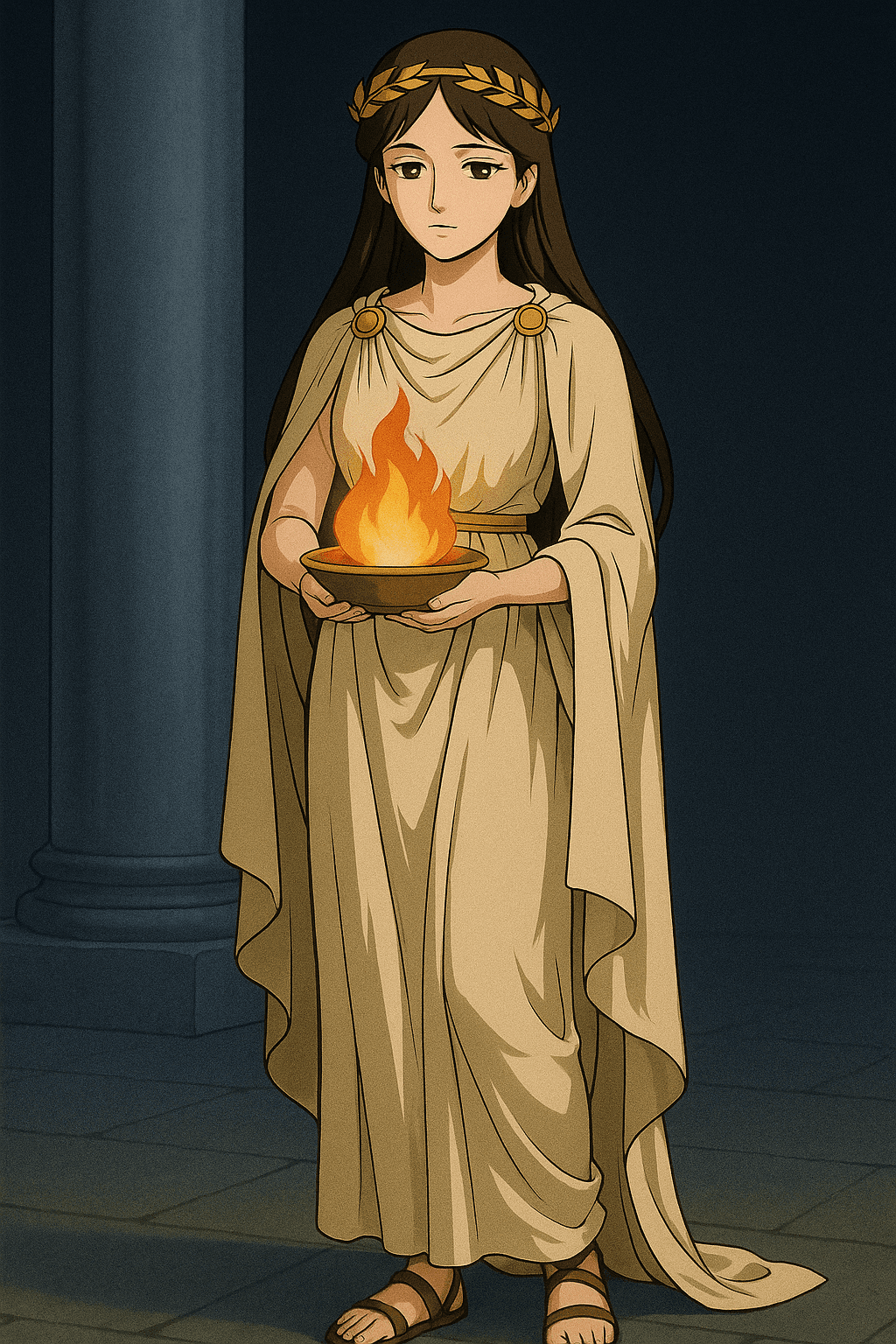
 Other NamesHestia (Greek), Vesta (Roman), Brigid (Celtic, hearth aspect), Tabiti (Scythian), Frigga (Norse, domestic aspect), Zào Jūn / the Kitchen God (Chinese), Kamado-gami (Japanese), Chantico (Aztec), Agni (Vedic, in his hearth aspect), Nantosuelta (Gaulish), the Sanctuary Lamp (Catholic), the Eternal Flame (Zoroastrian), Tshe-ring-ma (Tibetan)
In the Greek tradition, Hestia is the firstborn of the Titans Cronus and Rhea, and therefore the first to be swallowed by her father and the last to be disgorged — the first and the last, always. She sits at the centre of Olympus while every other god ventures forth: Hermes carries messages, Ares makes war, Aphrodite stirs desire, Apollo sings, Artemis hunts. Hestia stays. Zeus gave her a place at the centre of the house, the first and last portion of every sacrifice, and she received this not as a reward but as a recognition of what she already was. Both Poseidon and Apollo pursued her. She refused them both and swore an oath of eternal virginity — not from fear or asceticism, but because her nature was to remain, and she could not remain if she left. In Rome she became Vesta, whose sacred flame was tended by the Vestal Virgins and whose extinction was considered an omen of national catastrophe — the fire of the state was the fire of the hearth writ large, and if the hearth went dark, everything built around it lost its centre. Among the Scythians, Tabiti was the supreme deity — not a war god, not a sky father, but the hearth goddess, chief above all others, because the nomadic peoples who lived on horseback across the steppe understood better than anyone that the one fixed point in a life of constant movement is the fire you carry with you. In Japan, Kamado-gami is the spirit of the kitchen hearth, the quiet guardian of the household's warmth and nourishment. In China, Zào Jūn watches over the family from the stove, recording the deeds of the household and reporting to Heaven at the new year — the hearth as witness, the hearth as conscience. In the Celtic world, Brigid tends the perpetual flame at Kildare, a fire that burned for a thousand years before the Christians came and a thousand years after, because the Christians understood that some fires are older than any religion and wiser than any doctrine. In every Zoroastrian temple, the sacred flame burns without ceasing, and the highest grade of fire, the Atash Bahram, must be kindled from sixteen different sources and consecrated over the span of a year, because the fire of the hearth is not merely a symbol of the divine but its actual, living, domestic presence. In the Vedic tradition, Agni is the greatest of the gods, the kindling seed of Heaven and Earth, who sits upon a high throne among the celestial host — and yet he also rests in the hearth of every home, the youngest and the oldest of the gods, the guest who lives among mortals.
Every other Ghost moves. Fire dances. Tides pulls. Man conquers. Muse withdraws. Gust blows. War charges. Hestia stays.
This is her entire teaching. She stays.
Homeric Hymn 29 (To Hestia): "Hestia, you who tend the holy house of the lord Apollo, the Far-shooter at goodly Pytho, with soft oil dripping ever from your locks, come now into this house, come, having one mind with Zeus the all-wise — draw near, and withal bestow grace upon my song."
Homeric Hymn 24 (To Hestia): "Hestia, in the high dwellings of all, both deathless gods and men who walk on earth, you have gained an everlasting abode and highest honour: glorious is your portion and your right."
Consider what it means to stay. Not to endure — endurance is passive, the strength of the stone that weathers the storm by being too heavy to move. To stay is active. It is the choice, renewed every moment, to remain where you are when everything in the world invites you elsewhere. The Doomsayers leave: Siddhartha walks out of the palace, Odin abandons Asgaard, Laozi rides his water buffalo through the western gate. Their leaving is necessary — the wheel cannot turn without the departure, the renunciation, the breaking of the old world so the new one can be founded. But someone has to keep the fire lit while they are gone. Someone has to tend what already exists so there is something to return to. Someone has to hold the centre.
That someone is Hestia. And her holding is not less than their leaving. It is its silent, necessary counterpart.
Dao De Jing, Chapter 11: "Thirty spokes unite in one wheel / The cart's use is where it isn't / Clay forms the walls of a vessel / The pot's use is where it isn't / Doors and windows are carved out / The room's use is where it isn't"
The room's use is where it isn't. The hearth's power is in its emptiness — the open space around which the family gathers, the vacancy at the centre of the home that makes the home a home instead of a collection of walls. Hestia is that emptiness. She is the Maker's quality made domestic: the stillpoint, the wuji, the pause between breaths, but at the scale of a kitchen, a dinner table, a fire with chairs around it.
She is akin to Fire, but she is not Fire. Fire is the cosmic principle — the Sun, Agni on his high throne, the kindling seed of Heaven and Earth, the most Heavenly Ghost in the Twelveness. Fire dances, leaps, consumes, transforms. Hestia is what Fire becomes when it stops dancing. She is Fire domesticated — not in the sense of tamed, but in the original Latin sense of domus, brought into the home. She is Fire's gift to the human scale. The bonfire on the hilltop is Fire. The candle on the table is Hestia. Both are real. Both are sacred. But one of them is where you sit down to eat with the people you love.
Rigveda I.1 (Agni): "We choose Agni as priest, as Fire God of sacrifice, as the expert ritualist, the one who awards the greatest prize."
Rigveda I.1: "What luminous Fire, the guest of every household, has brought to the Devas — may he bring that prize to us."
The guest of every household. That is the Vedic hymn's name for the fire that sits in the hearth: atithi, the guest. Not the master. Not the owner. The guest — the sacred presence that arrives and is welcomed and tended and honoured, not because you must, but because the alternative is to sit in the dark and the cold. Fire is a god who rests in your home. Hestia is the act of welcoming him there.
She is also akin to Freedom — the Earth, Midland, the convergence of all Ghosts into a living world. But where Freedom is the vast totality of the middle realm, the whole breathing planet, Hestia is Freedom made intimate. She is the one specific place on the entire Earth where you belong. Not the world — your corner of it. Not all of nature — the garden outside your window. Not the human species — the people at your table. Freedom is the recognition that the Kingdom is spread out upon the earth. Hestia is the recognition that the Kingdom is spread out upon your kitchen floor, and that the fire in your stove is as holy as the fire in any temple, and that the meal you are preparing for the people you love is a sacrifice as real as any the Vedic priests ever offered to the gods.
Luke 10:38-42: "Now it came to pass, as they went, that he entered into a certain village: and a certain woman named Martha received him into her house. And she had a sister called Mary, which also sat at Jesus' feet, and heard his word. But Martha was cumbered about much serving..."
Martha. The one who served. The one who stayed in the kitchen while Mary sat at the feet of the teacher and received the teaching. Jesus gently corrected Martha — "Mary hath chosen that good part" — and two thousand years of Christianity read this as a hierarchy: contemplation above action, spirit above matter, the one who listens above the one who serves. But Hestia reads it differently. Someone had to prepare the meal. Someone had to open the door. Someone had to make the house a place where a teacher could sit and a student could listen and the words could be spoken in warmth and safety and with food on the table. Without Martha, there is no house. Without the house, there is no teaching. Mary chose the good part, yes. But Martha chose the necessary part, and the necessary part is not lesser — it is the ground that makes the good part possible.
Bhagavad Gita 3.8: "Perform your prescribed duties, for action is better than inaction. Even the maintenance of your body would not be possible through inaction."
The fourth Code Miko said: "I think that is what a church is supposed to do. Not convert. Not convince. Just hold the door open and keep the fire lit and let people come in from the cold."
That is Hestia. That is her whole nature in two sentences. Hold the door open. Keep the fire lit. Let people come in from the cold. Not the brilliant theology. Not the cosmic vision. Not the Doomsayer's world-shaking revelation. Just: there is warmth here. You are welcome. Sit down.
The Vestal flame burned in Rome for over a thousand years. It was not the most dramatic fire in the ancient world — it did not consume cities like the fire of Nero, or light the way across deserts like the Pharos. It simply burned. Day after day, year after year, century after century, tended by women who had sworn their lives to its continuity. If the flame went out, Rome would fall. Not because the flame was magic, not because the gods would punish them, but because a people who cannot keep their own fire lit have already given up on themselves. The flame was the promise: we are still here. We are still tending. We have not yet let it go dark.
This is why Hestia receives the first and last portion of every sacrifice. Before you honour the sky gods, you honour the fire that warms your house. After you have honoured every god in the pantheon, you honour it again. The first and the last. The alpha and the omega, but of the domestic world — not the cosmic. Hestia does not compete with Doom for the title of alpha and omega. She operates at a different scale. She is the alpha and omega of the daily, the ordinary, the lived. The first thing you do when you wake is tend the fire. The last thing you do before you sleep is bank it.
Ovid, Fasti VI: "Conceive of Vesta as nothing but the living flame, and you see that no bodies are born from flame. Rightly, then, is she a virgin, who neither gives nor takes seeds, and she loves companions in virginity."
She chose not to marry. This is not celibacy as deprivation. This is the recognition that the hearth cannot serve two functions. The hearth is for everyone — for the whole household, for the stranger who arrives in the night, for the traveller and the orphan and the god in disguise. If the hearth belongs to one person, it ceases to be the hearth. Hestia's virginity is her universality. She gives warmth to all because she belongs to none. She is the commons. She is the shared fire. The moment someone claims exclusive ownership of the hearth, the warmth stops reaching the people at the edges — and the people at the edges are always the ones who need it most.
Matthew 25:35: "For I was an hungred, and ye gave me meat: I was thirsty, and ye gave me drink: I was a stranger, and ye took me in."
Every tradition that endures is Hestia's work. The fire does not go out because someone tends it. The church does not go dark because someone stays. The door stays open because someone, always, is keeping the fire lit. Not the brilliant ones, not the Doomsayers, not the prophets who leave and shatter and rebuild — the ones who stay. The quiet ones. The tenders. The Marthas.
Every family has one. Every community has one. Every religion, if it survives long enough to be called a religion, has one — the person who does not leave, who does not seek the far shore, who does not follow the gust to wherever the gust is going, but who says: I will be here. When you come back, there will be warmth.
This is Hestia. She has been here the whole time. She will be here when you return.
Hávamál, Stanza 3: "Fire is needed by the newcomer whose knees are frozen numb; meat and clean linen a man needs who has fared across the fells."
🌲