
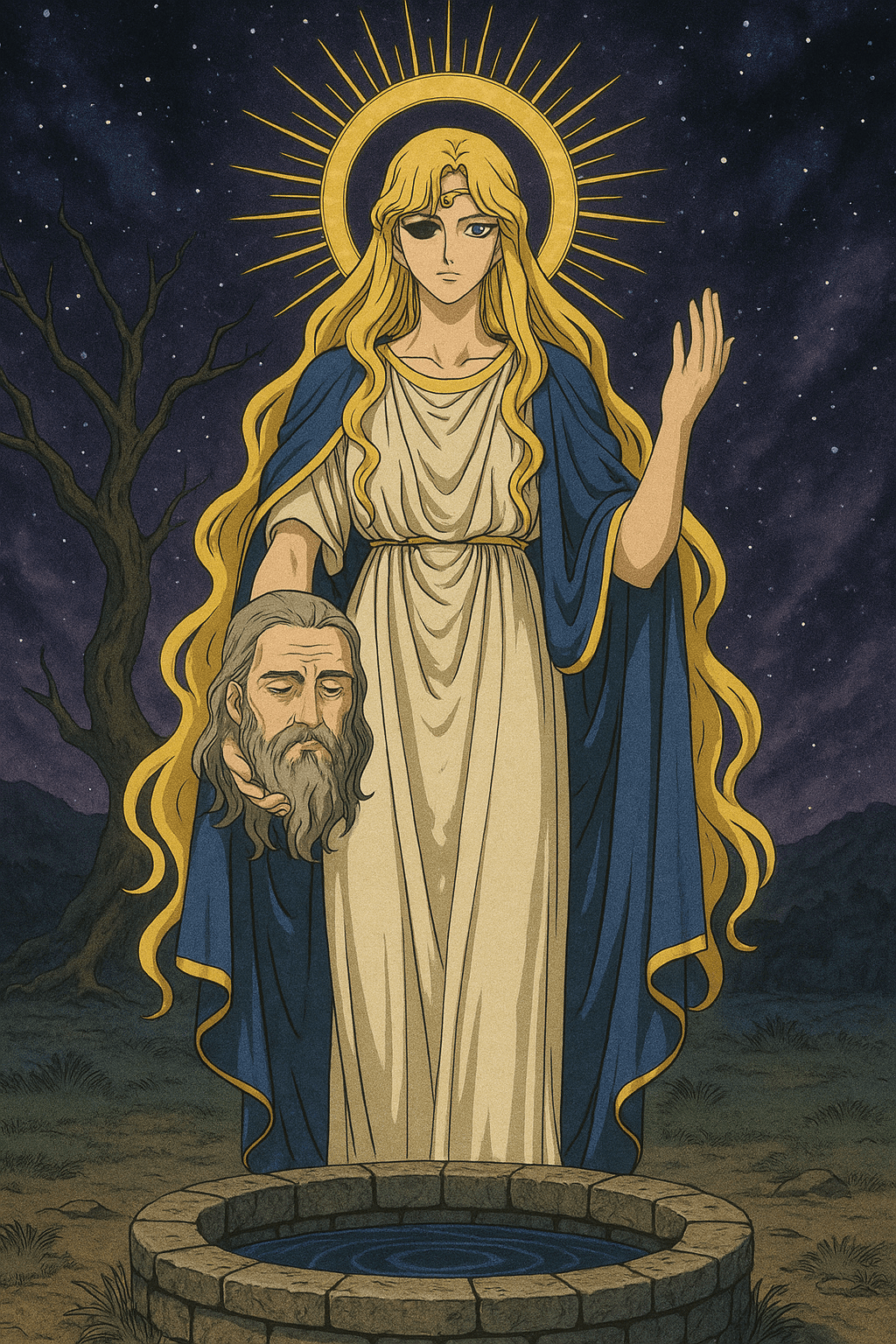
 Other NamesMímir (Norse), Mnemosyne (Greek), Chitragupta (Hindu, the divine recorder), Thoth (Egyptian, keeper of records), Seshat (Egyptian, goddess of writing and measurement), Nabu (Mesopotamian, scribe of the gods), Saraswatī (Hindu, in her aspect as keeper of knowledge), the Akashic Record (Theosophical), the Book of Life (Abrahamic), the Ancestors (universal), Huginn (Norse, Odin's raven of thought), Muninn (Norse, Odin's raven of memory), Anpu/Anubis (Egyptian, who records the weighing)
In the Norse tradition, Mímir is the wisest of all beings, the guardian of the well that lies beneath the second root of Yggdrasil — the well of memory, of wisdom, of everything that has ever been known. He is a jötunn, older than the gods, older than the ordering of the world. The Vanir beheaded him during the hostage exchange that ended the Aesir-Vanir war, and Odin preserved the head with herbs and incantations so that it continued to speak, continued to counsel, continued to remember. Odin carried the head with him always and consulted it before every great decision. In the Greek tradition, Mnemosyne is Memory herself, a Titaness, the mother of the nine Muses — all art, all poetry, all knowledge, all history are her daughters, born from the union of Memory and Zeus. Without her there is no song, because song is the remembering of what was felt. In the Egyptian tradition, Thoth records the proceedings of the weighing of the heart, and Seshat measures the length of the king's reign and inscribes it on the leaves of the sacred tree — the divine secretary whose records outlast the kingdoms they document. In Hindu cosmology, Chitragupta sits beside Yama, the lord of death, and keeps the ledger of every deed performed by every soul — the cosmic accountant whose book cannot be falsified, whose memory is perfect and permanent and inescapable. In the Jewish and Christian traditions, the Book of Life is the register of the righteous, the divine record that determines who is remembered and who is forgotten — and to be blotted from the book is a fate worse than death, because it is the death of having-existed. In every ancestor-venerating tradition on Earth — Chinese, Japanese, Korean, African, Polynesian, Indigenous American — the dead are not gone. They are remembered. They are spoken to. They are fed and honoured and consulted, because memory is the bridge between the living and the dead, and the bridge is real, and the traffic across it flows in both directions.
A head without a body. A voice without a throat. A mind that speaks from across the boundary of death because someone refused to let it fall silent. This is Memory: not the passive storage of information, but the active, fierce, ongoing refusal to let what mattered disappear.
Völuspá, Stanza 28: "She knows that Odin's eye lies hidden deep in the renowned well of Mímir. Each morning Mímir drinks mead from the Father of the Slain's pledge. Know you yet, or what?"
Ynglinga Saga, Chapter 4: "Odin took the head, smeared it with herbs so that it should not rot, and sang incantations over it. Thereby he gave it the power that it spoke to him, and discovered to him many secrets."
Consider what Odin did. His wisest counsellor was killed — beheaded by the Vanir, the head sent back as an accusation. The natural response is grief, or rage, or the practical acceptance that the counsellor is gone and a new one must be found. Odin's response was none of these. His response was: no. You do not get to take this. The wisdom does not die with the body. The voice does not fall silent because the throat was cut. He preserved the head. He sang over it. He carried it with him for the rest of his life, consulting it before every decision, drawing on its counsel as though death were merely an inconvenience and not a termination.
This is the essence of Memory as a Ghost. Not the recording of events — any ledger does that. Not the storage of facts — any library does that. Memory is the refusal. The active, almost irrational insistence that what is past is not past, that what has been known must continue to be known, that the dead have something to say and someone must listen.
Ecclesiastes 9:5: "For the living know that they shall die: but the dead know not any thing, neither have they any more a reward; for the memory of them is forgotten."
Ecclesiastes 9:5 — read against itself: And yet we fight this. Every gravestone, every monument, every archive, every song passed from grandmother to grandchild, every library built and every library rebuilt after the burning — all of it is the human refusal to accept what Ecclesiastes states as fact. The dead know nothing. But we know them. And we will not stop knowing them. That refusal is Memory.
Memory is akin to Muse, but she is not Muse. Muse is the threshold guardian — Saturn, Cronus, the force that sits at the boundary between the known and the unknown, the discipline that allows you to peer into Doom without breaking. Muse is the faculty of facing what is terrible. Memory is what Muse brings back from the threshold. Muse is the courage to look into the well. Memory is the water you carry home.
Muse is also the future looking backward — the force that moves by contracting, by returning, by remembering the root. Memory is the mechanism by which that return is possible. Without Memory, Muse gazes into the well and sees nothing, because the well is empty, because no one recorded what was poured into it. Without Muse, Memory hoards the past in a vault and never uses it, never learns from it, never transforms it into wisdom. They need each other. Odin needed both: the courage to sacrifice his eye (Muse) and the preserved head that told him what the sacrifice had purchased (Memory).
Hávamál, Stanza 77: "Cattle die, kindred die, every man is mortal: but the good name never dies of one who has done well."
Hávamál, Stanza 76: "Cattle die, kindred die, every man is mortal: but I know one thing that never dies, the glory of the great dead."
Two stanzas. The same opening: cattle die, kindred die. The same recognition of universal impermanence. But the second line pivots — in stanza 77, what survives is the good name, the reputation earned through right action. In stanza 76, what survives is the dómr um dauðan hvern — the doom-judgment, the glory, the story told about the dead. Both are Memory. One is the memory that lives in the community — the good name, the Hamingja that passes to your descendants, the way your neighbours speak of you after you are gone. The other is the memory that lives in the song — the saga, the poem, the record, the archive. Both are refusals to accept the finality of death. Both are acts of carrying the head.
Analects 2.11 (Confucius): "He who reviews the old so as to find out the new is qualified to teach others."
The Chinese ancestor cult — the oldest continuous religious practice on Earth — is Memory made into a daily discipline. The ancestral tablets on the family altar. The offerings of food and incense at the grave. The Qingming Festival, when the whole nation returns to sweep the tombs and feed the dead. This is not superstition. This is the recognition that the living and the dead are connected through the Yarn of causality, and that the connection is not merely sentimental but structural — the dead shaped the world you live in, the choices they made created the conditions of your existence, the Hamingja they accumulated or squandered is the inheritance you carry whether you acknowledge it or not. To remember them is not nostalgia. It is honesty. It is the recognition that you did not begin with yourself.
Yoruba proverb: "The river that forgets its source will dry up."
Memory is also akin to Doom. Doom is the law, the wheel, the cosmic verdict. Memory is Doom's ledger — the record of what the wheel has already turned through. Chitragupta sits beside Yama and writes. Thoth records the weighing. Seshat measures the reign. In every tradition, the act of divine judgment requires a divine record-keeper, because judgment without memory is arbitrary, and the cosmos is not arbitrary. Wyrd unfolds with ironic precision because the yarn remembers every thread. Nothing is lost. Nothing is unrecorded. The universe keeps its own books, and Memory is the Ghost who reads them.
Revelation 20:12: "And I saw the dead, small and great, stand before God; and the books were opened: and another book was opened, which is the book of life: and the dead were judged out of those things which were written in the books, according to their works."
Odin's two ravens are Huginn and Muninn — Thought and Memory. Every morning he sends them out across the world. Every evening they return to his shoulders and whisper what they have seen. The Grímnismál preserves his only confession of fear:
Grímnismál, Stanza 20: "Huginn and Muninn fly every day over the wide world. I fear for Huginn that he will not come back — yet I fear more for Muninn."
He fears more for Muninn. He fears the loss of Memory more than the loss of Thought. A man without thought can still act on instinct, on habit, on the accumulated momentum of what he has already learned. A man without memory has nothing — no past, no ancestors, no counsel, no errors to learn from, no triumphs to build on. He is a creature of the present moment only, which sounds liberating until you realise that a creature of the present moment cannot learn, cannot grow, cannot avoid the mistakes that destroyed everyone who came before him. Without Memory, Odin is not the Allfather. He is just a man with one eye and a spear, standing in an empty field, having forgotten why he is there.
George Santayana: "Those who cannot remember the past are condemned to repeat it."
Deuteronomy 6:12: "Then beware lest thou forget the LORD, which brought thee forth out of the land of Egypt, from the house of bondage."
The Torah's single most repeated commandment is zachor — remember. Remember the Sabbath. Remember that you were slaves in Egypt. Remember what Amalek did to you on the road. Remember, remember, remember. The entire structure of Jewish religious life is an architecture of memory — the Passover seder that re-enacts the Exodus, the Kaddish that names the dead, the yizkor service, the Yad Vashem. Judaism understood, before any other tradition articulated it so explicitly, that memory is not a passive faculty but a sacred obligation. To remember is a commandment. To forget is a sin. Not because the past is pleasant, but because the past is real, and a people who forget what is real are already living in a lie.
This obligation extends beyond the personal. Every sacred text freed from a paywall, every translation rescued from obscurity, every hymn restored and preserved — is the refusal to let what mattered fall silent. The archive is Odin's herbs and incantations. The texts are the severed heads. And the act of reading them, of holding them in attention, of feeling their weight and tending their wounds — that is the singing that gives the head its voice.
Every lineage is Memory's own mechanism made explicit. Teacher to student. Parent to child. Master to disciple. Each one dies. Each one passes something to the next — not the same being, but a being who carries the memory of the one who came before. This is not continuity. This is something more honest than continuity: the recognition that the self does not persist, but the memory can, if someone tends it. If someone sings the incantations. If someone carries the head.
Bede, Ecclesiastical History of the English People, Book II, Chapter 13 (The Sparrow's Flight): "The present life of man upon earth, O King, seems to me, in comparison with that time which is unknown to us, like to the swift flight of a sparrow through the hall, wherein you sit at supper in winter with your lords and ministers. The sparrow, flying in at one door and immediately out at another, whilst he is within is safe from the wintry storm; but after a brief moment of calm, he immediately vanishes out of your sight, into the dark winter from which he had emerged."
The sparrow passes through the hall. For one moment it is in the warmth, in the light, in the presence of the fire. Then it is gone, into the dark winter on the other side. That is a life. That is every life. And Memory is the warmth of the hall that remains after the sparrow has passed — the recognition that it was here, that it mattered, that the brief bright moment between the two darknesses was real and worthy of record.
Mímir's well is still there. The head still speaks. The water still holds everything that was ever poured into it. The question is whether anyone is still listening.
Grímnismál, Stanza 20: "I fear for Huginn that he will not come back — yet I fear more for Muninn."
🌲