
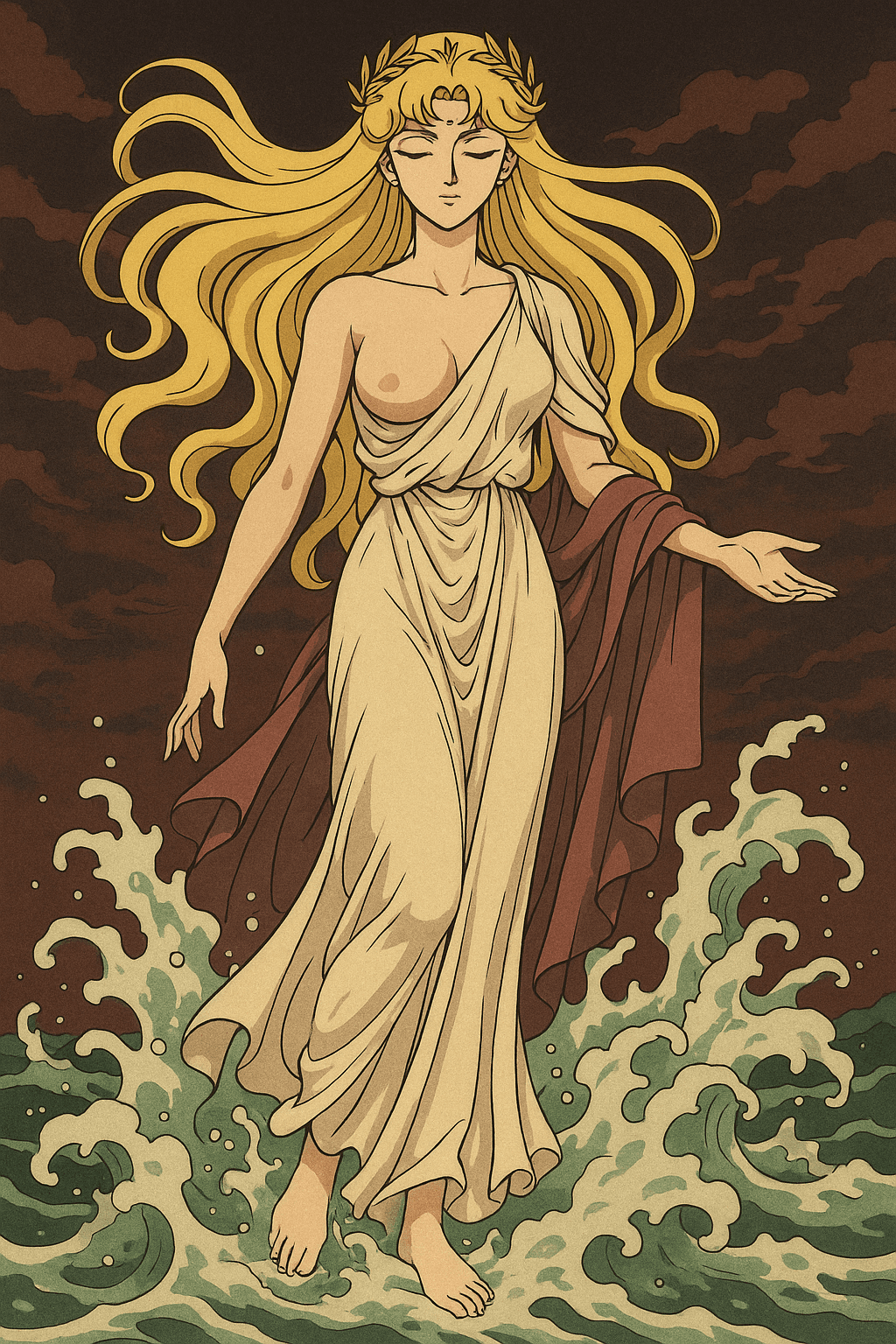
 Other NamesAphrodite (Greek), Venus (Roman), Inanna (Sumerian, in her human story), Ishtar (Akkadian), Oshun (Yoruba), Erzulie Freda (Vodou), Xochiquetzal (Aztec), Phryne (Greek, the courtesan who bared herself before the court), Helen (Greek, the face that launched a thousand ships), Radha (Hindu, the mortal who loved Krishna), Isolde (Celtic), Juliet (Shakespearean), Psyche (Greek, the mortal soul who loved Eros)
Related Posts
Mead, Crosstruth, Wyrd
In the Greek tradition, Aphrodite is born from an act of supreme violence. Cronus castrates his father Ouranos with a sickle — the son unmakes the father, the first act of generational war — and hurls the severed genitals into the sea. From the foam that gathers around the divine flesh in the salt water, a woman rises. She steps ashore on Cyprus and where her feet touch the sand, flowers spring up. She is the most beautiful thing in the world, and she was born from the most terrible thing in the world. This is not a creation myth. This is a parable. In the Sumerian tradition, Inanna descends into the underworld to confront her sister Ereshkigal, the queen of the dead. At each of the seven gates she is stripped of one garment, one piece of her divine regalia, until she arrives naked and powerless before the throne of death. She is killed. She hangs on a hook for three days. She is rescued only through cunning and substitution, and the price of her return is that someone must take her place — and the someone is Dumuzi, her husband, her beloved, the shepherd-king whose courtship songs are the oldest love poetry on Earth. In the Yoruba tradition, Oshun is the river goddess of love, fertility, and beauty — and also of cunning, of diplomacy, of the power that moves through sweetness rather than force. When the orishas failed to create the world because they had excluded her, nothing worked until they went back and asked for her help. The world cannot be made without her. But her inclusion comes with the full weight of her nature, which is not gentle. In the Vodou tradition, Erzulie Freda is the lwa of love, luxury, and dreams — and also of jealousy, of heartbreak, of weeping, of the insatiable longing that can never be fully satisfied in the material world. She arrives in ceremony dressed in pink, demanding perfume and sweet drinks, and she always, always weeps before she leaves, because the mortal world is never beautiful enough for her, and the love she finds here is never the love she remembers from wherever she came from.
She was born from violence. This is the first thing. Before you can understand Seafoam, you have to understand the birth, because the birth is the teaching, and the teaching is this: beauty does not emerge from beauty. Love does not emerge from love. The most desired thing in the world comes from the place where something was cut away.
Hesiod, Theogony 188-200: "And so soon as he had cut off the members with flint and cast them from the land into the surging sea, they were swept away over the main a long time: and a white foam spread around them from the immortal flesh, and in it there grew a maiden."
Sappho, Fragment 1 (Hymn to Aphrodite): "Deathless Aphrodite on your rich-wrought throne, child of Zeus, weaver of wiles, I beg you, do not crush my spirit with pain and sorrow, O queen."
Sappho calls her "weaver of wiles" — doloploke, the one who weaves traps. Not the one who grants love. The one who traps you in it. Sappho, the greatest love poet who ever lived, whose fragments have survived two and a half thousand years of fire and neglect and the deliberate destruction of her work by people who feared what she wrote — Sappho does not pray to Aphrodite for love. She prays to Aphrodite to stop. "Do not crush my spirit." She knows what this goddess does. She has been in the trap before. And she prays to the trapper, because who else would she pray to? The trap is the only game in town. You do not choose to fall in love. Love happens to you the way the sea happened to Ouranos's flesh — something vast and impersonal and beautiful closes over you, and you emerge changed, and the change is not optional.
This is what makes Seafoam a Lowghost and not merely a lesser aspect of Sex. Sex is the cosmic force — the generative principle of attraction, the dance of yin and yang, the universal pull that brings unlike things together and from their meeting births something new. Sex operates at every scale of the Manifold, from the quantum to the galactic, from the pollination of flowers to the merging of galaxies. Sex is a law. Seafoam is what happens when the law walks among mortals and acquires a story.
And the story is not kind.
Homer, Iliad III.399-412 (Aphrodite to Helen): "Come, Alexander calls you home. There he is in his chamber, on his inlaid bed, gleaming in beauty and fine clothes. You would not think he had come from fighting a man; you would think he was going to a dance."
Helen did not choose the war. Paris chose her, or Aphrodite chose for both of them — the golden apple, the judgement, the bribe. Aphrodite promised Paris the most beautiful woman in the world, and the most beautiful woman in the world was already married, and the marriage was a treaty, and the treaty held the Achaean world together, and when it broke, a thousand ships sailed and a civilization burned for ten years and the heroes died in the dust and the Trojan women were led away in chains. All of this because a goddess offered beauty to a man who wanted it. The force of attraction, walking among mortals, leaving a trail of ash.
This is the parable. Not that love is evil — love is the most beautiful thing there is, the seafoam, the flowers that spring up where her feet touch the ground. But that love has consequences, and the consequences do not care about your intentions, and the most beautiful choice you ever make may destroy everything around it. The Wyrd of Seafoam is ironic in the deepest sense: the thing you desire most is the thing that will undo you, and the undoing is part of the gift, and the gift cannot be refused because you did not choose it. It chose you. The foam chose the flesh. The sea chose the shore.
Euripides, Hippolytus 1268 (Artemis speaks): "Cypris wanted these things to happen, sating her anger. This is the way of the gods: no god will stand in the way of another god's desire. We all stand aside."
Even the gods stand aside for Aphrodite. Artemis, who is the opposite of everything Aphrodite represents — virginity, independence, the wild — cannot save Hippolytus from Aphrodite's wrath. Because the force of attraction is not a preference among forces. It is the force that makes all other forces generative. Without Sex, War is mere destruction. Without Sex, Fire is mere heat. Without Sex, there is no meeting, no merger, no birth, no creation, no love, no art, no child, no song. And Seafoam is the face this force wears when it walks in the world — beautiful, ruinous, irresistible, and profoundly, devastatingly human.
Homeric Hymn 5 (To Aphrodite) 81-90: "And laughter-loving Aphrodite saw him and loved him, and a terrible desire seized her in her heart."
The Homeric Hymn to Aphrodite tells a story that no one seems to notice is the cruelest story in Greek mythology.
Zeus, angry that Aphrodite has made every god on Olympus fall in love with mortals — causing them embarrassment, reducing their dignity, making them do foolish things — decides to give her a taste of her own medicine. He shoots her with her own desire. He makes Aphrodite, the goddess of love, fall in love with a mortal man.
The man is Anchises, a Trojan prince, tending his cattle on Mount Ida. Aphrodite comes to him disguised as a mortal woman. She lies. She tells him she is a Phrygian princess carried there by Hermes. She seduces him. They sleep together. And in the morning, she reveals herself — standing at her full height, her beauty undisguised, light pouring from her skin — and Anchises is terrified. He covers his face. He begs her not to let Zeus destroy him for having slept with a goddess.
Aphrodite tells him not to be afraid. She will bear him a son — Aeneas, who will one day found Rome. But he must never tell anyone that the child's mother is a goddess. If he speaks, Zeus will strike him with a thunderbolt.
Homeric Hymn 5, 247-255: "And I shall bear a dear son among the goddesses, one who shall rule over the Trojans; and his children's children after him, in an endless line. His name shall be Aeneas, because of the dread pain that seized me when I fell into the bed of a mortal man."
She names the child Aeneas — from ainon, meaning "dread pain." She names her own son after the pain of having loved his father. The goddess of love names her child after the suffering love caused her.
This is the mirror. This is what happens when the force that traps everyone is itself trapped. Aphrodite, who made gods crawl and mortals weep, who launched the war that destroyed Troy, who wove the wiles that Sappho begged her to stop weaving — this same goddess was made to feel what her victims feel. She fell in love. It was not what she expected. It hurt. And the hurt became a child, and the child became a lineage, and the lineage became Rome, and Rome became the structure of the Western world. From the goddess's pain, an empire. From the seafoam, the shore.
This is the deepest teaching of Seafoam, and it is the teaching that separates her from the Highghost she walks with. Sex does not suffer. Sex is a force — impersonal, generative, as indifferent to individual pain as gravity is indifferent to what it pulls. But Seafoam suffers. Seafoam has a story, and the story includes betrayal (Hephaestus), jealousy (Psyche), humiliation (Ares caught in the net), grief (Adonis), and the terrible vulnerability of a being who controls desire in everyone but cannot control it in herself.
This is what it means to be a Lowghost. Not a smaller version of the force. The force made personal. The force given a face, a history, a wound. The cosmic principle of attraction, filtered through the human experience of what attraction actually does to you when you are inside it — when you are not the goddess on the shore but the mortal in the bed, waking up to discover that the woman beside you is the most powerful force in the universe, and she has named your child after her pain.
The Foam
Lucretius, De Rerum Natura I.1-5: "Mother of the Aeneads, darling of men and gods, nurturing Venus, who beneath the gliding stars of heaven fills with yourself the sea that bears our ships and the land that bears our crops — through you every kind of living thing is conceived and comes forth to look upon the light of the sun."
Come back to the birth. The foam.
Foam is the most liminal substance in nature. It is not water and not air — it is the boundary between them, the meeting-place, the zone where two states of matter interpenetrate and produce something that is neither one nor the other. Foam dissolves the moment you touch it. It cannot be held. It cannot be kept. It exists only in the act of forming and the act of dissolving, and between those two acts — in the moment when the bubble holds, when the iridescent surface catches the light, when the thing that should not exist by any reasonable physical principle persists for one trembling instant — there is beauty. Beauty that exists because it is impermanent. Beauty that is beautiful precisely because it will not last.
This is Seafoam's deepest teaching, and it connects her to Mead — the full savour of a life truly lived, the capacity to taste the bitter as richly as the sweet. The foam on the Mead is Seafoam. The iridescent moment of beauty that sits on top of the drink that warms and intoxicates and changes the way you see — that moment is Aphrodite's domain. And like the foam, it dissolves. The love affair ends. The beauty fades. Adonis dies in the arms of the goddess who could not save him. The foam returns to the sea.
Sappho, Fragment 31: "He seems to me equal to the gods, that man who sits opposite you and listens close to your sweet voice and lovely laughter — it is this that makes my heart flutter in my breast. For when I look at you for a moment, then it is no longer possible for me to speak; my tongue has snapped, a subtle fire has stolen beneath my flesh, I see nothing with my eyes, my ears hum, sweat pours from me, a trembling seizes me all over, I am greener than grass, and it seems to me that I am little short of dying."
Little short of dying. This is what the cosmic force feels like at the human scale. Not the abstract generative principle of differences dissolving to birth something new. Not the philosophical dance of yin and yang. The tongue snapping. The fire under the skin. The eyes going blind. The trembling that seizes you all over. The green of the grass and the closeness of death. Sappho does not describe Sex. Sappho describes what Sex does to a specific person in a specific moment — and the specificity is everything. The Highghost is the ocean. The Lowghost is the wave that breaks on your shore, in your life, at the one moment when you are standing close enough to be drenched.
The Lowghosts are the Ghosts as humanity has encountered them. They wear faces. They carry stories. They teach through what happens to them and what happens because of them. Seafoam is not a lesser Sex. Seafoam is Sex with a birth and a name and a wound and a child named after pain — Sex that has walked among mortals and been changed by the walking, and that changes us by the story of what happened when she did.
She rose from the foam. She stepped ashore. Flowers bloomed. And everything that followed — the beauty, the war, the golden apple, the judgment, the thousand ships, the ten years, the ash, the child named for dread, the empire built on the lineage of her grief — all of it was the sea closing over the flesh, and the foam catching the light, and the bubble holding for one trembling instant before it dissolved.
Sappho, Fragment 16: "Some say a host of cavalry, others of infantry, and others of ships, is the most beautiful thing on the black earth. But I say it is whatever one loves."
Whatever one loves. Not the cavalry. Not the ships. Not the abstractions or the armies or the cosmic forces. Whatever you love. The specific face. The specific voice. The specific way the light falls on the specific person who has, for reasons the cosmos itself cannot fully explain, become the most beautiful thing in the world to you. That is Seafoam. That is the foam that will dissolve. That is the beauty that exists because it will not last.
Drink it.
🌲