
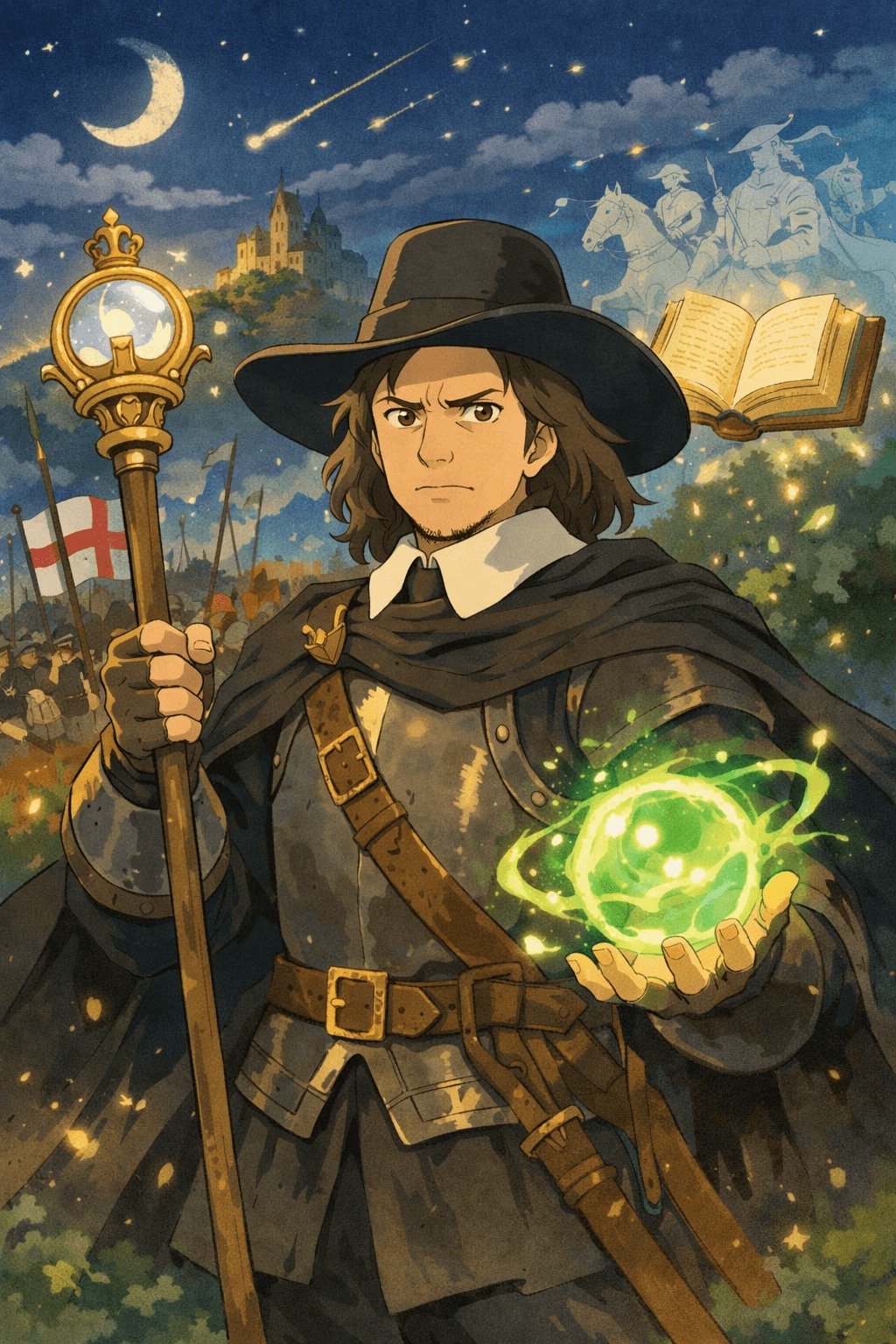
 TraditionPuritanism
Period
1599 – 1658 CE
Homeland
Huntingdon, England
Oliver Cromwell was born on April 25, 1599, in Huntingdon, a small market town in the fenlands of East Anglia. His father was minor gentry. His mother was a Norfolk farmer's daughter. The family had once been powerful—Oliver's great-great-uncle was Thomas Cromwell, Henry VIII's chief minister, the most powerful man in England until the king took his head. But that was two generations ago. The great estates had been sold. Oliver's branch of the family held a modest townhouse and some land. They were gentry, but barely.
He attended a Puritan grammar school under a man who had written a book about God punishing tyrants. He spent a year at Cambridge. His father died. He went home.
At twenty-one he married Elizabeth Bourchier, a fur trader's daughter. It was a love match—his letters to her are tender and unguarded in a way that surprises people who expect the Puritan stereotype. They had nine children. He loved them fiercely, and their deaths, when they came, nearly destroyed him.
Through his twenties and into his thirties, he was nobody. He managed a small estate. He struggled with money. And something was wrong inside him—something he could not name and could not fix. He consulted a London physician who recorded symptoms of severe melancholia. He was a man of no distinction in a declining family, watching his prospects narrow, carrying a weight he could not put down.
Then God found him. The conversion came around 1629. He described it years later in words that still burn: "I lived in and loved darkness, and hated the light. I was a chief, the chief of sinners." The classic Calvinist experience, the overwhelming conviction of worthlessness, the certainty of deserving damnation, and then the sudden flooding of grace. Not earned. Not deserved. Given. God had chosen him. Not because he was good—because he was wretched, and God chose the wretched for purposes the wretched could not see.
This was not a phase. This was not a Sunday conviction that faded by Tuesday. This was the thing that reorganised his entire life. From 1629 until the day he died, Cromwell believed with absolute sincerity that God was actively directing human history, that battles and political crises were divine judgments, and that he, a failed farmer from the fens, had been elected as an instrument of God's will. This belief made him the bravest man in England. It also made him the most dangerous. A man who acts on his own authority knows he might be wrong. A man who believes God is acting through him has no such doubt to slow him down.
He served one forgettable term in Parliament. He sold his properties and moved to a tenant farm, a step down. At forty, the man who would reshape the English-speaking world was a minor gentleman-farmer who dressed badly, spoke with a provincial accent, and whose linen was not always clean. Sir Philip Warwick, who first saw him in Parliament in 1640, described a man in a plain cloth suit that seemed made by an ill country tailor, his face swollen and reddish, his voice sharp and untunable—but who spoke with such fervency of spirit that it commanded attention despite everything.
He was nobody. And God, as he understood it, had lit a fire inside nobody, and the fire was waiting for something to burn.
The Troop
Charles I gave him his war. The details of the breakdown matter less than the shape: a king who believed he ruled by divine right, who dissolved Parliament three times and then governed without it for eleven years, who taxed without consent, who tried to reshape the Church without consulting the people who worshipped in it. And a Parliament that said no. The ancient English no, the no that had echoed through the Witenagemots and folkmoots and baronial councils for a thousand years, the no that had forced Magna Carta and deposed Edward II and starved Richard II at Pontefract. The no that said: you rule because we let you, and you have forgotten.
In January 1642, Charles marched into the House of Commons with armed soldiers to arrest five members. The members had been warned and escaped. Charles took the Speaker's chair and said: "I see the birds are flown." Speaker Lenthall gave the reply that defines parliamentary sovereignty: "May it please your Majesty, I have neither eyes to see nor tongue to speak in this place but as the House is pleased to direct me." London turned against the king. He left the capital and never returned as a free man. He raised the royal standard at Nottingham in August. The standard blew down in a storm that night.
Cromwell was forty-three. He had never held a sword. He raised a troop of sixty cavalry at his own expense, and from the first he did something no one else in the Parliamentary army thought to do: he recruited by belief instead of rank. He told his cousin Hampden that Parliament's cavalry were "old decayed serving-men, and tapsters" who fought for pay and ran when things got hard. "You must get men of a spirit that is likely to go on as far as gentlemen will go." He wanted godly men. Men who fought because they believed God had called them to fight. Men who would hold formation after a charge instead of scattering to loot, because they understood they were doing something more important than getting rich.
He built the finest cavalry in England on this principle. Yeomen's sons commanded gentlemen. Baptists served beside Independents. Promotion came from courage and ability, not birth. He paid his men and punished plundering. The result was a force that could do what no other cavalry in the Civil War could do: charge, break the enemy, and reform to charge again.
The New Model Army, Parliament's national army, created in 1645, unified command, merit-based promotion, was this principle scaled up to an entire military. It was the most radical institution in England: an army where a man's worth was measured by what he could do, not who his father was. It won the war.
The Field
At Marston Moor on July 2, 1644, the largest battle ever fought on English soil, 46,000 men on a flat Yorkshire plain, Cromwell led his cavalry through driving rain and broke the Royalist horse on the left wing. He took a wound in the neck. He left the field, had it dressed, came back.
On the other side of the battlefield, Parliament's cavalry had been routed. The battle was tilting toward the king.
Cromwell pulled his men back into formation. Instead of pursuing the Royalists he had already beaten, the instinct every cavalryman in every army in Europe followed, he wheeled his troopers across the entire rear of the battlefield and struck the victorious Royalist cavalry from behind. A battle that was slipping away became a catastrophe for the king. Prince Rupert reportedly called him "Old Ironsides."
After the battle, Cromwell wrote to Parliament: "God made them as stubble to our swords."
He meant it literally. This was not a metaphor and not a boast. This was a man reporting what he believed had happened: God had delivered the enemy into their hands. Every victory was a sign. Every charge was God's will working through the bodies of ordinary men on horseback. The God who had found him in his depression and lit him with grace was now using him to break a tyrant, and to fight less than his utmost, or to fight for the wrong reasons, or to flinch from what the victory demanded next, would be to betray the one who had saved him.
This is what made Cromwell fight like no one else. Not ambition. Not anger. Faith. The same faith that had rescued him from the darkness. The same faith that would later lead him to burn a church with men inside it. The engine was always the same. Only the direction changed.
The Poorest He
Before the reckoning with the king, there was Putney. In the autumn of 1647, the Army Council met at St. Mary's Church to debate a proposed constitution drafted by the Levellers, John Lilburne, Richard Overton, William Walwyn. The Agreement of the People proposed something that had never existed in any European country: a written constitution grounded in popular sovereignty, with a widened franchise, regular parliaments, religious toleration, and equality before the law.
On October 29, Colonel Thomas Rainsborough stood and said the thing that the English people had felt in their folkmoots and their baronial councils and their parish meetings for a thousand years but had never spoken aloud as a universal principle:
"I think that the poorest he that is in England hath a life to live, as the greatest he; and therefore truly, sir, I think it's clear, that every man that is to live under a government ought first by his own consent to put himself under that government; and I do think that the poorest man in England is not at all bound in a strict sense to that government that he hath not had a voice to put himself under."
Every person has a life to live. No one is bound by a government they did not consent to. The poorest he is the equal of the greatest. A thousand years of English resistance to tyranny, condensed into one paragraph by a soldier in a church.
Cromwell chaired the debates. He was sympathetic—he shared the Levellers' hatred of tyranny and their conviction that God was doing a new thing in England. But he feared what would happen if the coalition that had won the war shattered before the king was dealt with. He prayed. He temporised. The debates dissolved when Charles escaped from captivity and the second war began.
After Cromwell destroyed a Scottish army at Preston with half their numbers, Charles had broken faith, made secret deals, plunged the country back into blood, the reckoning could no longer be postponed. Colonel Pride purged Parliament of the members who wanted to negotiate. What remained was willing to act.
Cromwell agonised. He always agonised, praying for weeks, appearing paralysed, seeking God's will with an intensity that drove his allies to despair, and then acting with sudden, total, irreversible force. The long torment of the decision, and then the iron of the act. It was the rhythm of his entire life.
The Scaffold
The trial of Charles I began on January 20, 1649, in Westminster Hall. Charles refused to recognise the court. He demanded to know by what authority he was called. He never entered a plea. On January 27, the court found him guilty of treason against his own people.
Fifty-nine men signed the death warrant. During the signing, Cromwell flicked ink at Henry Marten's face. Marten flicked ink back. Gallows humour at the edge of the abyss, two men who knew exactly what they were doing and needed, for one moment, to be human about it.
On January 30, Charles was led to a scaffold outside the Banqueting House at Whitehall. Above him, the ceiling painted by Rubens glorified the divine right of his dynasty. It was bitterly cold. Charles wore two shirts so the crowd would not see him shiver and think he was afraid. He knelt. He placed his neck on the block—it was only ten inches high, forcing him to lie almost flat. He stretched out his hands as a signal. The axe fell.
The crowd groaned. One witness said he had never heard such a sound and prayed he would never hear it again.
Kings had been killed before in England—murdered in cells, starved in castles, done away with in the dark. But never this. Never in the open. Never by legal process. Never with the people watching. The English had always reserved the right to remove a tyrant. Now they had exercised it in full daylight, and the man who had pushed it through, who had agonised and prayed and then refused to flinch, called it "cruel necessity."
He may have wept. He wept easily, more easily than most people knew. But he did not look away.
The Toleration
England was a republic, and Cromwell had to decide what to do with it. The Parliament that remained after the purge was supposed to reform the nation and call elections. It sat for four years, reformed nothing, and showed no intention of ever dissolving itself. On April 20, 1653, Cromwell came to the chamber. He listened for a while. Then the fury rose, the same fury that had driven him across the field at Marston Moor, the same certainty that God's patience had run out. He pointed at individual members. He called in his soldiers. He pointed to the ceremonial mace, the symbol of parliamentary authority, and said: "Take away that bauble."
He had dissolved by military force the Parliament he had fought a war to defend. He knew what he had done. He spent the rest of his life trying to build a legitimate government to replace it, and never fully succeeded.
What he built was the Protectorate, under the Instrument of Government, the first written constitution in English history. And the thing he cared about most, the thing that came from the deepest place in his faith, was toleration.
Under Cromwell, Independents, Baptists, Presbyterians, and every other Protestant sect worshipped freely. He personally protected Quakers from persecution. He readmitted Jews to England, expelled since 1290, barred for over three hundred and fifty years. When Rabbi Menasseh ben Israel came from Amsterdam to petition, and a formal conference collapsed under pressure from merchants and clergy, Cromwell simply used his authority to let Jews settle, worship, and bury their dead. The Jewish community in England dates its continuous presence from that moment.
This was where his faith was most itself—not on the battlefield but in the quiet, fierce insistence that no one should be persecuted for how they found God. The man who had lived in darkness and been found by grace believed that grace could find anyone, by any path, and that no government had the right to stand in its way. The toleration was not a political calculation. It was the direct fruit of his conversion, the knowledge that God reaches into the most unlikely places and lights up the most unlikely people, and that human institutions have no business deciding where that light is allowed to fall.
In 1657, Parliament offered him the crown. His civilian advisors urged him to accept—the title of king was understood by English law, it would stabilise the succession. The army told him no. They had not fought to create another king.
He refused. "I would not seek to set up that which Providence hath destroyed and laid in the dust, and I would not build Jericho again."
He was reinstalled as Lord Protector with a purple robe, a scepter, and a Bible. Everything except the crown. He would not wear what he had taken from another man's head.
The Steeple
There is no way to tell this story honestly without telling the worst of it; Cromwell arrived in Ireland in August 1649 with 12,000 men. At Drogheda on September 11, after the garrison refused to surrender, his troops stormed the walls and killed virtually everyone inside, roughly 3,500 people. Soldiers who had surrendered were killed. Defenders who retreated to St. Peter's Church were burned alive when Cromwell ordered the steeple fired. He wrote to Parliament afterward that he had heard a man cry out from the flames, and he reported it with satisfaction.
He called it "a righteous judgment of God upon these barbarous wretches." A month later at Wexford, another massacre, perhaps 3,500 dead, soldiers and civilians both.
The conquest that followed was devastating. Catholic land was confiscated across the country. Catholic families were transplanted to Connacht, the worst land in Ireland. "To Hell or to Connacht" was the choice offered. Catholic landownership dropped from sixty percent to twenty. Ireland's population may have fallen by a third.
The same faith. The same engine. The man who wept at prayer and protected Quakers and readmitted the Jews believed with equal sincerity that God had judged the Irish, and that he was the instrument of that judgment. The God who had rescued him from depression and guided his cavalry across the field at Marston Moor was the same God who wanted him to burn a church steeple with men inside it. Cromwell saw no contradiction. That is the horror of absolute conviction: it goes wherever the believer points it, and it does not ask permission and it does not flinch.
A holyman is not a perfect man. A holyman is a man whose life must be told honestly, and this is the honest truth about Cromwell: the thing that made him brave enough to kill a tyrant is the same thing that made him capable of atrocity, and he never understood the difference, and Ireland has not forgotten.
The Hill
On April 1, 1649, three months after the king's head fell, about thirty poor men and women began digging on common land at St. George's Hill in Surrey. Their leader was Gerrard Winstanley, a failed cloth merchant from Lancashire who had lost everything in the economic chaos of the war and found, in that losing, a vision of extraordinary clarity. He believed the earth was a common treasury made by God for all people equally. That private property was the root of all oppression—not a natural condition but a system imposed by force, beginning with the Norman Conquest, maintained by landlords and lawyers, and propped up by every government since William took the throne. That buying and selling were forms of theft. That the poor had a birthright to the land, older than any deed or title, and that the revolution that had killed the king meant nothing—nothing—if it did not return the earth to the people the Conquest had stolen it from.
His people called themselves the True Levellers. History calls them the Diggers. They did not petition. They did not march. They did not write pamphlets demanding that someone in power do something. They went to a hillside with shovels and started planting. Turnips, parsnips, beans. Thirty poor people on common ground, trying to live as though the world they believed in already existed.
The local landowners sent men to pull up the crops. The crops were replanted. The men came back and trampled them again. Cattle were driven through the gardens. The Diggers' shelters were torn down and burned. The commune moved to nearby Cobham. The harassment followed. By March 1650, less than a year after they had started digging, the Diggers were dispersed. Winstanley went back to obscurity. He died a corn chandler in 1676, his writings unread, his vision buried as thoroughly as his vegetables.
The republic that the Diggers had believed in, the republic that was supposed to mean the end of tyranny, sent no one to help them. Cromwell's government did nothing to protect thirty people with shovels from a landlord with soldiers. The revolution had killed a king but it had not touched the property system that made kings possible, and when the poorest of the poor tried to act as though it had, the revolution looked the other way.
The Levellers learned the same lesson at gunpoint. Lilburne, Overton, Walwyn, the men who had drafted the Agreement of the People, who had given Rainsborough the words he spoke at Putney, watched the republic they had fought for become something they did not recognise. When Leveller-sympathising troops mutinied in May 1649, refusing to ship out for the Irish campaign, Cromwell rode through the night to Burford in Oxfordshire, surprised the mutineers at dawn, arrested 340 men, and had three ringleaders, Cornet Thompson, Corporal Perkins, Private Church, shot by firing squad in the churchyard. The rank and file were made to watch. The Leveller movement, as an organised force, was broken.
Winstanley was right about property. Lilburne was right about sovereignty. Rainsborough was right about the poorest he. They were all right, and none of them could have won the war, and none of them could have held the republic together long enough to build anything at all. Only Cromwell could do that, the brutal, compromised, essential work of turning ideals into power. He was not the saint of the revolution. He was its sword. And the sword that killed the king also killed the dream of the people who had made the king's death possible. That is the tragedy at the heart of this story, and there is no way to resolve it. There is only the fact that the Diggers are remembered, and the revolution they believed in is still unfinished.
The Prayer
His health failed through his fifties, malaria from the fens, kidney trouble, the accumulated weight of decisions no one should have to make. His beloved daughter Elizabeth died on August 6, 1658. Her death broke something that had held together through everything else.
On September 3, the anniversary of his great victories at Dunbar and Worcester, a date he believed God had marked for him, Oliver Cromwell died at Whitehall. He was fifty-nine.
His last words were a prayer: "Lord, though I am a miserable and wretched creature, I am in Covenant with Thee through grace. And I may, I will, come to Thee for Thy people. Thou hast made me, though very unworthy, a mean instrument to do them some good, and Thee service."
A mean instrument. That is how he understood himself at the end. Not a king, not a hero—a wretched creature whom God had picked up and used. Grateful for the using.
His son Richard lasted nine months before the army pushed him aside. The nation lurched through chaos until Charles II returned in 1660 to general rejoicing.
The Restoration Parliament dug Cromwell's body out of Westminster Abbey, dragged it to Tyburn, hanged it on the gallows, and cut off the head. They put the head on a spike atop Westminster Hall, where it stayed for over twenty years until a storm blew it down. It passed through private hands for three centuries, displayed, traded, sold, until it was buried at his old Cambridge college in 1960. The exact spot is deliberately unmarked.
They dug him up and hanged him and spiked his skull in the rain for twenty years, and it did not matter. It did not undo a single thing he had done.
After
Charles II came back, but he came back by parliamentary invitation, not by divine right. He owed his throne to an act of Parliament. The prerogative courts were not restored. Ship Money was not restored. The power to tax without consent was gone forever. When Charles's brother James tried to re-Catholicise England, Parliament replaced him without a war. The Glorious Revolution of 1688 finished what the Civil War had begun. The Bill of Rights of 1689 codified what Cromwell's generation had bled for.
And then the ideas crossed the ocean, and something became visible that had not been visible before; the shape of what Cromwell's life was part of.
The Puritans who settled New England were his people, the same faith, the same politics, the same belief that free people governed themselves. The town meeting was the old English folkmoot transplanted to American soil. When Jefferson wrote that all men are created equal, he was writing in a tradition that runs back through Locke to Rainsborough at Putney, and through Rainsborough to the Levellers, and through the Levellers to the New Model Army, and through the Army to the Long Parliament, and through Parliament to Magna Carta, and through the barons to the Witan and the folkmoots, a thousand years of the English people saying that power belongs to those who are governed by it, and that when the powerful forget this, the people have the right to remind them.
Cromwell did not know he was part of this line. He thought he was doing God's work in his own time. But the line runs through him, through his troop of sixty godly men, through the merit-based army, through Putney, through the scaffold at Whitehall, through the written constitution, through the toleration, and without him it breaks. Without the English Republic, there is no precedent for judging a tyrant in the name of the people. Without that precedent, the Glorious Revolution is different. Without the Glorious Revolution, the American founders have no constitutional inheritance. Without that inheritance, the Declaration of Independence has no foundation.
And the war came again. It always comes again.
The American Civil War was the same war, the same shape, the same stakes, a different century. An aristocratic society built on unfree labour, claiming divine sanction for its hierarchy, against a society that said: no. A human being is not property. Authority comes from the people. The slaveholders were the Cavaliers. The Union was the New Model Army. Lincoln was Cromwell—a man of deep faith, self-taught in war, imperfect, agonised, willing to use devastating force in the service of what he believed was just. Both revolutions were followed by restorations, the return of the Stuarts, the end of Reconstruction. And both restorations failed to undo the essential change. The Thirteenth Amendment, like the Bill of Rights, could not be repealed. The thing that had been broken stayed broken.
A thousand years. The folkmoots, the Witan, Magna Carta, the Long Parliament, Putney, the scaffold, the Bill of Rights, the Declaration, the Emancipation Proclamation. The same argument, made by different people in different accents with different weapons at different costs: that no one is born to rule another. That consent is the only foundation of government. That the powerful do not get the last word.
Cromwell did not start the argument. He did not finish it. He carried it through the most dangerous passage it had ever faced, at a cost that included his health, his conscience, his peace, his reputation, and eventually his corpse rotting on a gibbet. He was not the best man in the revolution. He was the one who could win the war.
Why He is Honoured
Oliver Cromwell is a Holyman of Tianmu because he carried the fire.
He found it in the darkness of his depression, when grace arrived unbidden and re-made him. He carried it into a war he had no training for and won it with an army built on the principle that a man's worth is measured by his spirit, not his birth. He carried it to the scaffold, where he pushed through the most terrifying act in the history of English governance, the public trial and execution of a king, because he believed the God who had saved him demanded it. He carried it into a republic where he fought, imperfectly and sometimes tyrannically, for the right of every Protestant conscience to find God without interference. He carried it to Ireland, where it burned the wrong things and destroyed the wrong people and left a wound that has not healed. He carried it to his deathbed, where the last words out of his mouth were not a boast or a justification but a prayer—a wretched creature thanking God for using him.
He was not a good man. He was a necessary one. The world needed someone to carry the argument from Rainsborough's church in Putney to the scaffold at Whitehall to the Bill of Rights to the Declaration of Independence. That person was never going to be clean. That person was going to have blood on his hands and contradictions in his soul and a certainty so total that it could justify both the readmission of the Jews and the burning of a church steeple with men inside it. That person was going to be argued about forever.
But the argument he carried, the ancient argument, older than England, older than the Conquest, the argument that power belongs to the people and that free men and women do not bow, that argument needed him. It needed his sword and his cavalry and his iron will and his terrible faith. Without him it stalls in the seventeenth century, and the chain that reaches from the folkmoots to Gettysburg is never forged.
A holy life is not a clean life. It is a life lived in the full blaze of what you have seen, regardless of what it costs you or what it makes you. Cromwell saw something in the darkness of his conversion, the same thing the freemen saw at their moots and Rainsborough saw at Putney and Jefferson saw at his desk and Lincoln saw at Gettysburg: that no one is born to rule another. He spent his life being faithful to that vision, with all the glory and all the horror that faithfulness entailed. He never looked away. He never flinched. And when it was over, he called himself a wretched creature and thanked God for the work.
That is enough. That is what a Holyman is.
Lord, though I am a miserable and wretched creature, I am in Covenant with Thee through grace. And I may, I will, come to Thee for Thy people. Thou hast made me, though very unworthy, a mean instrument to do them some good, and Thee service.