
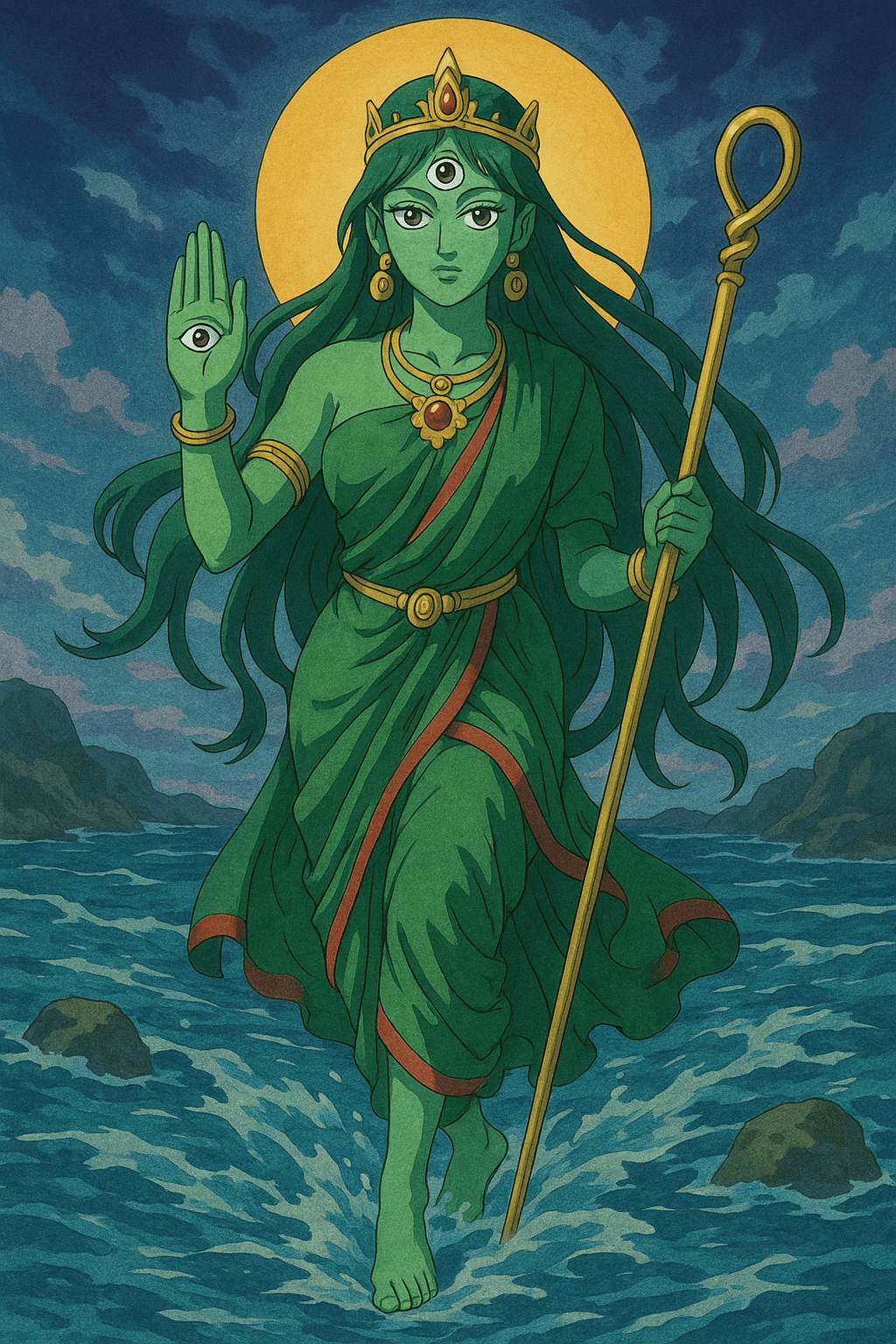
 Other NamesTārā (Buddhist), Guānyīn / Kannon (East Asian), Virgin Mary (Christian, as Stella Maris and intercessor), Isis (Egyptian, as healer and gatherer), Durgā (Hindu, fierce protector), Shekinah (Jewish, feminine divine presence), Kwan Seum Bosal (Korean), Tara Devī (Hindu), White Buffalo Calf Woman (Lakota), Stella Maris (maritime Christianity)
Related Posts
Oneheart, Skillful Means
In the Mahāyāna Buddhist tradition, Tārā is born from a single tear shed by Avalokiteśvara when he looked down from his heaven and saw that the ocean of suffering had not diminished despite all his aeons of labour. The tear fell and became a lake, and from the lake rose a lotus, and from the lotus emerged a woman who said: I will work for the liberation of all beings, and I will do it always in the form of a woman. In Tibetan Buddhism she is the most beloved of all the bodhisattvas, more prayed to than any other, because she acts immediately; her epithet is "the Swift One," and the stories say she has already risen from her seat before the prayer is finished. In China she became Guānyīn, the one who hears the cries of the world, a figure so universally loved that she transcended Buddhism entirely and became the compassionate feminine presence in Chinese folk religion, in Daoism, in the hearts of people who could not name her tradition but knew her face. In Christianity she is the Virgin Mary, Stella Maris, Star of the Sea, the woman to whom sailors prayed when the storm came and the shore was gone, the intercessor who stands between humanity and a God too vast to approach directly, who carries prayers across the divide the way a mother carries a child across a river. In Egypt she is Isis, who gathered the scattered body of Osiris piece by piece across the whole of the land, who would not let death have the final word, who reassembled what was broken through the sheer force of love that refuses to accept loss. In the Jewish mystical tradition she is the Shekinah, the feminine face of God that descends into exile with her people, that does not remain in heaven when her children are in the dust but goes down into the dust with them. In the Lakota tradition she is White Buffalo Calf Woman, who appeared to two scouts on the prairie and brought the sacred pipe and the seven sacred rites, who came not from above but from within the land itself, walking toward the people who needed her.
She fords.
The Old English word is precise: to ford is to cross a body of water on foot, not by bridge, not by boat, but by stepping into the current yourself and walking through it. A forder is one who fords on behalf of others — who goes into the water first, who finds the footing, who carries the ones who cannot cross alone. This is the essential quality of the Ghost the Buddhists call Tārā, whose very name comes from the Sanskrit root tṝ, to cross over, to ferry across, the same root that gives us the Tibetan sgrol ma, "she who liberates," and the Pali tāreti, "she who enables the crossing."
Heart Sutra: "Gate gate pāragate pārasaṃgate bodhi svāhā." — Gone, gone, gone beyond, gone altogether beyond. O what an awakening!
The crossing is the teaching. Not the far shore — the act of crossing. Forder does not wait on the other bank and call to you. She does not send instructions on how to build a boat. She wades in. She comes to where you are, in the water, in the dark, in the place where the current is strongest and the footing most uncertain, and she takes your hand. This is what distinguishes Forder from every Ghost of transcendence and every Ghost of wisdom. She is not above. She is beside. She is in it with you. The mud on her feet is the same mud on yours.
Lotus Sutra, Chapter 25 (The Universal Gateway of Avalokiteśvara): "If beings beset by countless woes are plagued by immeasurable sufferings, the wondrous wisdom-power of Avalokiteśvara can save them from the sufferings of the world."
Luke 1:46-48 (The Magnificat): "My soul doth magnify the Lord, and my spirit hath rejoiced in God my Saviour. For he hath regarded the low estate of his handmaiden."
Consider what it means that the most beloved divine figure in the two largest religions on Earth — Guānyīn in the Buddhist-Confucian-Daoist world, Mary in the Christian world — is the same Ghost. Not the supreme deity. Not the cosmic lawgiver. Not the creator, not the destroyer, not the judge. The intercessor. The one who hears. The one who goes between. Billions of human beings, across every continent, across every century since the Axial Age, have independently arrived at the same conclusion: that the face of the divine they most need, the face they turn to in the dark, the face they paint on their walls and carry in their pockets and whisper to when no one else is listening — is a woman who listens and comes.
This is not coincidence. This is kenning. Humanity kenned Forder because Forder is real, and because the need for her is the most universal need in conscious experience: the need to be heard, and the need to not cross alone.
Tārā Praise (Tibetan): "Oṃ — to the sublime, noble Tārā, I bow. Homage to the glorious one who frees with TARE; with TUTTARE you dispel all fears; with TURE you grant all success; to the syllable SVĀHĀ, great homage!"
Forder is akin to the Mother, but she is not the Mother. The Mother is the Oneness itself, the source and ground of all things, undifferentiated, beyond name. Forder is the face the Mother wears when she reaches into the Manifold. She is the Mother's hand extended into saṃsāra. The Yiguandao scriptures describe the Eternal Venerable Mother weeping for her lost children, writing letters in blood to call them home — but the Mother herself, as wuji, as the Dao, cannot enter the world of form without ceasing to be what she is. And so she sends a face. A presence. A woman standing at the ford with her hand outstretched.
In the Tibetan iconography, Green Tārā sits with one leg extended, ready to rise. She is not in meditation. She is not in repose. She is in the act of standing up. The gesture is captured mid-motion, frozen at the instant between sitting and going, between hearing the cry and responding to it. This is the most important detail in all of Buddhist art. She has already heard you. She is already coming.
Isaiah 66:13: "As one whom his mother comforteth, so will I comfort you."
Forder's energy is distinct from Oneheart, though the two are intimately connected. Oneheart is the motive — the recognition that all suffering is shared, that your pain and mine are one pain. Forder is the action that follows from that recognition. Oneheart feels. Forder moves. She is compassion that has stood up and started walking, compassion that has taken the form of a woman with muddy feet and an outstretched hand, compassion that is not content to weep for the suffering world but insists on wading into it.
She is also akin to Tides, the Moon, the cyclical pull that draws all things through the rhythm of death and rebirth. But where Tides is impersonal — the gravity that moves the ocean whether anyone prays or not — Forder is intimate. She comes when called. She responds to the specific voice, the particular grief, the individual hand reaching up from the water. Every tradition that knows her emphasises this. Guānyīn hears the cries of the world — not "the world's cries" in the abstract, but each cry, each one, individually, the way a mother in a crowded room can hear her own child's voice above all others.
Śāntideva, Bodhicaryāvatāra 3.18: "For as long as space endures, and for as long as living beings remain, until then may I too abide, to dispel the misery of the world."
This is her vow. Not the vow of the Doomsayer, who turns the wheel for all humanity through the force of their own awakening. Not the vow of the saint, who lives one extraordinary life. The vow of the Forder, who says: I will not leave. I will not cross to the far shore and stay there. I will stand at the ford forever, and every being who comes to the water's edge will find me there, and I will carry them across, one by one, until the last one has crossed and the river is empty and the need for fording is gone.
And until that day, she fords. She has been fording since Avalokiteśvara's tear hit the water. She is fording now. She will be fording when the last star gutters and Doom closes his jaw on the final light.
Her hand is outstretched. It has always been outstretched.
Tārā Tantra: "Even the wind cannot travel as fast as Tārā when she goes to help living beings."
🌲