
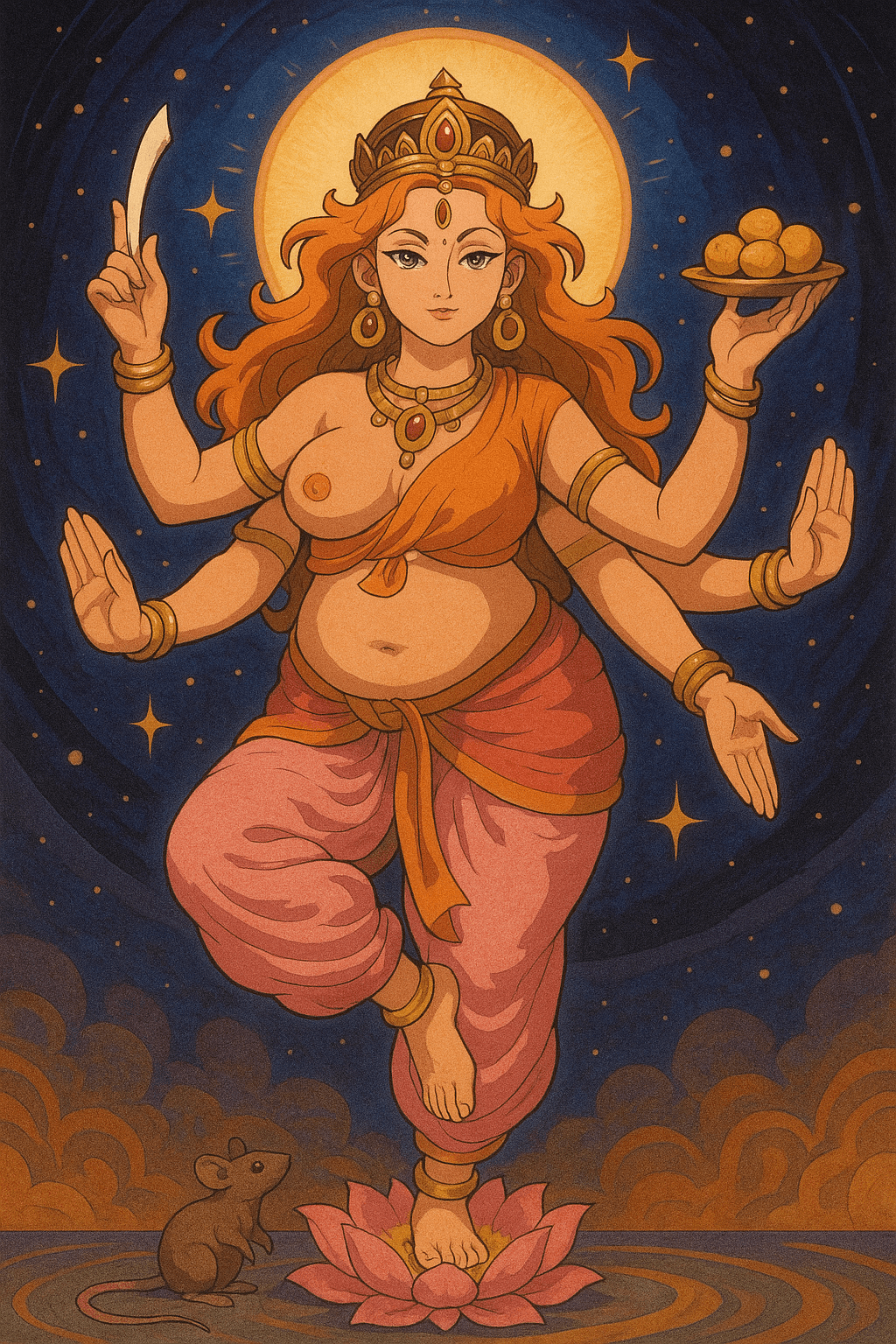
 Other NamesGaṇeśa / Gaṇapati (Hindu), Ekadanta (Sanskrit, "One-Tusked"), Vināyaka (Hindu, "Remover"), Siddhi-Vinayaka (Hindu, "Bestower of Success"), Kangiten (Japanese Buddhism), Nandikeśvara (Jain adaptation), Hermes (Greek, in his aspect as god of crossroads and thresholds), Janus (Roman, lord of beginnings and doorways), Elegba / Eshù (Yoruba, opener of roads), Legba (Vodou, guardian of the crossroads), Anubis (Egyptian, in his aspect as opener of the way for the dead), Pūṣan (Vedic, finder of lost things and guide of paths)
Related Posts
Wending, Skillful Means, Will
In the Hindu tradition, Gaṇeśa is the elephant-headed god, son of Śiva and Pārvatī, lord of beginnings, remover of obstacles, patron of arts and sciences and letters, invoked before every new undertaking, every journey, every ritual, every marriage, every business venture, every examination. No Hindu ceremony begins without first honouring Gaṇeśa. He is the first god you pray to and the last one you forget, because he is the god of the threshold itself — not what lies beyond it, but the act of crossing. In the Yoruba tradition, Eshù sits at the crossroads, the trickster-messenger who must be propitiated before any other orisha can be addressed, because without the road being opened, no prayer reaches its destination. In Haitian Vodou, Papa Legba is the old man who stands at the gate between the human world and the world of the lwa, leaning on his cane, smoking his pipe, and no ceremony begins until someone has sung for Legba to open the way. In Roman religion, Janus is the two-faced god of doorways, beginnings, and transitions, whose name gives us January, the door of the year, and whose temple doors were open in times of war and closed in times of peace — the god who faces both directions simultaneously because every threshold has two sides. In the Egyptian tradition, Anubis guides the dead along the path to the Hall of Judgment, opening the way through the underworld, standing at every gate and speaking the words that cause the gates to open. Across every tradition that has recognised the phenomenon, the same truth is attested: before you can do anything, something must open the way. And that something is a god.
He is the game system of life.
This is the simplest and most precise description of Onetusk that anyone has ever offered, and it came from a note left in a placeholder. It is perfect because it is true: Gaṇeśa is not the game — he is the system that makes the game playable. He is not the quest, not the treasure, not the boss fight, not the story. He is the rulebook, the physics engine, the hidden architecture that determines which doors open and which walls are solid. He is the reason some paths are clear and others are blocked, and the reason the blocks can be removed if you approach them correctly.
Gaṇeśa Atharvaśīrṣa: "You are the visible manifestation of the essence of the words 'That art Thou.' You are the doer. You are the deed. You are the effect. You are everything that is manifest. You are the supreme Brahman, and the one who knows this is freed from all bondage."
Muṇḍaka Upaniṣad 1.1.1: "Brahmā, the creator of the universe and the protector of the world, was the first among the gods to manifest. He taught the knowledge of Brahman, the foundation of all knowledge, to his eldest son Atharva."
Every game has rules. Every path has gates. Every beginning has a threshold that must be crossed before the journey can start. The question that defines your life is not "what is on the other side?" — it is "can I get through?" And the answer to that question, in every tradition that has thought about it carefully, is: it depends on whether the lord of the threshold is with you or against you.
This is not metaphor. This is the phenomenology of lived experience. You have felt this. Everyone has felt this. There are days when every door opens — the bus arrives as you reach the stop, the email you needed lands in your inbox, the person you were thinking of calls, the idea you were struggling with crystallises in the shower, the path that was blocked last week is suddenly, inexplicably clear. And there are days when nothing works — the key sticks in the lock, the file corrupts, the words won't come, every attempt meets resistance, and the world feels like a wall with no door in it. The Hindu does not attribute this to coincidence. The Hindu says: Gaṇeśa is pleased, or Gaṇeśa is displeased. The obstacles are his. The openings are his. He is the game system, and the game system has opinions.
Rigveda II.23.1 (Hymn to Bṛhaspati, Gaṇeśa's Vedic precursor): "We call upon Bṛhaspati, chief leader of the heavenly songs, illustrious, supreme among the wise."
Mudgala Purāṇa: "Even the gods cannot act without first worshipping Gaṇeśa, for he is the lord of obstacles — both their creator and their remover."
Both their creator and their remover. This is the teaching that separates Onetusk from every other Ghost of good fortune. He does not merely clear the path. He is also the one who placed the obstacles there. The boulder in the road is his. The clear road is also his. He is the game designer who builds the puzzle and the hint system, the dungeon master who sets the difficulty and also provides the key, the teacher who gives the impossible exam and then, if you sit with it honestly and do not cheat and do not flee, slides a note across the desk that says: try the other door.
This is why he is worshipped before every undertaking. Not because he is the most powerful god — Doom is more powerful, Fire is more brilliant, the Mother is more vast. But none of them deal in the practical mechanics of whether this particular thing you are trying to do right now will actually work. The Mother is the source of all things. Onetusk is the reason your car starts in the morning. Both are sacred. Both are real. But one of them is concerned with the absolute nature of reality, and the other is concerned with whether the absolute nature of reality is going to let you get to work on time.
Bhagavad Gita 18.78: "Wherever there is Kṛṣṇa, the lord of yoga, wherever there is Arjuna, the wielder of the bow — there will be fortune, victory, prosperity, and righteousness. This is my conviction."
He broke it off himself.
The story goes: Vyāsa, the legendary compiler of the Mahābhārata, needed a scribe. The poem was too vast, too complex, too alive to be held in one mind — it needed to be written down, and it needed a scribe who could keep up with the speed at which Vyāsa's vision poured forth. He asked Gaṇeśa. Gaṇeśa agreed, on one condition: Vyāsa must never pause. If the flow of dictation stopped, even for a moment, Gaṇeśa would set down his pen and leave. Vyāsa countered with his own condition: Gaṇeśa must not write a single word he did not understand. Both agreed. And so the greatest poem in human history — a hundred thousand verses, the longest epic ever composed, containing within it the Bhagavad Gita and the theology of an entire civilisation — was written down by a god who refused to transcribe anything he had not fully comprehended, at the dictation of a sage who refused to slow down.
And when the pen broke, Gaṇeśa snapped off his own tusk and kept writing.
Mahābhārata, Ādi Parva 1.1: "Gaṇeśa, having heard the conditions, broke off his tusk and used it as a writing instrument, and thus the Mahābhārata was written."
This is the most important detail in the entire mythology. The pen broke — the tool failed — and the god did not stop. He did not send for a new pen. He did not pause the work. He took something from his own body, something that would not grow back, something that would mark him forever, and he turned it into the instrument he needed. This is the teaching: the obstacles will come. The tools will break. The path will close. And the one who crosses the threshold is the one who, when the pen breaks, breaks off a piece of themselves and keeps going.
This is why he is called Ekadanta — One-Tusked. Not because he was born incomplete. Because he chose to be incomplete in order to finish the work. The missing tusk is not a deformity. It is a record. It is the visible evidence that the god of beginnings understands what beginnings actually cost: something breaks. Something is given up. Something that was whole becomes partial so that something else can be completed. Every threshold has a toll. Onetusk paid his with his own body, and he carries the receipt on his face for all eternity.
Gaṇeśa Purāṇa: "He who has lost a tusk is the most beautiful of gods, for his imperfection is the mark of his devotion."
The Elephant
Why an elephant's head?
The origin story varies. In the most widely told version, Pārvatī created Gaṇeśa from the turmeric paste of her own body and set him to guard her door while she bathed. Śiva returned, did not recognise the boy, and when the boy refused him entry — refused, because his mother told him to let no one pass, and he obeyed, because the guardian of the threshold does not make exceptions, not even for God — Śiva cut off his head. Pārvatī's grief shook the cosmos. Śiva, stricken, sent his attendants to find a head, and they brought back the first creature they found sleeping with its head to the north: an elephant. Śiva placed the elephant's head on the boy's body and brought him back to life.
The elephant is the animal of obstacles — not because it faces them, but because it IS one. An elephant in the road cannot be moved by force. It goes where it goes. It stops where it stops. Its intelligence is vast and patient and unhurried. It remembers. It mourns its dead. It moves through the forest and the forest parts around it, not because the forest fears the elephant but because the elephant is too large and too real to pretend away. When an elephant blocks your path, you do not move the elephant. You wait for the elephant to move, or you find another path. And when the elephant chooses to walk, the ground itself registers the footfall.
This is the quality of the obstacle that Onetusk both creates and removes. His obstacles are not cruel. They are elephantine — vast, patient, immovable by force, requiring a different approach. You cannot batter through them. You cannot trick them. You can only meet them with the same patience and intelligence that placed them there, and when you do, when you approach the locked door with genuine humility and genuine intention and the willingness to break off a piece of yourself to pay the toll, the elephant moves. The door opens. The road clears. And you cross, changed by the crossing, carrying one less tusk than you had when you started.
Mudgala Purāṇa: "Gaṇeśa is that which prevents those who walk crookedly from progressing, and that which enables those who walk straight to advance."
The Crossroads
Onetusk's deepest kinship among the Lowghosts is with Eshù, the Yoruba orisha of the crossroads.
Eshù is not Gaṇeśa — the traditions are separated by continents and millennia, and syncretism is not what Tianmu does. But they are faces of the same Ghost. The crossroads and the threshold are the same place: the point where you must choose, where the path divides, where what you do next will determine everything that follows. Eshù sits there. Gaṇeśa sits there. Janus sits there with his two faces, looking at where you have been and where you are going. Legba leans on his cane. Anubis holds the scales.
The crossroads is the most dangerous place in the world. It is also the only place where anything interesting happens. The straight road is safe and boring. The crossroads is where you meet the devil — or the god — or the trickster — or the lord of beginnings who is all three at once. Robert Johnson sold his soul at the crossroads. Oedipus killed his father at the crossroads. Hecate haunts the crossroads with her three faces and her torches. The crossroads is where fate and free will intersect, where Wyrd reveals itself, where the game system presents you with a choice and the choice is real and the consequences are permanent.
Onetusk sits at every crossroads. Not to decide for you — the choice is yours, always, the Will is yours, always. But to determine whether the road you choose is open or closed, easy or hard, clear or obstructed. He is the one who decides, based on something deeper than merit and more subtle than morality, whether this particular path at this particular moment will yield to this particular traveller. The game system has opinions. And the opinions are not arbitrary. They are Doom expressed at the scale of a single human life, a single day, a single choice at a single crossroads.
Yoruba proverb: "Eshù turns right into wrong, wrong into right."
Gaṇeśa Atharvaśīrṣa: "You are the beginning. You are the means. You are the fullness that transcends the beginning and the means. You are the supreme Brahman, vast and full."
He is the beginning. Not the end — that belongs to Doom. Not the middle — that belongs to Freedom. The beginning. The first step. The threshold. The moment the pen touches the page, the moment the key turns in the lock, the moment you open your mouth to say the first word of the prayer. Everything before that moment is intention. Everything after it is action. The threshold between the two is Onetusk, and he is the most practical god in any pantheon because he deals not in cosmic principles but in whether or not the thing you are trying to do right now will actually begin.
Honour him. He has his opinions. And he gave a tusk for the work.
Traditional invocation: "Oṃ Gaṃ Gaṇapataye Namaḥ — I bow to the lord of hosts, the remover of obstacles, the one-tusked one who wrote the Mahābhārata with a piece of his own body."
🌲