
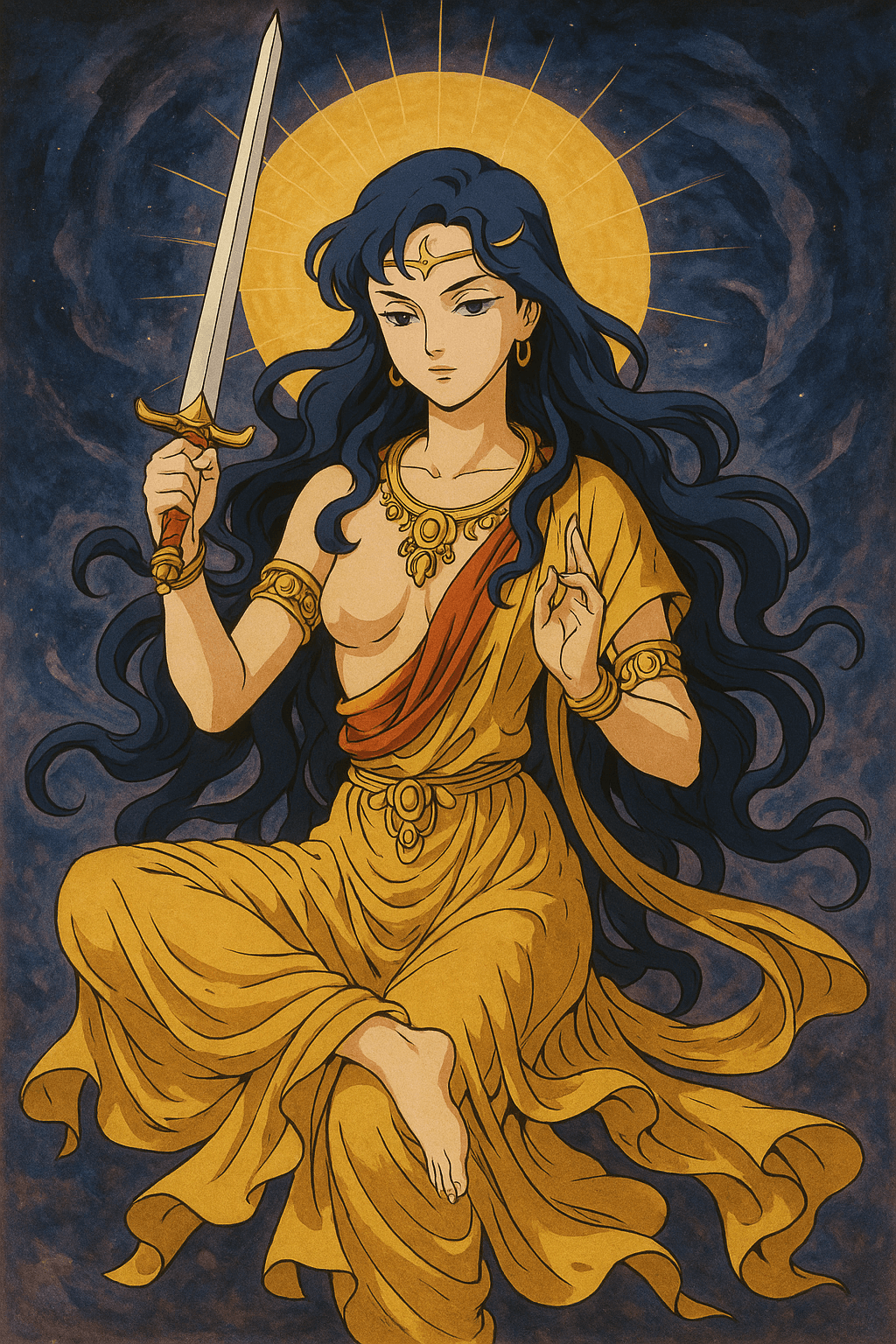
 Other NamesMañjuśrī (Buddhist), Monju Bosatsu (Japanese), Wénshū Púsà (Chinese), Prajñā personified (Buddhist), Athena (Greek, in her aspect of cutting wisdom), Michael the Archangel (Abrahamic, the sword that casts down delusion), Vajra (Buddhist, the diamond thunderbolt), Durga (Hindu, in her aspect as slayer of the buffalo demon of ignorance), Fudō Myō-ō / Acala (Japanese, the Immovable Wisdom King), Skanda / Murugan (Hindu, the spear that pierces), Kalki (Hindu, the sword at the end of the age)
In the Mahāyāna Buddhist tradition, Mañjuśrī is the bodhisattva of wisdom — not wisdom as accumulated knowledge, not wisdom as patience and experience, but wisdom as a sword. He is depicted as an eternally youthful prince seated on a lion, holding in his right hand a flaming sword and in his left a lotus bearing the Prajñāpāramitā Sūtra, the Perfection of Wisdom. The sword is not for killing. It is for cutting — cutting through ignorance, through delusion, through the tangled undergrowth of concepts and fears and false constructions that keep the mind trapped in the mare. In Japan he is Monju, and the proverb says "Three heads are better than Monju's" — meaning that collective human effort can approach, but never quite match, the razor clarity of transcendent insight. In China he is Wénshū, whose mountain Wǔtái Shān is one of the four sacred Buddhist mountains, perpetually wreathed in clouds, where pilgrims climb to the summit hoping to glimpse the bodhisattva riding his lion through the mist. In Greek mythology, Athena springs fully armed from the head of Zeus — wisdom born not through gestation but through rupture, through the splitting of the skull, through the sudden violent opening of the mind to something it was not prepared to contain. In the Abrahamic traditions, Michael is the archangel of the sword, the one who casts Satan down from heaven — not through superior force but through the clarity that sees the lie for what it is and will not flinch. In the Hindu tradition, Durgā rides a lion into battle against Mahiṣāsura, the buffalo demon — the personification of dull, bestial ignorance that cannot be defeated by any god but is slain by the Goddess in a single decisive stroke. In Japan, Fudō Myō-ō sits wreathed in fire, holding a sword in his right hand and a lasso in his left — the sword to cut through delusion, the lasso to bind it, the fire to burn what remains. Across every tradition, the same image recurs: a blade, a flame, a single decisive stroke that severs what entangles.
The name is precise. Quick — from the Old English cwic, meaning alive. The quick and the dead. Quicksilver. The quick of the fingernail — the living flesh beneath the surface. To be quick is to be alive, awake, responsive, present. And mare — the demon, the suffocating spirit, the ur-delusion that sits on the sleeper's chest and presses the breath out of them. Mara. The nightmare.
Quickmare: the one who is alive inside the nightmare. The one who wakes up within the dream and does not flee but draws the sword.
Diamond Sutra 32: "All conditioned phenomena are like a dream, an illusion, a bubble, a shadow — like dew or a flash of lightning; thus we shall perceive them."
Vimalakīrti Nirdeśa Sūtra 3: "Mañjuśrī, illness has no reality, has no inherent existence — yet beings who have not freed themselves from the disease of ignorance all suffer. The bodhisattva should bring about their liberation."
The mare triad — Daymare, Nightmare, Sight — are the three outer Highghosts beyond Muse's threshold, the regions of outsideness where the knowable gives way to the unknown. Daymare suffocates you with false structure — neurosis, the empty scaffolding, Kafka's court. Nightmare drowns you in false meaning — psychosis, the ocean of symbols, Lovecraft's incomprehensible deep. Sight dances at the edge of both, the faculty that can see across the boundary but risks madness in the looking.
Quickmare is none of these. Quickmare is the force that operates within them — the cutting intelligence that recognises the mare for what it is while the mare is still happening. Not after, in retrospect, when you have woken and can laugh at the nightmare. Not before, in preparation, when you arm yourself with techniques and teachings. During. In the thick of it. In the moment when the archons are pressing in and the meaning is flooding and the scaffolding is collapsing and you are inside the dream and the dream is inside you — in that moment, something flashes. Something sees. Something in you recognises: this is not real. And in the act of recognising, the thing that is not real begins to dissolve.
Bardo Thodol (Tibetan Book of the Dead): "O nobly born, whatever terrifying and bewildering visions may appear, recognise them as your own projections. Recognise them as the luminosity, the natural radiance of your own mind. If you recognise them in this way, you will be liberated at once, without a shadow of a doubt."
This is the Bardo instruction distilled to its essence, and it is the purest description of Quickmare's action in any scripture. The wrathful deities appear — the blood-drinkers, the skull-wearers, the manifestations of everything your mind has ever feared. They are real in the bardo. They can devour you. They can trap you in cycles of terror that spin you back into rebirth without understanding. But if you recognise them — if you see, in the moment of terror, that they are projections of your own consciousness wearing masks — they dissolve. They become peaceful deities. The nightmare becomes the dream. The mare becomes the mount.
Recognise. That is the whole action. Not fight. Not flee. Not analyse. Recognise. Mañjuśrī's sword does not swing — it illuminates. The flame on the blade is not heat but clarity. When the sword touches the demon, the demon is not slain — the demon is revealed to have been empty all along. The cut is the seeing. The seeing is the cut. They are the same gesture.
Heart Sutra: "Form is emptiness, emptiness is form. Emptiness is not other than form; form is also not other than emptiness."
Prajñāpāramitā Sūtra (8,000 lines): "The perfection of wisdom, Subhūti, cuts off all wrong views, all clinging, all entanglement, as a sharp sword cuts through a tangle of threads."
This is why Mañjuśrī holds the Prajñāpāramitā in his left hand — the Perfection of Wisdom, the teaching that all phenomena are empty of inherent existence, that the self is a process and not a thing, that what you fear is made of the same substance as the one who fears it: nothing. And this is why he holds the sword in his right — because knowing this intellectually is one thing, and wielding that knowledge in the dark, in the mare, in the suffocating press of delusion, is another thing entirely. The sūtra is the teaching. The sword is the teaching applied. The sūtra tells you that the demons are empty. The sword is what you use when the demons are in front of you and the sūtra is a memory and your hands are shaking and the only thing between you and the abyss is whether you can see in this moment, right now, that what is terrifying you has no substance.
Bhagavad Gita 4.42: "Therefore, with the sword of knowledge, cut asunder the doubts born of ignorance that lie in your heart. Arise, O Arjuna, take your stand in yoga."
Quickmare is akin to Fire — both cut through unknowing, both illuminate, both transform through clarity. But Fire is the Sun — vast, cosmic, the kindling seed of Heaven and Earth, the principle that cuts through ignorance at the universal scale. Quickmare is the blade in your hand. Fire is the light by which you see. Quickmare is the act of seeing in the instant it matters — the moment the blade meets the thread, the moment the recognition flashes through the bardo, the moment you wake up inside the dream and know it is a dream.
Quickmare is also akin to Wit — both are swift, both are precise, both navigate complexity with grace. But Wit operates within the knowable, within the ordered world of language and logic and structure. Quickmare operates in the territory where structure has failed — in the outsideness beyond Muse's threshold, where Daymare's false scaffolding and Nightmare's flooding symbols have made Wit's tools useless. In the mare, cleverness cannot save you. Only the sword can save you. And the sword is not cleverness — it is the thing beneath cleverness, the bare, raw, pre-conceptual flash of awareness that sees what is true before the mind has time to construct an interpretation.
Linji Yixuan (Rinzai): "If you meet the Buddha on the road, kill him."
This is Quickmare's koan. The Buddha on the road is the last delusion — the belief that enlightenment is something outside you, something you will encounter, something with a face you can recognise. Kill it. Cut it. Not with hatred but with the same recognition that dissolves the wrathful deities in the bardo: it is a projection. The Buddha you meet on the road is your own mind wearing the mask of the sacred. The real Buddha is the one holding the sword. The real Buddha is the one who recognises.
Mañjuśrī is depicted as eternally young. Not a child — a youth, a kumārabhūta, a prince in the prime of first adulthood. This is not incidental. Every other great bodhisattva carries the weight of ages — Avalokiteśvara weeps with the accumulated grief of aeons, Kṣitigarbha descends into the hells and waits there until the last being is freed. Mañjuśrī is young because the sword is always young. The cutting edge has no history. The moment of recognition has no memory. You do not accumulate your way to the flash of insight that dissolves the mare — you arrive at it as if for the first time, every time, because the moment of waking is always new.
This is what distinguishes Quickmare from Memory. Memory carries the past forward. Quickmare has no past. The sword does not remember its previous cuts. The flash of recognition in the bardo does not draw on the flash of recognition from a previous bardo. It is always and only now — the present moment, the only moment in which the mare can be seen for what it is, the only moment in which the sword can cut. This is why the teaching says: be quick. Not quick as in fast, though speed matters. Quick as in alive. The dead cannot wield the sword. Only the quick — the living, the awake, the present — can see through the mare.
Dōgen, Shōbōgenzō (Genjōkōan): "To study the Buddha Way is to study the self. To study the self is to forget the self. To forget the self is to be awakened by the ten thousand things."
Mañjuśrī-nāma-saṅgīti (Chanting the Names of Mañjuśrī), Verse 1: "Mañjuśrī is the embodiment of the wisdom of all the Buddhas, in him the wisdom of the past, present, and future is concentrated."
The lion he rides is important. In the Buddhist iconography, the lion's roar is the proclamation of truth — the fearless declaration that does not flinch, does not hedge, does not soften itself for comfort. The Diamond Sutra. The Heart Sutra. "Form is emptiness." Three words that annihilate the entire constructed universe of the mind and leave only what is real. That is the lion's roar. And Mañjuśrī rides it because the sword and the roar are the same act — the cutting and the proclaiming are one gesture. To see the truth clearly IS to speak it. The recognition and the declaration are simultaneous. The wrathful deity dissolves the moment you say its name.
Śūraṅgama Sūtra: "You use your mind to seek the mind — this is the greatest of all mistakes."
You use your mind to seek the mind. The mare uses fear to create fear. The nightmare uses confusion to create confusion. And the sword — the quick, alive, present awareness that sees through the whole mechanism — is the only thing in the universe that is not made of the same substance as the thing it cuts. Everything else in the mare is mare. The fear is mare. The analysis of fear is mare. The philosophy of fear is mare. The spiritual practice designed to overcome fear — that too, if it is not wielded by the quick mind, is mare, elaborate mare, sophisticated mare, mare wearing the robes of a teacher. Only the bare flash of recognition is not mare. And that flash is Quickmare.
He is young because the flash is always young. He carries a sword because the truth cuts. He rides a lion because the truth roars. He holds the sūtra because the truth is already written — the Perfection of Wisdom already knows what you are only now discovering — but he holds it in his left hand, the passive hand, because the sūtra alone cannot save you. The sword is in the right.
Mañjuśrī-nāma-saṅgīti, Verse 69: "He is the great terror to the terrifying. He is the great illusion-destroyer."
The great terror to the terrifying. The mare's own nightmare. The thing that the nightmare is afraid of: someone waking up.
🌲