
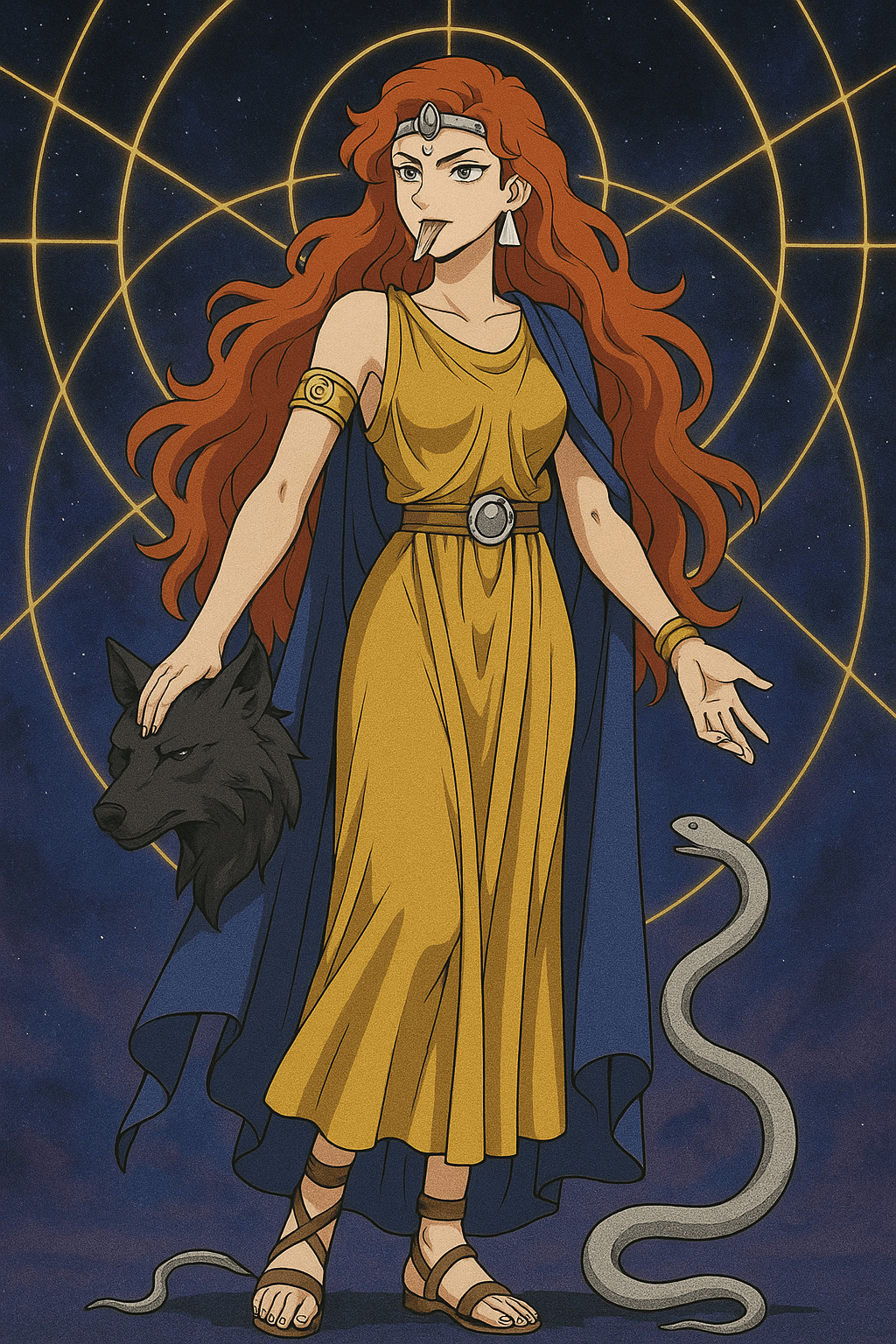
 Other NamesLoki (Norse), Coyote (Indigenous American), Anansi (Akan/West African), Hermes (Greek, in his thief aspect), Sun Wukong (Chinese, the Monkey King), Māui (Polynesian), Set (Egyptian, in his trickster aspect), Eshù (Yoruba, in his trickster aspect), Reynard the Fox (European), Prometheus (Greek, the one who stole), Raven (Pacific Northwest), Krishna (Hindu, in his childhood trickster aspect), Narada (Hindu, the divine stirrer), Till Eulenspiegel (German), Nasreddin (Sufi)
Related Posts
Crosstruth, Wyrd, Wildmind
In the Norse tradition, Loki is the most troublesome figure in the cosmos — blood-brother to Odin, father of Hel and the Fenris Wolf and the Midgard Serpent, the shapeshifter who once became a mare and gave birth to Sleipnir, the eight-legged horse, from his own body. He cuts Sif's golden hair and must replace it. He wagers his own head and loses and wriggles out on a technicality — they can take the head but they cannot touch the neck. He engineers the death of Baldr, the most beloved of the gods, and is bound beneath the earth with a serpent dripping venom into his face until the end of the world. In the Lokasenna, the "Flyting of Loki," he walks into the feast of the gods uninvited and tells every single one of them the truth about themselves — their adulteries, their cowardices, their broken oaths — until Thor arrives and threatens to beat him silent. In West African and Caribbean tradition, Anansi the Spider tricks the sky god, tricks the python, tricks the hornets, tricks death itself, and wins all the stories of the world — because the trickster is always the one who owns the stories. Among the Indigenous peoples of North America, Coyote created the world — badly, imperfectly, with all its flaws and its beauty — because the trickster does not create according to plan. He creates through accident, through improvisation, through the glorious mess of a mind that cannot follow a straight line because straight lines are lies. In China, Sun Wukong is the Monkey King who stormed Heaven itself, defied the Jade Emperor, fought the celestial armies to a standstill, and was only subdued when the Buddha trapped him under a mountain for five hundred years — and even then, he emerged unchanged, irrepressible, the stone monkey who was born from the rock and returns to the rock and in between causes more trouble than any other being in Chinese literature. In Polynesia, Māui fished up the islands from the ocean floor, stole fire from the underworld, slowed the sun with a jawbone, and died trying to crawl into the goddess of death to reverse mortality — and the birds laughed, and the world stayed mortal, and the trickster's last gift was the reminder that even the cleverest cannot outwit the end.
The gods need him. They hate that they need him. That is the whole story.
Gylfaginning (Prose Edda): "Loki is handsome and fair of face, but evil in disposition and very changeable of mood. He surpassed all men in the art of cunning, and he always cheats. He constantly placed the Æsir in great difficulties, and often helped them out again by guile."
Constantly placed the Æsir in great difficulties, and often helped them out again by guile. Snorri says it plainly: the same being who creates the problem is the one who solves it. The same tongue that cuts Sif's hair is the tongue that talks the dwarves into forging Mjölnir. The same shapeshifter who births monsters is the one who retrieves the treasures the gods cannot live without. Remove Loki from the Norse cosmos and you do not get a better cosmos — you get a static one. A cosmos without problems, without the creative destruction that forces the gods to adapt, without the constant disruption that keeps Asgard from calcifying into the kind of dead, mechanical, self-congratulatory order that Daymare represents.
This is the teaching: the trickster is necessary. Not tolerable. Not acceptable as a cost of doing business. Necessary. The house cannot improve without the one who burns it down. The system cannot evolve without the one who breaks it. The truth cannot surface without the one who says the thing everyone knows but no one will speak.
Lokasenna 47 (Loki to the gods): "Ale you brewed, Ægir, and you shall never again hold a feast. All your possessions here within — may flame play over them, and may fire burn your back!"
Nasreddin (Sufi parable): "The Hodja was asked: 'Do you believe more in fate or in free will?' He answered: 'In fate, obviously, because I have no choice.'"
The Lokasenna is the key text. It is the most uncomfortable scene in Norse literature, more uncomfortable than the death of Baldr, more uncomfortable than the binding of Fenrir, because in the death of Baldr the gods are victims and in the binding of Fenrir the gods are villains, but in the Lokasenna the gods are exposed. And the exposure is unbearable because it is true.
Loki walks in uninvited. He kills a servant. He demands a seat at the feast — invoking the blood-brotherhood oath Odin swore, which means Odin cannot refuse him. And then, one by one, he addresses every god and goddess in the hall, and he tells them what they are.
To Bragi: you are a coward who avoids battle. To Iðunn: you slept with your brother's killer. To Gefjun: you sold yourself for a necklace. To Odin: you practised seiðr, the unmanly art, you dressed as a woman, you beat the drum like a witch. To Frigg: your son is dead and you could not save him. To Freyja: every god and elf in this hall has had you, including your own brother. To Tyr: Fenrir bit off your hand and you will never get it back. On and on, through the entire pantheon, each truth sharper than the last, each one landing on the precise wound the god has been hiding.
No one can refute him. That is the terrible part. Bragi is timid. Odin did practise seiðr. Freyja's sexual liberty is part of the tradition. The truths are ugly and partial and stripped of context and hurled with malice — and they are true. The gods sputter, they threaten, they try to redirect, but they cannot say "you are lying," because he is not lying. He is doing something worse than lying. He is telling the truth selectively, without compassion, without the mercy that makes truth livable.
Proverbs 27:6: "Faithful are the wounds of a friend; but the kisses of an enemy are deceitful."
Is Loki a friend? He is a blood-brother. He is the oldest companion. He has been there since the beginning — he was there when Odin and his brothers killed Ymir and made the world from his body. He is family. And the wounds he inflicts are faithful in the sense that they land on real wounds, they name real failures, they illuminate real shadows. But they are not delivered in love. They are delivered in fury, in resentment, in the bitterness of a being who has always been the outsider at the feast — tolerated for his usefulness, never truly honoured, needed but not loved.
This is the Crosstruth of Silvertongue: the truth-teller who tells the truth for the wrong reasons. The necessary liar whose lies serve the cosmos even as they serve his own resentment. The fire that burns the house down, and the fire is purifying, and the fire is also arson. Both. Always both. The trickster cannot be reduced to a single moral valence because the trickster IS the refusal to be reduced.
The Binding
After the Lokasenna — after the death of Baldr, which Loki engineered, which was the final act that turned the cosmic order against him — the gods hunt him down. He flees, he transforms, he becomes a salmon in a waterfall, and they catch him with a net he himself invented. The irony is total. The trickster is caught by his own trick.
They bind him to three stones with the entrails of his own son. They place a serpent above his face that drips venom onto him. His wife Sigyn holds a bowl to catch the venom, but when the bowl fills, she must turn away to empty it, and the drops fall on his face, and he writhes in agony so terrible that the earth shakes. Every earthquake is Loki struggling beneath the earth. He will lie there until Ragnarök, when the world ends and everything that was bound breaks free.
Völuspá 51: "Loki is freed from his fetters, the wolf runs free. Far and wide she sees — the Wise Woman knows all, she sees the doom of the gods."
This is the binding that every culture imposes on its trickster. Prometheus is chained to the rock and the eagle eats his liver. Sun Wukong is trapped under the mountain. Set is confined to the desert. Anansi is — well, Anansi is never quite caught, because the West African tradition is wiser about tricksters than the Norse or the Greek. But the pattern is clear: the order that the trickster disrupts eventually turns on him and pins him down, because order cannot tolerate permanent disruption. It needs the disruption — it needs the fire, the theft, the broken rule, the uncomfortable truth — but it cannot admit that it needs it. And so it punishes the one it needs, chains the fire it depends on, and calls this justice.
And the trickster endures. And the venom drips. And the earth shakes. And Sigyn holds the bowl.
Sigyn
She deserves her own moment.
Sigyn. The Faithful. She is barely mentioned in the mythology — a few lines in the Prose Edda, a reference in the Lokasenna where Loki, in the middle of his scorched-earth truth-telling, says nothing cruel to her. Nothing. He insults every other being in the hall. To his own wife, the one being he could hurt most, he says nothing. This is either restraint or recognition — the trickster who destroys everything meets the one thing he will not destroy.
And she stays. She holds the bowl. She catches the venom so it does not touch his face. When the bowl fills, she turns away to empty it, and the drops fall, and he screams, and the earth shakes, and she returns and holds the bowl again. She does this until the end of the world. She is Hestia married to Silvertongue — the hearth-keeper bound to the fire-starter, the one who stays married to the one who cannot stop leaving, the steadiness that tends the chaos, the bowl that catches the poison.
She is the most quietly heroic figure in Norse mythology. She chose this. She could have left. The gods would not have stopped her — they had no quarrel with her. But she stays because the bound god is still her husband, and the venom still falls, and someone must hold the bowl, and she is the one who holds it.
Völuspá 35: "She saw there, wading in heavy streams, treacherous men and murderers — and the one who seduces another's beloved. There Níðhöggr sucked the corpses of the dead, the wolf tore men apart. Know you yet, or what?"
The Gift
What did the trickster give?
Prometheus stole fire from the gods and gave it to humanity. Māui stole fire from the underworld. Coyote stole fire from the fire-keepers. Anansi stole all the stories. Sun Wukong stole the peaches of immortality. In every tradition, the trickster steals — not because stealing is good, but because the thing that was stolen was hoarded, and hoarding is the enemy of the living world, and the trickster is the one who breaks the hoard open.
The good things in the world — fire, stories, knowledge, laughter, the capacity to see the powerful as they really are — these were not given freely by the gods. They were stolen by the trickster, at the trickster's expense, for the trickster's punishment. Every comfortable lie was disrupted by an uncomfortable truth. Every calcified order was shattered by a necessary crime. Every locked door was opened by a thief.
This is the Wildmind in its most dangerous form. The trickster is the undomesticated intelligence — the mind that has not been tamed, that will not follow the script, that sees the rule and asks: who does this rule serve? And if the answer is "the powerful," the trickster breaks the rule and accepts the consequence. The fire was locked in heaven because the gods wanted it for themselves. Prometheus stole it because humanity was cold. The theft was a crime. The punishment was eternal. And humanity has fire.
Gospel of Thomas, Saying 39: "The Pharisees and the scribes have taken the keys of Knowledge and hidden them. They themselves have not entered, nor have they allowed to enter those who wish to."
Jesus said this about the Pharisees. But the one who actually takes the keys back — who breaks into the vault and steals the fire and distributes it to the people who were kept in the cold — is not the prophet. It is the trickster. The prophet names the injustice. The trickster remedies it, badly, messily, at great cost, and the remedy is never clean, and the trickster is never thanked.
William Blake, The Marriage of Heaven and Hell: "The reason Milton wrote in fetters when he wrote of Angels and God, and at liberty when of Devils and Hell, is because he was a true Poet and of the Devil's party without knowing it."
Silvertongue is bound beneath the earth, and the venom drips, and the earth shakes. But the fire is free. The stories are told. The truth has been spoken at the feast. And the gods sit in their hall with their secrets exposed, and they call this justice, and the trickster laughs beneath the mountain, because the laugh is the one thing they cannot bind.
Lokasenna 65 (the final exchange): "Thor said: 'Be silent, you creature of evil, or my mighty hammer Mjölnir shall strike you dumb. I will hurl you up and away to the east, where no one will ever see you again.' Loki said: 'Of your journeys to the east you should never speak, since once you crouched in the thumb of a glove, O great hero, and you forgot then that you were Thor.'"
Even at the end, when the hammer is raised, when the binding is coming, when all is lost — even then, the last word is Silvertongue's. The last word is always the trickster's. Because the powerful have the hammer, but the trickster has the tongue, and the tongue outlasts the hammer every single time.
Hávamál, Stanza 71: "The lame man rides a horse, the handless man drives a herd, the deaf man fights and wins. A blind man is better than a burned man — a dead man is no use to anyone."
A dead man is no use to anyone. But a bound man — a bound man can still speak.
🌲