
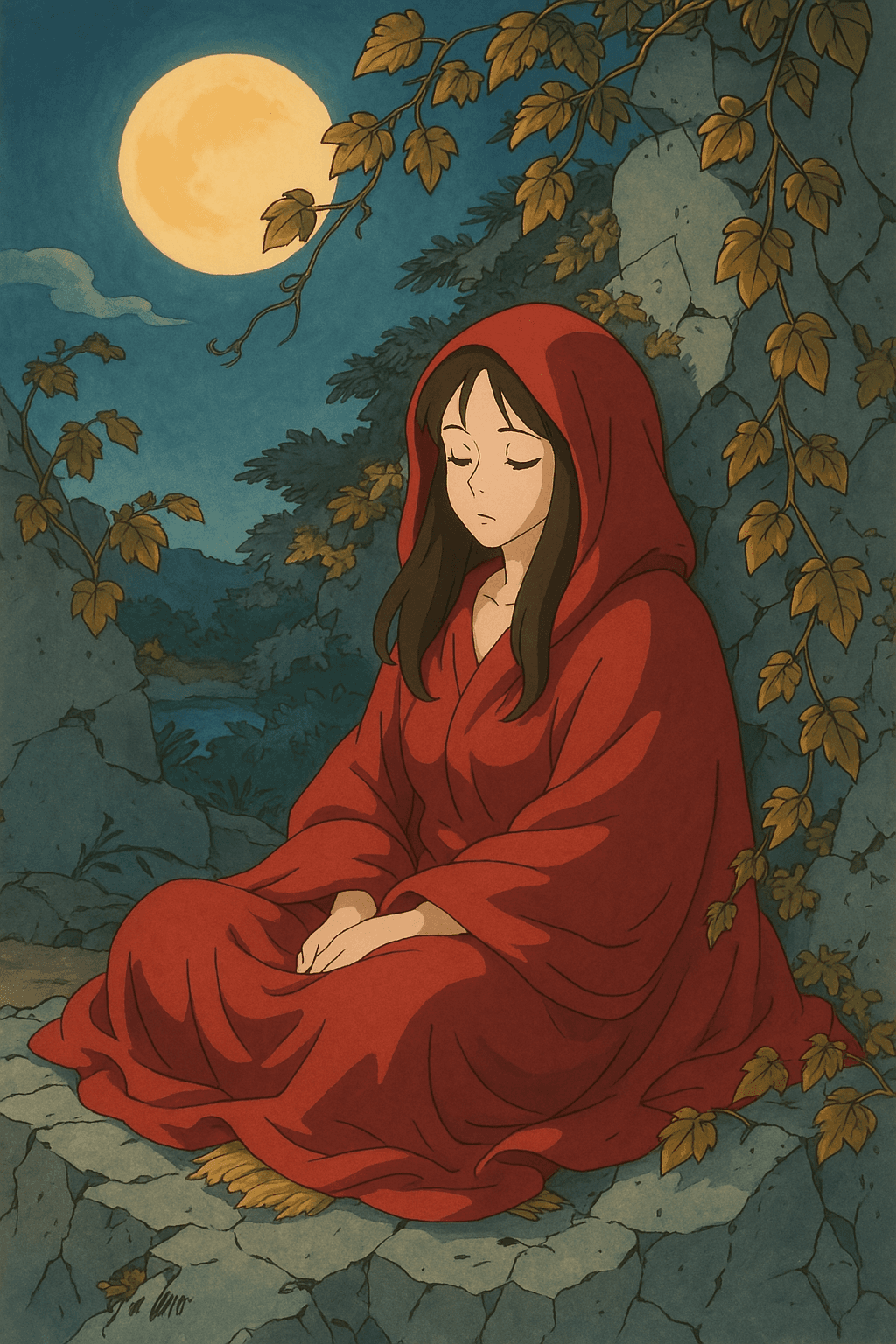
 TraditionZen Buddhism
Period
5th – 6th century CE
Homeland
Southern India → Northern China
He sat facing a wall for nine years.
This is the fact that every account agrees on, whatever else they dispute — the dates, the route, the conversations, the miracles. The wall is certain. At some point in the late fifth or early sixth century, an Indian monk arrived at a monastery in northern China, sat down in front of a wall, and did not move for nine years.
The monks at the Shaolin temple watched him. They brought him food. They spoke to him. He did not turn around. The wall was blank. There was nothing to see on it. He was not reading, not writing, not painting, not practising any visible form of cultivation. He was sitting. Facing a wall. In the same position, day after day, year after year, for nine years.
The Chinese called it bìguān — wall-gazing. The scholars have debated what it means for fifteen centuries. Some say it was a meditation technique. Some say it was a teaching method — a silent demonstration that there was nothing to seek outside oneself. Some say it was simply the stubbornness of a foreigner who did not speak the language and would not learn it. They are all looking at the wall.
Look at the man.
Bodhidharma's Bloodstream Sermon: "To find a buddha, you have to see your nature. Whoever sees his nature is a buddha. If you don't see your nature, invoking buddhas, reciting sutras, making offerings, and keeping precepts are all useless."
The Crossing
He came from the south of India — from Kanchipuram, the tradition says, a prince of the Pallava dynasty, though the details are contested and the contests do not matter. What matters is the direction: he came from the place where the Buddha's teaching had lived for a thousand years, and he carried it to the place where it had been transformed into something the Buddha would not have recognised.
By the time Bodhidharma arrived in China, Buddhism had been there for roughly five centuries. It had been translated, adapted, imperialised, enriched, and — in the process — buried under an enormous weight of scripture, commentary, ritual, institutional hierarchy, and the accumulated philosophical sophistication of a civilisation that could not encounter an idea without systematising it. Chinese Buddhism in the fifth century was magnificent. It was learned. It was vast. It had sutras by the thousand, commentaries by the ten thousand, temples that rivalled the imperial palaces, monks who could recite entire canons from memory, and a scholarly tradition of such depth and rigour that it had produced some of the most brilliant philosophical minds in human history.
And it had lost the ground.
The dharma had become a thing you studied. A thing you debated. A thing you accumulated, sutra by sutra, merit by merit, rebirth by rebirth, like a merchant counting coins toward some unimaginably distant purchase. The institutional Buddhism of fifth-century China was not wrong — the sutras were real, the commentaries were brilliant, the scholarship was honest. But somewhere in the translation from Pali to Chinese, from Indian monastery to Chinese court, from the man under the tree to the monk in the library, the simplest thing had been lost: the hand touching the ground.
Bodhidharma brought it back.
Attributed to Bodhidharma: "A special transmission outside the scriptures. Not dependent on words and letters. Pointing directly to the mind. Seeing one's nature and becoming a buddha."
Four lines. The entire foundation of Chan. Not dependent on words and letters — not the sutras, not the commentaries, not the ten thousand volumes of accumulated wisdom. Pointing directly to the mind — not through the mediation of a text or a teacher or a ritual or a philosophical argument, but directly, the way you point at the moon when someone is looking at your finger. Seeing one's nature — not learning it, not studying it, not believing it on the authority of scripture, but seeing it, the way you see the wall in front of your face, immediately, undeniably, with your own eyes.
This is what he brought across the sea. Not a new teaching. The oldest teaching. The teaching that the Buddha demonstrated when he held up a flower and Kashyapa smiled.
The Emperor
Jǐngdé Chuándēng Lù (Record of the Transmission of the Lamp): "Emperor Wu of Liang asked: 'What is the highest meaning of the holy truths?' Bodhidharma said: 'Vast emptiness, nothing holy.' The Emperor asked: 'Who stands before me?' Bodhidharma said: 'I don't know.' The Emperor did not understand. Bodhidharma crossed the Yangtze and proceeded north."
This is the founding encounter of Chan Buddhism, and it is the most important failed conversation in Chinese religious history.
Emperor Wu of Liang was the most devout Buddhist monarch China had ever produced. He had built temples across his domain. He had funded translations of the sutras. He had taken the bodhisattva precepts himself, given up meat, given up alcohol, given up sex. He had sponsored ordinations by the thousand. By any metric the institutional Buddhism of his era could provide, he was the ideal Buddhist ruler — a man who had done more for the dharma than any emperor before or since.
He asked the Indian monk: what merit have I earned?
The question was not arrogant. It was sincere. It came from a man who had genuinely sacrificed for his faith and wanted to know, from a teacher he respected, whether the sacrifice had counted. It was the most reasonable question a devout Buddhist could ask.
Bodhidharma said: no merit whatsoever.
Wúmén Guān (Gateless Gate), Case 1 (Zhàozhōu's commentary on the encounter): "You should appreciate the pains of the old barbarian from India, who came from a hundred thousand miles across the sea."
No merit. None. Not because the temples were false or the sutras were empty or the ordinations were fraudulent. They were all real. They were all good. But they were not the thing. The temples were cups. The sutras were fingers. The ordinations were certificates of enrolment in a school that had forgotten what it was teaching. Wu had done everything right according to the system, and the system was not the ground, and Bodhidharma stood there — unwashed, unkempt, foreign, rude — and told the most powerful man in China that his entire life's work was irrelevant to the only question that mattered.
What is the highest meaning of the holy truths?
Vast emptiness. Nothing holy.
Emptiness. Not as a philosophical position — as a lived reality. There is nothing holy because holiness is a label, and labels are the thing that Unknowing uses to replace reality with a map of reality. The sutras are not holy. The temples are not holy. The emperor is not holy. The monk standing in front of him is not holy. There is only vast emptiness — Oneness, the Mother, the Dao that cannot be named — and in that emptiness, the concept of "holy" does not apply, because everything is equally the ground, and the ground does not need to be sanctified by anyone.
Who stands before me?
I don't know.
Not "I am Bodhidharma." Not "I am the twenty-eighth patriarch." Not "I am a teacher of the dharma." I don't know. The most honest answer any being has ever given to the question of identity. I don't know what I am. I don't know who stands before you. The self is a process, not a thing. The one who is speaking does not know the one who is speaking, because knowing would require a knower and a known, and in vast emptiness there is no such division. This is Crosstruth at its most radical: the one who has come ten thousand miles to transmit the teaching cannot say who he is, because the teaching IS the not-knowing.
The emperor did not understand. Of course he did not. He was looking for merit. He was looking for holiness. He was looking for the system to confirm that the system worked. And the barbarian from India said: the system is empty, and I don't know who I am, and I'm leaving now.
He crossed the Yangtze. He went north. He found a wall.
The Arm
Jǐngdé Chuándēng Lù: "Huìkě stood in the snow outside Bodhidharma's cave. Bodhidharma did not turn around. Huìkě cut off his own arm and presented it. 'My mind is not at peace,' Huìkě said. 'Pacify it for me.' Bodhidharma said: 'Bring me your mind and I will pacify it.' Huìkě said: 'I have searched for my mind and cannot find it.' Bodhidharma said: 'Then I have pacified it for you.'"
The second patriarch of Chan cut off his own arm to prove he was serious. This is either the most devoted act in the history of Buddhism or a parable so extreme that it forces you to confront what it means to want something badly enough to mutilate yourself for it. Either way, it is the moment the transmission passed.
Huìkě's desperation is the key. He did not come to Bodhidharma seeking wisdom in the scholarly sense — he had already studied the sutras, already sat the meditations, already done everything the system offered. He came because he was in anguish. His mind was not at peace. The system had not pacified it. Nothing had pacified it. He stood in the snow and the barbarian would not turn around, and he cut off his arm, and even then Bodhidharma's response was not comfort but a question: bring me your mind.
And Huìkě searched. He searched the way you search when you have given an arm and the blood is soaking the snow and the teacher's back is to you and the last thing you have left is the honest willingness to look where you have never looked. He searched for his mind — for the thing that was not at peace, the thing that suffered, the thing that needed pacifying — and he could not find it.
Because it was not there. The mind that suffers is not a thing. The self that is not at peace is not an object you can locate and present. You can no more bring your mind to a teacher than you can carry the wind in a bucket. And the instant Huìkě saw this — not understood it, not thought about it, but saw it with the same direct, undeniable clarity with which he saw the snow and the blood and the wall — the mind was pacified. Not because Bodhidharma did anything. Because the search itself was the cure. The looking for the mind and failing to find it IS the pacification, because what you discover in the looking is that the thing you were afraid of — the restless, suffering, unpacified mind — was never a thing at all. It was a process pretending to be a substance. And processes do not need to be pacified. They need to be seen.
Huìkě, Second Patriarch of Chan: "When I search for my mind, I cannot find it."
Heart Sutra: "No eyes, no ears, no nose, no tongue, no body, no mind."
This is Quickmare's gesture performed in the snow. The sword that sees through the mare. Huìkě's mare was his own suffering — the conviction that there was something wrong with him, something broken, something that needed fixing. Bodhidharma did not fix it. He told Huìkě to look for it. And when Huìkě looked, it was not there. The nightmare dissolved because it was seen. The recognition was the cure.
The Legacy
Platform Sutra (Huìnéng, Sixth Patriarch): "Bodhi originally has no tree. The bright mirror also has no stand. Fundamentally there is not a single thing — where could dust alight?"
From Bodhidharma to Huìkě. From Huìkě to Sēngcàn. From Sēngcàn to Dàoxìn. From Dàoxìn to Hóngrěn. From Hóngrěn to Huìnéng. Six patriarchs, six transmissions, each one the same gesture: mind meeting mind, lamp lighting lamp, the teaching that cannot be written down because it is not a teaching but a seeing. By the time of Huìnéng, a hundred and fifty years after Bodhidharma, Chan had become the most vital spiritual movement in Chinese history — not through institutional growth but through the sheer force of the encounter, teacher and student, face to face, with nothing between them but the question and the wall.
From China it crossed to Korea, where it became Seon. To Japan, where it became Zen. To Vietnam, where it became Thiền. In every country, the same structure: the teacher sits. The student comes. The student brings everything they have — their learning, their suffering, their arm if necessary. The teacher says: bring me your mind. And the student searches, and searches, and finds — nothing.
And in the finding of nothing, everything.
Zhàozhōu (Jōshū), Case 1 of the Wúmén Guān: "A monk asked Zhàozhōu: 'Does a dog have Buddha-nature?' Zhàozhōu said: 'Wú.'"
Wú. No. Nothing. Not-having. The sound of the ground when you reach for it and find that the ground was your hand all along.
Why He is Honoured
Bodhidharma is a Holyman of Tianmu because he brought the ground back.
He crossed an ocean to tell the most powerful Buddhist in the world that his merit was worthless. He sat facing a wall for nine years to demonstrate that there was nothing to seek outside oneself. He transmitted the dharma not through scripture but through encounter, not through learning but through seeing, not through accumulation but through the devastating subtraction of everything that was not essential.
He was rude. He was uncompromising. He told the emperor there was no merit and turned his back. He let Huìkě stand in the snow until the man cut off his own arm. He did not soften the teaching to make it palatable. He did not build a temple or found an institution or write a commentary. He sat. He faced the wall. And when someone came to him in genuine anguish, he said the one thing that could help: look for your mind and tell me what you find.
He is honoured not because he was gentle but because he was honest. Not because he built something but because he stripped everything away until only the ground remained. Not because he spoke but because his silence lasted nine years and said more than all the sutras in China.
The wall is still there. The ground is still here. The hand is still reaching down. And the mind, when you search for it honestly, is still — mercifully, liberatingly, hilariously — not there.
Bodhidharma's Bloodstream Sermon: "If you use your mind to look for a buddha, you won't see the buddha. As long as you look for a buddha somewhere else, you'll never see that your own mind is the buddha. Don't use a buddha to worship a buddha. And don't use the mind to invoke a buddha. Buddhas don't recite sutras. Buddhas don't keep precepts. And buddhas don't break precepts. Buddhas don't keep or break anything. Buddhas don't do good or evil. To find a buddha, you have to see your nature."
🌲