
Okay I’ll bite... “Many religions are true” is just asking someone if they believe in, essentially, the most vague gesturing towards ‘Perennialism’ and I mean specifically the oldest more orthodox definition of this word. This is -MOST PEOPLE- in 2025.
The thing you must understand is that there are two kinds of religious people, there are religious who believe that they must believe in and have faith in the correct things, and that this is a gatekeeping measure to the afterlife. These people are, frankly, and I will not mince words here, insane. These are the people who commit war crimes in the name of their faith, the fundamentalists, the literalists, the people who truly do not have a religious or spiritual bone in their body and if they did they would immediately develop anti-social solipsistic quasi-gnostic schizophrenia.
The other kind of religious person is not this kind of paltry domestic creature of the first kind, this person understands that religions are manmade but also correctly understand that they directionally point to something ‘True’. They typically understand that ‘Truth’ cannot be known, but that the quest for pointing the compass as best towards it, despite the pointer’s constant and unending wobble, is genuinely worth it, and might even be something fundamental to the human spirit. Some people take it in a materialistic way and say that we are biological animals who evolved to think like this, so in a self-improvement style way, the only way to be a full human is to embrace the razor’s edge of religiosity and in doing so happymaxx to their full potential. Either way they are essentially the same thing.
This latter group was not always the majority of religious people, it is a sorta carnivore vs herbivore population boom and growth dynamic. The first Protestants, if you read their writings, especially from the lower common people, are much like the latter person. Yet as time goes on, there is a regression towards the former, you see this in the most fundamentalist insane American Protestants today.
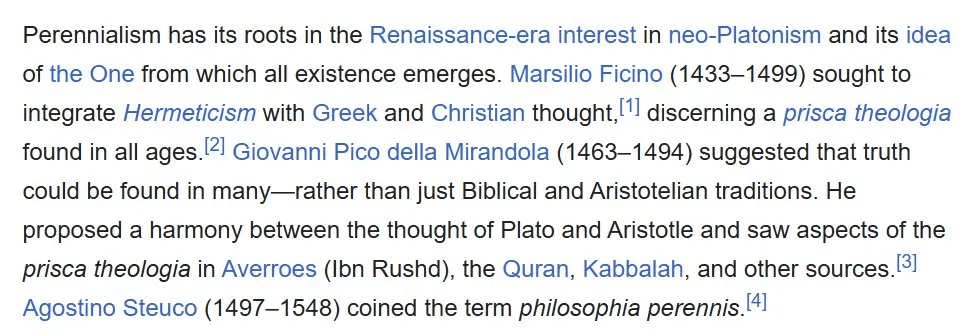
Yet in truth, no group is ever 100%. This is why you always have seekers and people who, and now I will insert my own beliefs, -rightfully- understand in the truth of Perennialism. This is a progressive and evolutionary mechanism and one that has been churning on since the Protestant reformation led to the Renaissance which lead to the Great Awakening which led to the New Age which has thus led us to now. This philosophical tract is all about Perennialism, and as the West becomes more and more secular we might expect a rise of atheism, and some statistics do mistakenly show that due to bad epistemics, but what we really see is more than half of American’s believing that you can talk to the dead, a trend consistent among stated religious beliefs, even atheists. The same is said for beliefs such as reincarnation, astrology, and divination like tarots or ‘synchronicities’, and the transformative supernatural power of prayer or ‘manifestation’. (If this interests you read the book ‘The Secular Paradox’).
So to the question, ‘How does it work’? Well it works because most people in 2025, even if officially they belong to an organized belief system, have adopted New Age (I call this Aquarian as ‘New Age’ has a negative stereotype and often only is used in the pejorative) beliefs into their mainstay. One of these is the idea of Perennialism. This is why I often jokingly say things like “American Buddhism is a form of Calvnism”, on its face with a vanilla hermeneutic it seems absurd, but when we look at things both genealogically and ontologically, as in; “If we completely ignore the coat of paint of aesthetics what does the actual engine of function look like?” then it starts to actually make sense both ontologically, because many operating assumptions of American Buddhism are the exact same as Calvnism or simply radical reinterpretations of Calvinist doctrine, rather than authentic and genuine importations of Buddhist ontology. (If this line of thinking interests you, be happy, I am working on an essay that begins with the provocative sentence “Western Buddhism is a form of Calvinist Protestantism and that’s a good thing”).
If you and I touch the same thing and I feel red and you feel blue, we touched the same thing ontologically, but our epistemology which is downstream of our lived experience differed. Like river systems diverging from a single source.
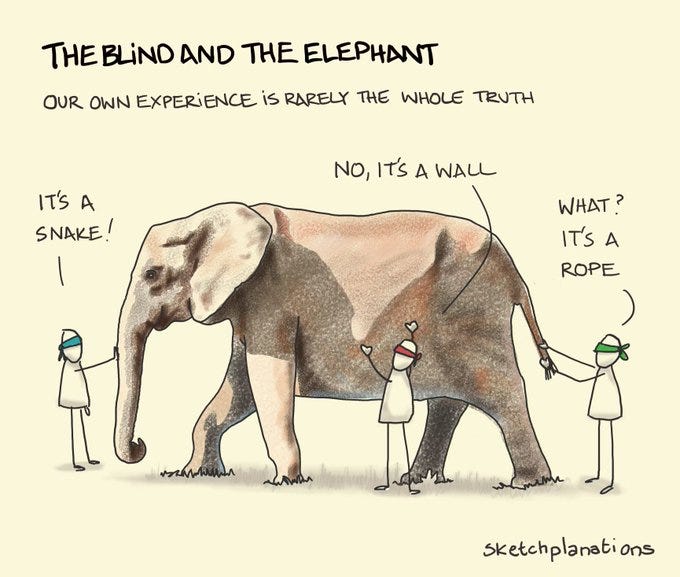
It works because most people correctly understand the ancient Vedic parable of ‘the blindmen and the elephant’ (see image 2) sufficed as the ancient hymn goes, “Truth is One, but the wise speak of it in various ways”
Simple…