Is ‘Rationalism’ a religion? This is the Question of the Day, but answering something like that requires us to actually understand what a ‘religion’ is. What is a religion? Well, if one wanted to know the answer to that question, they’d likely start with Religious Studies: what does the field of Religious Studies define as a religion?
(Note: If you clicked ‘Read More’ and are already
very angry, perhaps you see me as ‘outgroup’ already, please understand and lets show some epistemic humility here; I don’t think ‘Religion’ is a dirty word, and in fact, I think Rationalism as a ‘Secular Religion’ is quite interesting, so why don’t you humor me? I am not your enemy, and I have respect for Aella.)
Let us look at the history of the term:
From Émile Durkheim, The Elementary Forms of Religious Life
“Religion is a unified system of beliefs and practices relative to sacred things”
From Clifford Geertz, “Religion as a Cultural System”
“Religion is a system of symbols which acts to establish powerful, pervasive, and long-lasting moods and motivations in men by formulating conceptions of a general order of existence and clothing those conceptions with such an aura of factuality that the moods and motivations seem uniquely realistic.”
From the Stanford Encyclopedia of Philosophy
“It is sometimes assumed that to define religion as a social genus is to treat it as something universal … As common as beliefs in disembodied spirits or cosmological orders have been in human history, for instance, there were people … who have no views of an afterlife, supernatural beings, or explicit metaphysics.”
From T. Jeremy Gunn, “Towards a Constitutional Definition of Religion: Challenges & Prospects”
“Religion is a set of systematic beliefs in relation to a transcendent being, thing, or principle. An essential aspect of a religion is exercise or practice based on those beliefs. … the beliefs are in relation to a ‘transcendent being, thing or principle.’ … The definition also allows for the inclusion of secularism as a religion if it meets the other criteria.”
From Cantwell Smith, “The Meaning and End of Religion”
“There is no one essence of religion. There have been religions without gods, without doctrines, without rituals.”
From J. Z. Smith, “Imagining Religion”
“Religion is an exercise in world-building.”
From Ninian Smart, “The Science of Religion and the Sociology of Knowledge”
“A religion need not involve belief in a supreme being or beings, and it is not necessarily theistic. A religious tradition typically has practical, experiential, narrative, doctrinal, ethical, social, and material dimensions.”
Now let us take Smart’s definitions and apply it to Rationalism, shall we?
Rationalism has PRACTICAL dimensions: Practioners are expected to cultivate particular cognitive habits, update beliefs through ‘Bayesian reasoning’ and preform ongoing ‘rationality practice’.
It also has an EXPERIENTIAL dimension: Practioners describe moments of epistemic clarity, transformative insight, and a felt sense of overcoming bias that function analogously to religious experiences of revelation or enlightenment.
It has a NARRATIVE dimension: The Sequences supply origin stories, parables, morality tales, and exemplars of the Rationalist Ideal.
It has a DOCTRINAL dimension: Core claims such as reductionism, effective altruism’s utilitarian commitments, AI-risk framings, the primacy of Bayesian epistemology, are all treated not merely as hypotheses but as the central teachings that orient the Rationalist’s worldview.
It has an ETHICAL dimension: There are clear norms about intellectual honest, epistemic humility, ‘updating’, charity, and the moral imperative to optimize outcomes.
It has a SOCIAL dimension: Meetups, group houses conferences, collective terminology, ingroup/outgroup boundaries that define a coherent community.
It has a MATERIAL dimension: The books, substacks, blogposts, LessWrong archives, the diagrams, the community spaces, and even the aesthetic and symbolic markers that serve as material culture for the group.
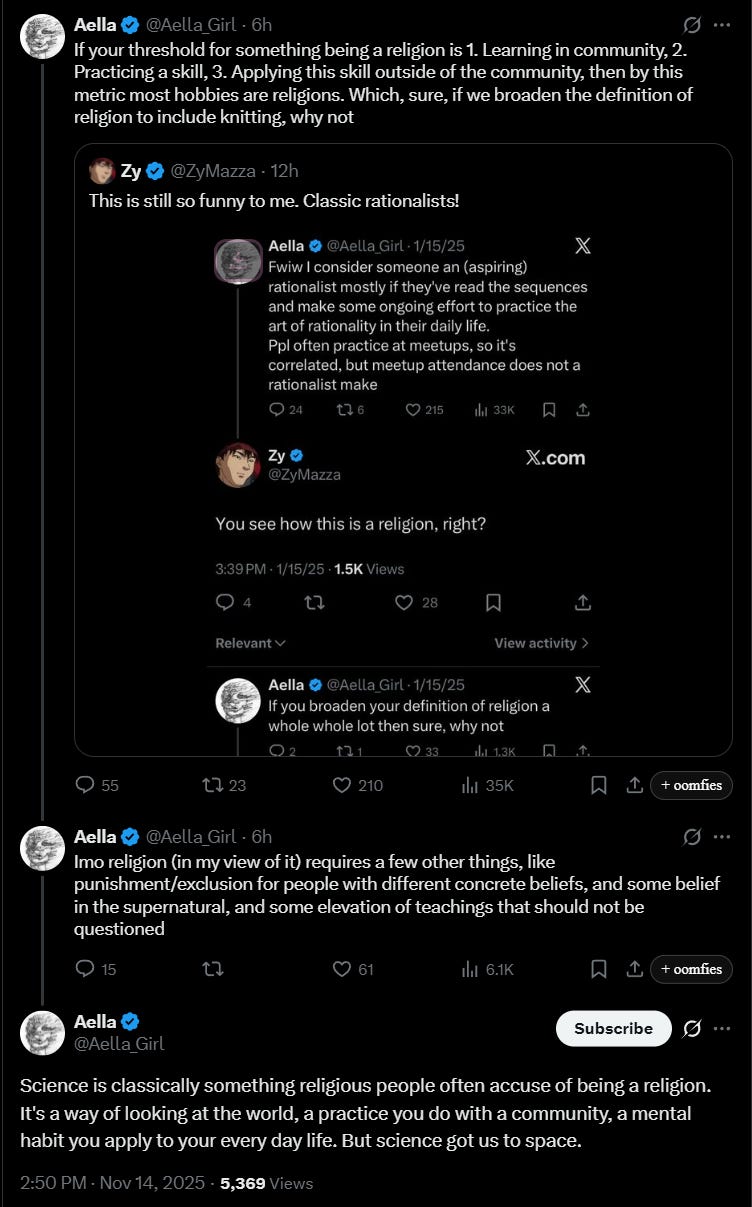
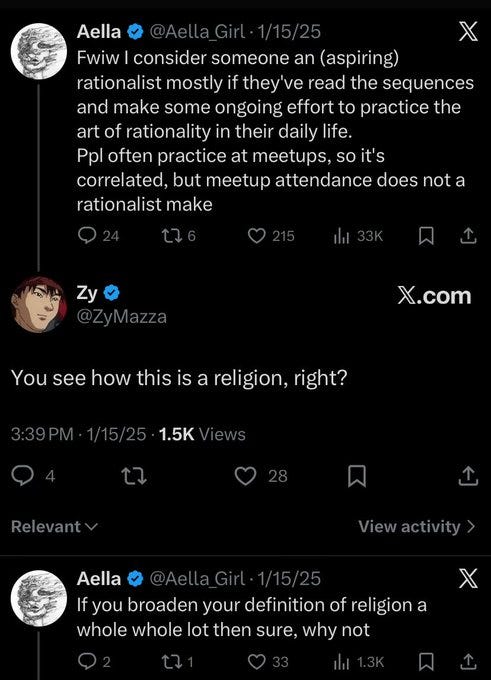
Aella’s claim that “this is just a hobby that people practice in community” breaks down the moment anyone applies even the most minimal, lenient, academically recognized list of religious dimensions. Hobbies do not -generally- include canonized texts prescribing ontological and epistemic conduct, they do not offer comprehensive theories of mind, ethics, and the ultimate fate of humanity (eschatology) and man’s salvation (soteriology). They do not erect boundaries around what counts as a “real” acolyte based on adherence to key teachings or specific ‘teachers’, they do not claim to reveal the proper structure of reality, they do not require members to revise their lives under a totalizing worldview.
Rationalism does all of these things.
One cannot dismiss this by insisting that a religion must involve belief in the supernatural. Scholars in the field of Religious Studies specifically, and repeatedly, reject this requirement. What matters for the comparison is not supernatural content but FUNCTION (which PRECEDES form): the practices, commitments, identity formation, moral expectations, and worldview-structuring role a system plays. On nearly -every single- functional measure developed to identify religions in Religious Studies, Rationalism qualifies, quite well in fact!
In a book I really advise everyone to read, if there’s one book I mention here, please read this one, by Joseph Blankholm, “The Secular Paradox: On the Religiosity of the Not Religious” he strengthens these points even further. Blankholm shows that people who identify as “not religious” often end up reproducing many of the very structures, habits, and moral logics of religion, oftentimes -more intensely than self described believers-. He documents how organized atheists, humanists, and secular activists build institutions, formulate shared moral visions, create canons of authoritative texts, venerate founding figures, and draw strict boundaries around orthodoxy and heresy within their own circles. The paradox, for Blankholm, is that in trying to escape religion, the secular often becomes religious in form but lacking in religion’s self awareness; it cultivates identity, ritual, community, and sacred values, only with different metaphysical commitments. Secular people do not simply reject religion, they often reinvent it in new shapes. His work shows that the impulse toward religious patterning is not eliminated by secularization, it is merely rerouted.
Frankly, I think Rationalism is interesting because it is -not- unique. Once you stop insisting that “religion = belief in spoopy doopy sky folk” you start seeing the same pattern show up all over modernity. Fandoms (K-Pop?), invented religions (Haruhism? Jediism?), Celebrity Cults (Swiftyism?), even in the people who loudly insist they are post-Religious (Atheism+?).
Religious thinking is INHERENT TO HUMAN NATURE. If you -truly consider yourself a Rationalist who listens to the experts- then it would BEHOOVE YOU to listen to them here, being aware of how we humans are suspectable to religious thinking and how it is innate in our psychology is -exactly how we avoid the pitfalls of religion gone mad-, and frankly one of the most dangerous things that a ‘religion’ can do is pretend that it is not a religion.
This is not new, this is not some woke hoodwink, scholars have been talking about this fore quite some time. Carole Cusack’s work on “invented religions” tracks movements that -openly- start as fiction: and then go on to behave like any other religious tradition albeit with a little wink: Discordianism, the Church of All Worlds, the Church of the Subgenius, Jediism, etc.. From a review of her work, these invented religions “fit newer models of religion that emphasize story, play, creativity, and the importance of meaning-making, both individual and collective. Whether the stories are fictions or ‘actually happened’ is, ultimately, unimportant.” Humans take shared stories, stack practices and norms on top of them, and then experience them as real, weighty, and binding. This is “religion-as-function”, not “religion-as-magic-ontology”.
Cusack has also written about fandoms, in a piece literally titled “Are fandoms a modern kind of religion?”, she notes that although religions and fandoms look very different on the surface, old vs new, scripture vs entertainment, both generate devoted communities organized around texts, ideals, rituals, and models for how to live and experience qualia. In other words, if you have a canon, even if it is community driven or anarchistic, and a set of practices that make the canon feel ‘real’ in your life, you are already halfway into religious territory.
David Chidester pushes this further in “Authentic Fakes: Religion and American Popular Culture”. He goes hunting for “the religious dimensions of American popular culture in expected places: baseball, the Human Genome Project, Coca-Cola, rock n’ roll...” This is not to say something absurd like “baseball is literally a Church”, it is that popular culture can “do religious world an exist in a religious framework” even when nobody involved thinks of it as a religion. Chidester states that the fight over what counts as ‘real’ religion is itself about authenticity and power: “What counts as religion, therefore, is the focus of the problem of authenticity in religion and American popular culture”. That is exactly what is happening when the Rationalist insist, with some... panic, that they are -NOTHING- like -those people- over their with their ancient cults and outlandish scriptures.
If you are willing to look at fandoms with the same tools, Swift’s fanbase is basically the perfect specimen. One academic paper argues “the culture surrounding Taylor Swift is a religion in which the singer is idolized and revered as a religious figure". Religious scholar Kathryn Lofton describes how Swift’s fans “worship” her “almost like a religion”, complete with screaming, crying, and call-and-response rituals that look uncannily like Low Church Protestant charismatic worship services. Another study of celebrity music fandom notes that scholars have linked the rise of intense fandom and celebrity worship to the decline of traditional churches, theorizing that “fans look to the media” to meet needs once met by religion. Work on Swift in particular argues that celebrity culture around h er “serves as a modern reinterpretation of ancient myths and rituals”, presenting her narrative arc in terms of death, rebirth, moral testing, and redemption. Journalistic pieces are also not shy to routinely describe Swiftie’s “near religious devotion” and the way fandom “fills spaces where traditional faith has lived”.
As we can plainly see, calling Swiftyism ‘religious’ is not some wild category error that makes “knitting a religion”, likewise Rationalism. Scholars are not randomly slapping the religion label on everything that looks enthusiastic. The reason these religious patterns show up so reliably is that religious thinking is not some weird aberration tacked onto an otherwise purely rational brain; as @MYTHOTROPOS said “The mind has no interface”, it is one of the native modes of the human mind. Cognitive science of religion has been banging this drum for more than two decades now. Seriously, just look this up, this is not some shit I am making up.
Pascal Boyer, in Religion Explained, writes “Having a normal human brain does not imply that you have religion. All it implies is that you can acquire it, which is very different. Religion arises naturally as by-products from mental modules selected for other purposes”. Human beings over detect agency (look up ‘Hyperactive Agency Detection’ if this interests you), we look for hidden intentions, we remember minimally counterintuitive stories better, and when you stack those biases together, you get gods, spirits, destiny, karma, doctrine, canon, prophecies and curses, whether you want them or not. Justin Barret’s work also makes a similar point in “Why Would Anyone Believe in God?”, he says “belief in God is an almost inevitable consequence of the kind of minds we have”. A later overview of the field summarizes Barrett’s position by saying that religious belief is “natural”, whereas scientific thinking is -not-. Science requires sustained effort against our intuitive biases. There is a book on this by Robert McCauley, “Why Religion Is Natural and Science Is Not”, where he argues that ritual, agent-detection, teleology, and narrative fit our maturationally natural cognition much more smoothly than abstract, counterintuitive scientific reasoning.
The human brain is religion shaped by default. It wants world-building stories, morally charged communities, sacred values, special persons, and rituals that make everything feel coherent and real. Give people a charismatic pop star, a fantasy universe, or a stack of blog posts about Bayes and AI, and all those same cognitive systems will spin up myth, devotion, heresy policing, pilgrimage, liturgy, and the list goes on.
Please, I write this entirely in good faith, listen to me, and if you don’t listen to me listen to many of the Religious Studies scholars I’ve brought up here. When Rationalists insist -they- are immune to all this, that -they- are too smart and too evidence based or epistemically virtuous to stumble into the same patterns that have shaped every tribe, cult, movement, fandom, and grand totalizing civilizational ideal since time immemorial, that this isn’t skepticism, it is hubris! It is the very bias they believe they have transcended! The neurological systems that generate religion are older than language, older than agriculture, older than duality, older than symbolic reasoning itself. You do not ‘outgrow’ them. The only way to wrestle with them is to recognize that they are working within you all the time, especially and most importantly in the places where you feel uniquely correct, uniquely rational, and uniquely above the fray.
Calling ‘Rationalism’ a religion is not an insult, if anything it is a compliment. It is an opportunity to gain self-awareness and thus agency over the mythmaking, the sacred values, the charismatic founders, the ritualized practices, the unexamined hierarchies, the ingroup/outgroup tribal lines, the moral fervor, the canon, the pilgrimage sites, the boundaries of heresy, the ordinary and very human things that get denied or repressed until they explode into much less healthy forms.
Humans cannot replace their firmware, yet.
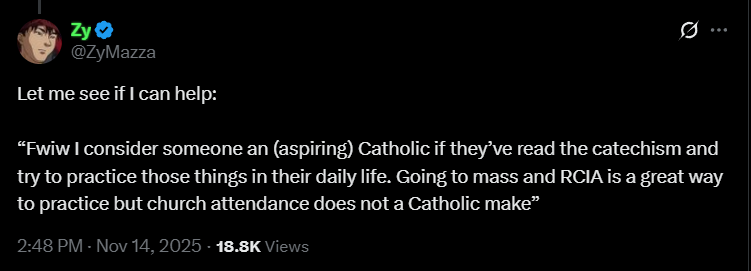
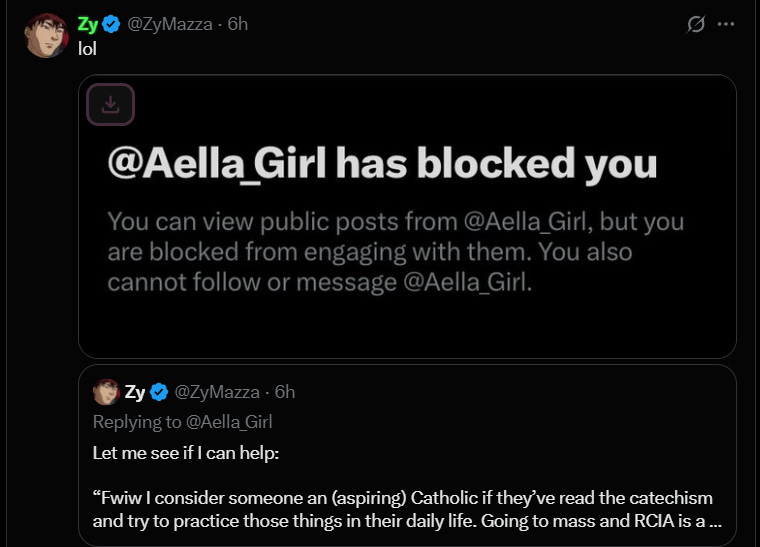
PS: For those missing context, here it is.