
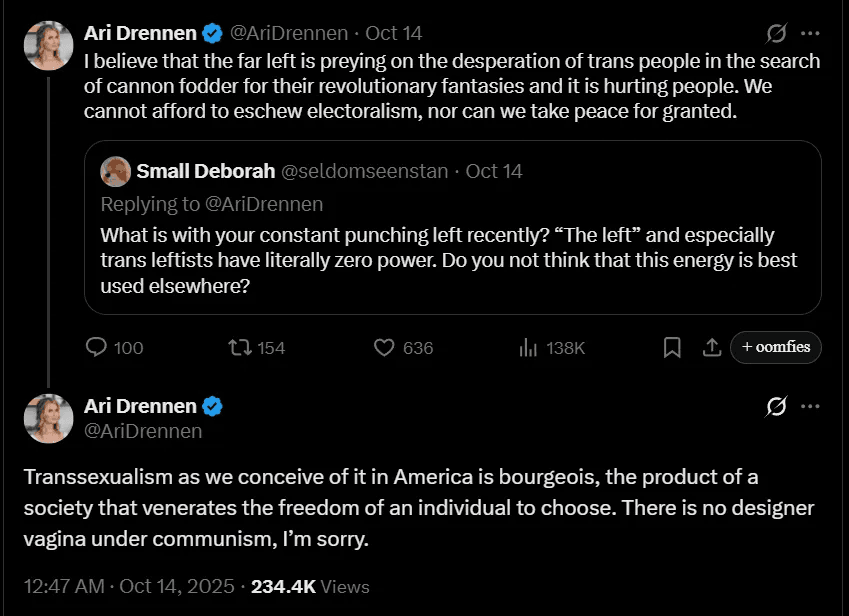
And here we see why Proletariat Communism will fail, what is the “Proletariat” but human excess? People born to labor and nothing else! Why then does Prole Communism say it is “Saving” the Proletariat while enshrining their ontological slavery as the pinnacle of existence?
Imagine for a moment you are a cow in a factory farm, would you support the cow that offers to set you free and return you back to your natural state, or perhaps even -overcome- that natural state, or would you support the cow that simply wishes to make the cows run the slaughterhouse? Proletariat Communism is simply the cattle running the butchery. It still assumes that man is a cog, but man is not a cog, man is spirit!
This is why the Communism I support is not ‘Communism’ in the classical sense, I see the condition of the ‘Working Class’ the ‘Proletariat’ as inhuman, and it is not inhuman because they are oppressed by a ruling class, though this is certainly part of it, Marx says the worker suffers from false consciousness, that they fail to recognize their true class interests and revolutionary potential as the proletariat, yet in truth they are oppressed because they are fed the lie that their only worth is in labor. Marx says that labor is the essence of human life, that through work we realize our speciesbeing and transform the world. I know Marx’s telos is post-scarcity; but my point here is that he elevates labor from a contingent material mediation into human identity, conflating the means with the end, freedom from necessity. Man is not the ‘laborious animal’. Man was not born to labor, man was not born to toil. Man was born to be post-scarcity, man was born to kill a mammoth with his friends and then have enough food to feed him and his family and his tribe for at least a year, maybe three if they’re lucky.
We are apex predators, the goal of life is leisure, and that leisure might have been somewhat precarious in the past, sure, the megafauna hunters did not have modern medicine, I am in no way an anti-Civilizationist “return to caveman” person, but I believe that Civilization itself was a gambit.
Humans naturally understood that the post scarcity given to them by the pre-Neolithic was fleeting and brutal. The point of the Neolithic and its wide adoption was utopia, you really must understand this. The early Neolithic was literally hell on earth, people were like a foot shorter than non-Neolithic people, all of their teeth fell out, they rarely if ever made it to being elderly. Why would they do it? Well, the answer is, hope, hope for a utopia. Neolithic people did not just spawn out of the ground, they did not just appear, before the Neolithic man was universally an apex predator, why would they give that all up? The answer is quite obvious, and when you read how the ancients we know of spoke of the ancients they knew of, it becomes exceeding obviously.
This tension is felt in the mythic poems and prose of every ancient religion before the days of Christ & Buddha as well. You are going to your 9-5 every day for a reason, a reason that you yourself in this incarnation had no say in, but one that you did have a say in, spiritually speaking, it was a choice that was chosen for you, but not out of malice, not out of greed, because even the ruling class of the neolithic people lived like shit compared to their wild cousins, but the hope that one day we would be more than just apex predators, one day we could not conquer nature, but rise to our ordained position as shepherd of nature, that we could let all people flourish and live their lives, so we could overcome the struggle. When we think of the early Neolithic people, the founders, you must imagine them like the Pietists, Quakers, Mennonites, and Amish, they were an insular utopian people breaking from the norms of the world around them, their ways were strange, at times counter intuitive, but they are joined by a belief that one day their way of living will pay off, and that consciousness is shared by all of their members, and as such they act historiographically as a single unit.
We have lost that sense in the modern world, even by antiquity we had lost that sense, why are we doing this? Why are we here? Why are we not Andamanese or Pirahan? Why must we toil while our brothers in the jungle know only plenty?
The goal isn’t to go back to some antediluvian paradise nor is it to build Sumer for Sumer’s sake, the goal is to elevate man to his rightful position among the gods. Man’s essential essence is not production, the ontology of toil was never meant to be enshrined as it has been, we have lost our way and our foresight, the future of man can only be post-scarcity, or these endless wars of Sumer begetting Sumer will have been all for naught, man’s nature is freedom and love.