The tragedy of the common is a myth. It did not happen. However, there -was- a “Tragedy of the Commons” and yet it was entirely different from the narrative that you were fed in school, the truth is, you don’t even fully understand what the ‘Commons’ is, do you? You don’t. To really understand what the ‘Commons’ is we need to understand its genealogical history. The Commons existed as a lived reality justified by an ancestral and God-given liberty until it was forcibly suppressed and violently enclosed.
The ‘Commons’ is a concept that is older than England itself and goes back to our days before we colonized Britannia, in fact the concept goes so far back that it is impossible to actually trace its origins, as far as the written historical record is concerned, it is as old as the ‘Germanic’ people themselves.
The Commons springs forth from a simple virtue, that no man should be forced to live a certain way other than what is natural to him, being a man. More directly, that no man should ever, against his will, be a slave. The ‘against his will’ here part is important.
Many do not fully realize this, but for all of European history, the Nordic people, of which the Angles, Jutes, and Saxons are apart of, probably had the least amount of time practicing serfdom of any other people, and the entire time was wrought with rebellions against this very sinister institution. Serfdom, as you should be aware, is slavery. Humans are property of the land and when land is sold the farm equipment, the serfs, are sold too. When we speak of the British-led global crusade to end slavery we must remember that this crusade did not first jump from the straits of Dover to the Ivory Coast, it was a movement and philosophy that first sprang forth at home.
So why were they like this? Well, modern historians have their explanations, but I am not a historian. I am a descendent of these people, and these people canonically have their own explanation and it is one that is rooted in firm religious reasoning. You see, they believed that they were direct descendants of the Gods themselves, and that this direct descent from Odin and Freya bestowed upon them certain liberties, privileges, and freedoms. This is often referred to in the literature as the ‘Ancient Constitution of England’, and one of the primary things that it banned was slavery for the English, not just the practice of slavery against others, but against themselves as well. “From the beginning, all men were by nature born free,” wrote the radical preacher Thomas Müntzer in 1524, echoing a sentiment that would ignite revolts across the Germanic world.
You might look at the history of England and say, “Well this doesn’t make sense, the English did this and that” except that is exactly downstream of this. First you must understand, England was conquered in 1066 and has not been controlled by those people since. Second you must understand that nearly all of England’s history is strife between this conflict between oppressed and oppressor, no other European country is better defined by the struggle between the have and the have-nots than merry England.
By the reign of Elizabeth I, serfdom had effectively died, and in 1574 the Crown declared that the remaining serfs on royal estates were to be treated as free, Russia would famously not abolish serfdom for a little more than 300 years from this point. Yet even as this institution was abolished, it was basically not even practiced, and had been in total decline since 1381 at the culmination of the, in Tory terms: “Peasant’s Revolt” or as I like to call it, in accordance with proper Whig historiography, the “Great Rising”, which was a mostly successful revolution that saw Serfdom abolished and the mass public execution of royal officials.
Quote from a speech by John Ball in 1381, a Catholic Priest one of the Leader’s of the Great Rising,
“From the beginning all men by nature were created alike, and our bondage or servitude came in by the unjust oppression of naughty men.”
Here’s another quote,
“My good friends, things cannot go on well in England, nor ever will until everything shall be in common, when there shall be neither vassal nor lord, and all distinctions levelled; when the lords shall be no more masters than ourselves…”
Here again we see a famous slogan from the time repeated as a chant and song,
“When Adam delved and Eve span,
Who then was a gentleman?”
As another anonymous chant from the same period declared,
“Now is time, if ever there were,
For folk to stand as free as air.”
The Great Rising was just a single instance of revolt from the people against the monarchy and this trend would repeat itself in the English Civil War and the American Revolution, many apt historiographers have rightfully shown a through line from the Peasant’s Revolt->English Civil War->American Revolution. This trend has happened countless times though in lesser and completely undocumented cases, even today these abstraction still live rent free in the minds of anyone born in the Anglosphere and given to English as their native tongue.
So how did this anti-slavery mindset manifest then, and how does it relate to the Commons? You see, much of England used to be held in what is called ‘Common’. This ‘Common’ land is what you are taught about in school ever so briefly when you go over the Tory perspective of the ‘Tragedy of the Commons’. You are taught that the Commons were abused, mismanaged, and they had to be consolidated into private land given to the land holders, it was simply unsustainable! And how wonderful of a story that is! You may have even been told that this enclosure of Common land was responsible for the industrial revolution, joyous!
With one hand they speak the truth, with the other they lie. The truth is, Common land was mismanaged, but it was not mismanaged by the Common man or the Wasteman, it was mismanaged by the gentry, nobles, and aristocracy that wished to, in great excess, use the land for their own purposes. As Gerrard Winstanley of the Diggers would later write, “The Earth was made a Common Treasury for all... not one word was spoken that one branch of mankind should rule over another.”
The tragedy of the Commons then becomes the tragedy of squabble between the landed. The enclosure was a solution to these squabbles, and from their perspective quite the fine one. There’s no more common land, so if you want to fuck up your land you can fuck it up for yourself and its your fault. How perfect!
Yet this all obscures what Common land actually was. Common land was a land free from rent seeking for those who had no property themselves. In these days most people were what we would today consider homeless, except it was not really that big of a deal to them. You see, when the Anglos Saxons Jutes and later Danes colonized this land they were not fully agriculturalized in the way the Latins were, they were still a little bit feral, a little bit wild, and as you could expect the more rural and undeveloped parts of England saw more of this traditional way of life stay in practice.
These people hunted, fished, chopped wood, open field farmed, and all around lived on Common land. Here among these people was found no tragedy, the tragedy came when the landed came to strip the land in excess. The people living on this land were not raping it of its equilibrium, they were living with it in harmony. You may find this hard to believe to a degree but let me remind you that this idea of ‘Common Land’ was practiced all over the Germanic, Celtic, and Slavic world, and the cultures that come out from Common and Wasteland can still be interacted with today, the Amish, Quakers, Mennonites, Pietists, and plenty of other Utopian Christian sects that were modeled on this way of living. Ever wondered where the Amish obsession with plainness comes from, or their disgust at excess? Their cultures formed in tune with their way of life.
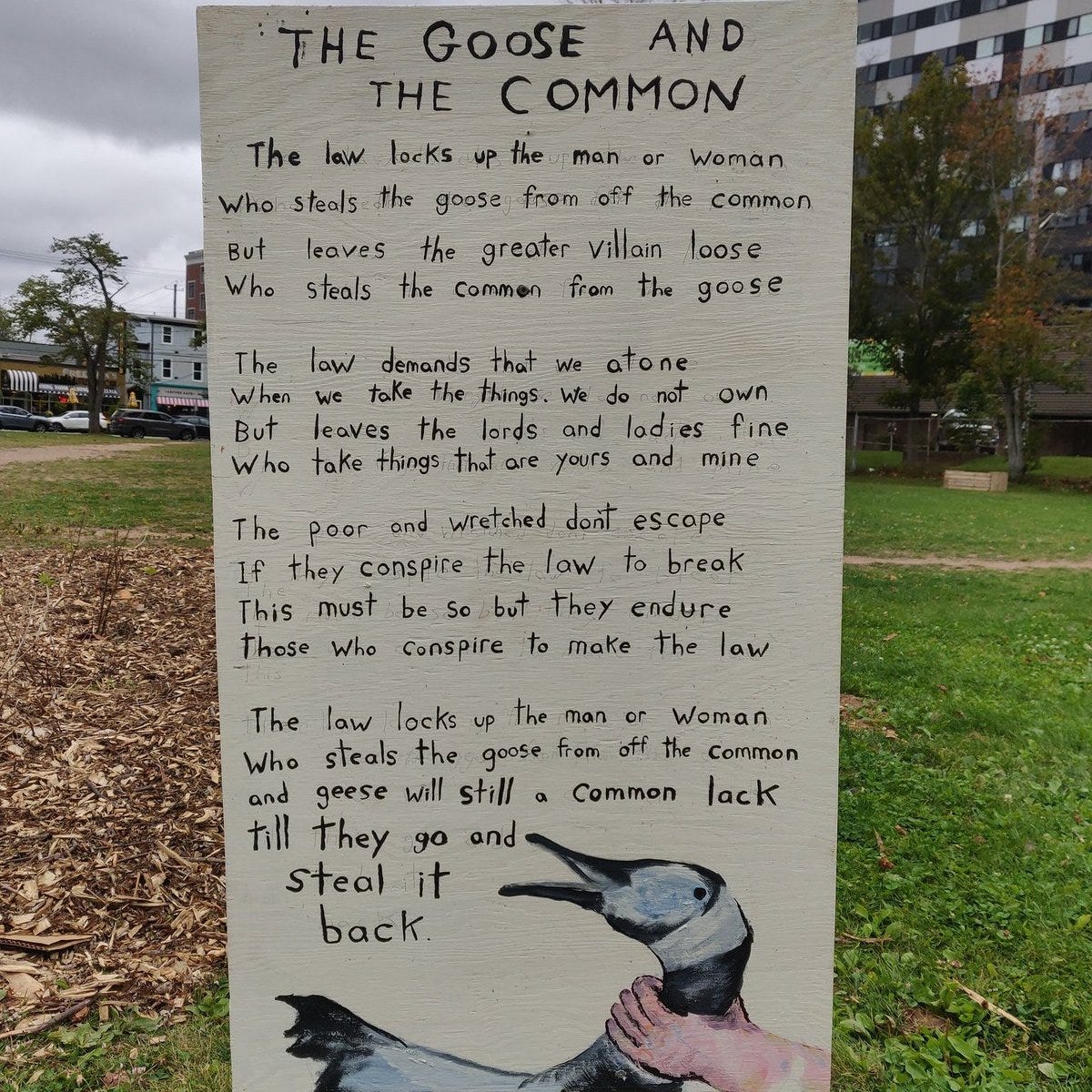
Here is a poem written in the late 18th century against the enclosures,
“The law locks up the man or woman
Who steals the goose from off the common
But leaves the greater villain loose
Who steals the common from the goose.
The law demands that we atone
When we take things we do not own
But leaves the lords and ladies fine
Who take things that are yours and mine.
The poor and wretched don’t escape
If they conspire the law to break;
This must be so but they endure
Those who conspire to make the law.
The law locks up the man or woman
Who steals the goose from off the common
And geese will still a common lack
Till they go and steal it back”
As the English radical William Cobbett would later lament, “Once there were commons for all... now all is taken, and we must buy our place upon the very earth we were born from.”
If this way of life were truly so chaotic and such a free for all that the Tory myth suggests, it would not have endured for centuries across tribes, kingdoms and continents. It would not still be practiced in a disjointed way by groups like the Amish. It persisted because it was regulated not by kings or landlords, but by customs, kinship, honor, and necessity. A man who overhunted or exhausted the pasture did not merely break a rule, he betrayed his whole family and tribe. The Commons sustained itself through living law.
It was destroyed because it stood in the way for the course of Empire.
When the landed folk wished to maximize profits from extraction, expand sheep grazing for the wool trade, and convert free peasants into wage slave, the Commons became an obstacle. It was not the people mismanaging the land, the ‘Tragedy’ in the elite’s eyes was that it was managed in a way that did not permit unlimited accumulation by the few. Enclosure thus arrives as a conquest, wielding a sword. The forests were fenced, the meadows measured, and people criminalized for stepping on the soil that had sustained them freely for generations. Life becomes trespass.
Here we see the myth of the ‘Tragedy of the Commons’, told after the fact to justify what had been done. We are told that the common people ruin shared things, that only private ownership ensures order, that enclosure was necessary because the Commons was doomed from the start. The Commons were brutally taken from the Common man, they did not fail, what is popularly told from above of a story of inevitable overuse is a eulogy rewritten by the executioner.
I must further contextualize this event, this horrible horrible event that we call ‘Enclosure’. Tens of thousands even hundreds of thousands of people lived on Common land throughout the English holdings. These people paid no rent, they did not pay for groceries, they worked when they needed to and when they did not wish to they did not. A man would work in hopes for a new fine silk cloak, but for rent and food never would he labor. These were things bestowed by God, not things to be bought and sold.
This mass of people were evicted, forcibly, violently, into the makeshift slums of the towns and cities. They were forced to labor for wages, to labor for bread. This here is the engine of the Industrial Revolution, and why it began in England, because no other country up to this point had so brutally forced the mass of their peasantry and freemen like cattle into the crowded towns and cities.
As Karl Marx described the enclosure process, “The expropriation of the agricultural producer, of the peasant, from the soil is the basis of the whole process.”
And again: “They were turned en masse into beggars, robbers, vagabonds, then flogged, branded, tortured for becoming what they had been forced to become.”
As William Blake writes in Jerusalem: The Emanation of the Giant Albion,
“And did the Countenance Divine,
Shine forth upon our clouded hills?
And was Jerusalem builded here
Among these dark Satanic mills?”
These “Satanic mills”, the result of the mass eviction and human trafficking of an untold number of people, would be what propelled the English into their dominant and preeminent position as the leaders and vanguards of the Industrial Revolution and saw the transformation of the free peasantry into what we now call the proletariat.
This was the ‘Tragedy of the Commons’.