
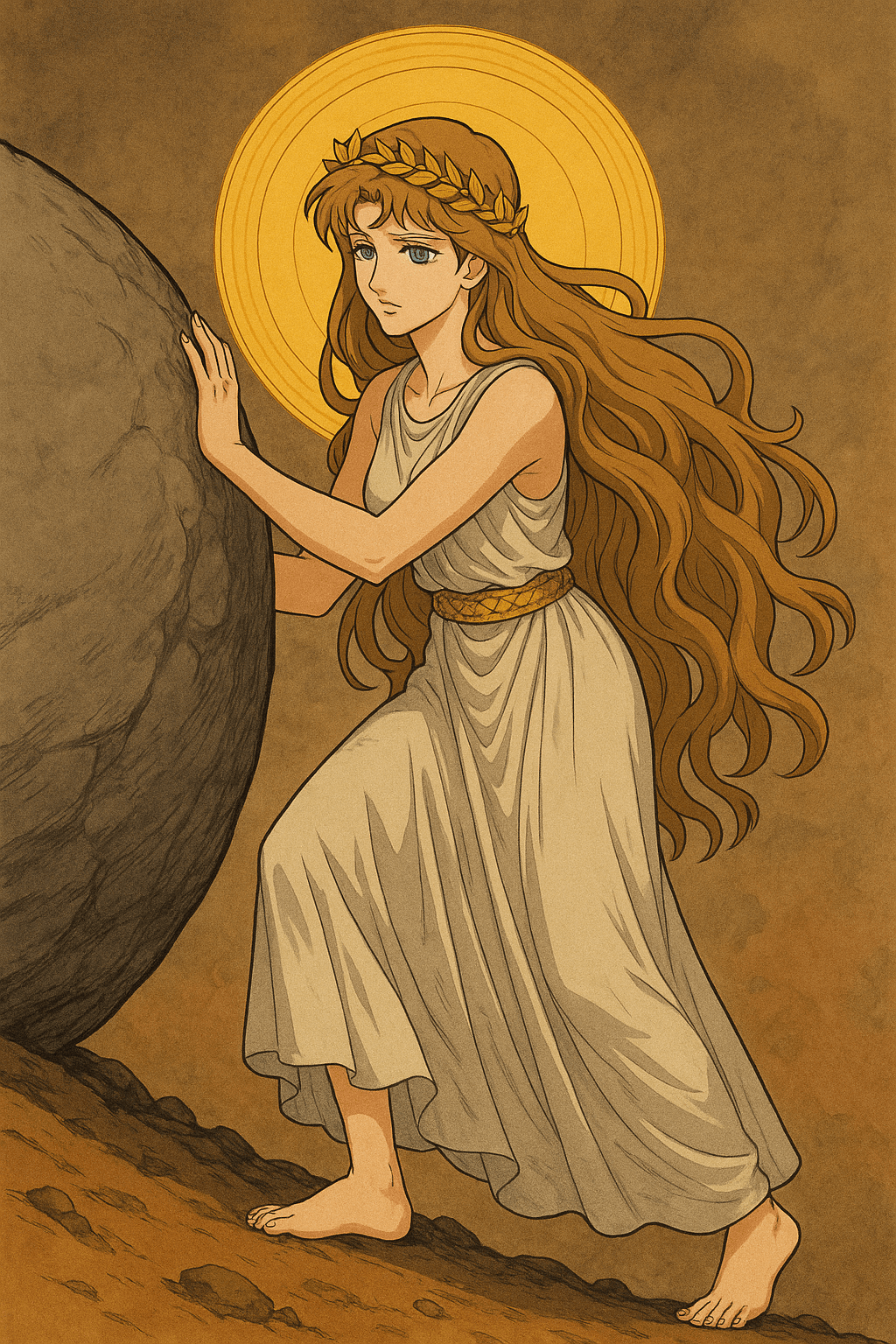
 Other NamesSisyphus (Greek), the Danaïdes (Greek, who fill leaking jars forever), Tantalus (Greek, who reaches and never grasps), Prometheus (Greek, in his aspect as the one who endures), Job (Abrahamic), the Saṃsāric being (Buddhist), Ixion (Greek, bound to the wheel), Atlas (Greek, who bears the sky), the Karmically Bound (Hindu), the Hamster on the Wheel (modern)
Related Posts
Doom, Mead, Crosstruth
In the Greek tradition, Sisyphus was the king of Ephyra, the cleverest mortal alive, a man who tricked Death himself — not once but twice. The first time, when Thanatos came for him, Sisyphus asked Death to demonstrate how the chains worked, then snapped them shut and kept Death prisoner. No one could die. The world went wrong. Ares freed Thanatos, and Sisyphus was dragged to the underworld. But before he went, he told his wife not to perform the burial rites. In Hades, he complained to Persephone that his wife had dishonoured him by failing to bury him properly, and begged to be sent back to scold her. Persephone agreed. Sisyphus returned to the sunlight and refused to go back, living on in defiance until old age took him a second time. The gods, having been tricked twice by the same mortal, devised a punishment that would last forever: he would push a boulder up a hill. Each time he neared the summit, the boulder would roll back to the bottom. He would descend. He would begin again. For eternity.
The punishment is the most famous image in Western philosophy, and every philosopher who has touched it has missed the same thing.
They see the repetition. They see the futility. They see the rock rolling back down the hill and the man trudging after it, and they reach for meaning — Camus says we must imagine Sisyphus happy, the existentialists say the absurd hero creates his own purpose, the nihilists say the punishment proves that existence is meaningless. All of them are looking at the hill.
Look at the man.
Homer, Odyssey XI.593-600: "And I saw Sisyphus too, suffering great torment, trying to push a monstrous stone with both his hands. Bracing himself with hands and feet, he would thrust the stone toward the crest of a hill, but just as he was about to push it over the top, the weight would turn it back, and the pitiless stone would roll back down to the plain. Then he would begin once more to push it up, straining, and the sweat poured from his limbs, and dust rose from his head."
Sweat poured from his limbs. Dust rose from his head. Homer does not describe a man in despair. Homer describes a man working. Straining. Bracing himself with hands and feet. The language is the language of effort — physical, muscular, present-tense, alive. Whatever Sisyphus is, he is not passive. He is not broken. He is pushing. He has been pushing since the world was young, and he is still pushing, and the sweat is still pouring, and the dust is still rising.
This is the story. Not the punishment — the pushing. Not the futility — the effort. The boulder rolls back and the man walks down the hill and picks it up and pushes again, and the story is not about the boulder. The story is about the walk back down.
Camus, The Myth of Sisyphus: "I leave Sisyphus at the foot of the mountain. One always finds one's burden again. But Sisyphus teaches the higher fidelity that negates the gods and raises rocks. He too concludes that all is well. This universe henceforth without a master seems to him neither sterile nor futile. Each atom of that stone, each mineral flake of that night-filled mountain, in itself, forms a world. The struggle itself toward the heights is enough to fill a man's heart. One must imagine Sisyphus happy."
Camus is close. Closer than anyone else. But Camus still frames it as a response to absurdity — the rebel who creates meaning in defiance of a meaningless universe. Tianmu sees something different. Not defiance. Not rebellion. Not the creation of meaning where there is none. Acceptance.
The boulder will roll back. It has always rolled back. It will always roll back. This is Doom. Not as punishment — as law. The wheel turns. The wave recedes. The harvest rots. The empire crumbles. The body ages. The fire gutters. Every single thing you build, tend, love, polish, perfect, and pour your life into will, given enough time, roll back to the bottom of the hill. This is not a curse placed on Sisyphus by vindictive gods. This is the condition of existence. It is what the Buddhists call dukkha — not suffering in the dramatic sense, but the inherent unsatisfactoriness of all conditioned things, the fact that nothing stays, that the summit is never the end, that the completed thing immediately begins its dissolution.
Ecclesiastes 1:2-4: "Vanity of vanities, saith the Preacher, vanity of vanities; all is vanity. What profit hath a man of all his labour which he taketh under the sun? One generation passeth away, and another generation cometh: but the earth abideth for ever."
Bhagavad Gita 2.47: "You have a right to perform your prescribed duties, but you are not entitled to the fruits of your actions. Never consider yourself to be the cause of the results of your activities, nor be attached to inaction."
Krishna's teaching to Arjuna is the teaching of Sisyphus read correctly. You have a right to the labour. You are not entitled to the result. Push the boulder because pushing is what you do — not because the summit will hold, not because the effort will be rewarded, not because the gods will notice. Push because you are a being with hands and the hill is in front of you and the alternative is to sit at the bottom and wait for death, and waiting for death is not living, and you are alive, and the alive push.
This is where Sisyphus meets Mead. The full savour of a life truly lived — the capacity to taste the bitterness as richly as the sweetness. The walk back down the hill, after the boulder has rolled, is the most bitter walk in the universe. It is the walk after the diagnosis. The walk after the funeral. The walk after the divorce. The walk after the project fails, the business closes, the book is rejected, the relationship ends, the thing you poured your life into dissolves back into the sea from which it came. Everyone knows this walk. Everyone has made this walk. And the teaching of Sisyphus is not that the walk is meaningless — it is that the walk is the Mead. The bitterness of the descent IS the savour. The grief IS the proof that what you pushed mattered. If the boulder meant nothing, its rolling back would cause no pain. The pain is evidence of love. And the act of walking back down, picking it up, and beginning again — that is the most human thing in the universe. That is the thing the gods punish because they cannot understand it. They are immortal. Their boulders do not roll back. They have never made the walk. They have never tasted the mead that Sisyphus drinks every time he reaches the bottom and turns around.
Dōgen, Shōbōgenzō (Genjōkōan): "Firewood becomes ash and does not become firewood again. Yet do not suppose that the ash is after and the firewood before."
Samuel Beckett, Worstward Ho: "Ever tried. Ever failed. No matter. Try again. Fail again. Fail better."
Do not forget what Sisyphus was before the hill. He was a trickster. The cleverest mortal alive. The man who chained Death and talked his way out of the underworld. Twice he outwitted the gods — the beings who are supposed to be beyond outwitting. He is kin to Silvertongue, to Hermes, to every cunning figure in every mythology who uses intelligence against power.
And the gods' response was not to kill him — they could not trust death to hold him. Their response was to give him something that intelligence cannot solve. The boulder does not respond to cleverness. There is no trick that makes it stay at the top. No argument, no stratagem, no scheme. The one thing the cleverest man alive cannot outsmart is the fundamental nature of reality: that things fall. That what goes up comes down. That the wheel turns.
This is the specific irony — the Wyrd — of Sisyphus's story, and it is what makes him a Lowghost rather than a figure in an allegory. He is not Everyman. He is a specific person with a specific character — the trickster, the clever one, the man who thought he could beat the system — and the system gave him the one problem cleverness cannot solve. The story teaches precisely because it happens to this person. If it happened to a humble farmer, it would be mere cruelty. Happening to Sisyphus, it is Crosstruth — the paradox of a mind brilliant enough to outwit death but incapable of outwitting gravity. The punishment fits not because the gods are just but because the universe has a sense of irony.
Ovid, Metamorphoses IV.460: "Sisyphus, you too are there, trying to catch the rock that always rolls back on you."
The Hill
The last teaching is the hill itself.
The hill is not flat ground. It is not a treadmill. The boulder does not merely resist — it rises. Each push is an ascent. Each effort lifts the stone higher, and for the duration of the push, progress is real. The summit is visible. The stone is moving in the right direction. The muscles burn and the dust rises and the sweat pours and the world is, for this stretch of the hill, exactly as it should be: a man working toward a peak, the weight giving way beneath his hands, the end in sight.
And then it rolls back.
But the ascent was real. The summit was touched, or nearly touched. The effort was not imaginary. The stone was higher than it was before, for a time. And the fact that it returned to the bottom does not retroactively unmake the climbing. The climbing happened. It was real. It mattered in the moment it was happening, and the moment is the only thing that ever exists.
This is why every seeker pushes. One day. One life. One practice. The effort ends and the boulder rolls back and the next generation starts at the bottom with an inheritance and the same hill. And the boulder that rolls back every time is also, somehow, slightly higher up the hill each time it starts again. Because Memory carries the progress even when the pusher does not.
One must imagine the seeker happy.
Hávamál, Stanza 77: "Cattle die, kindred die, every man is mortal: but the good name never dies of one who has done well."
🌲