
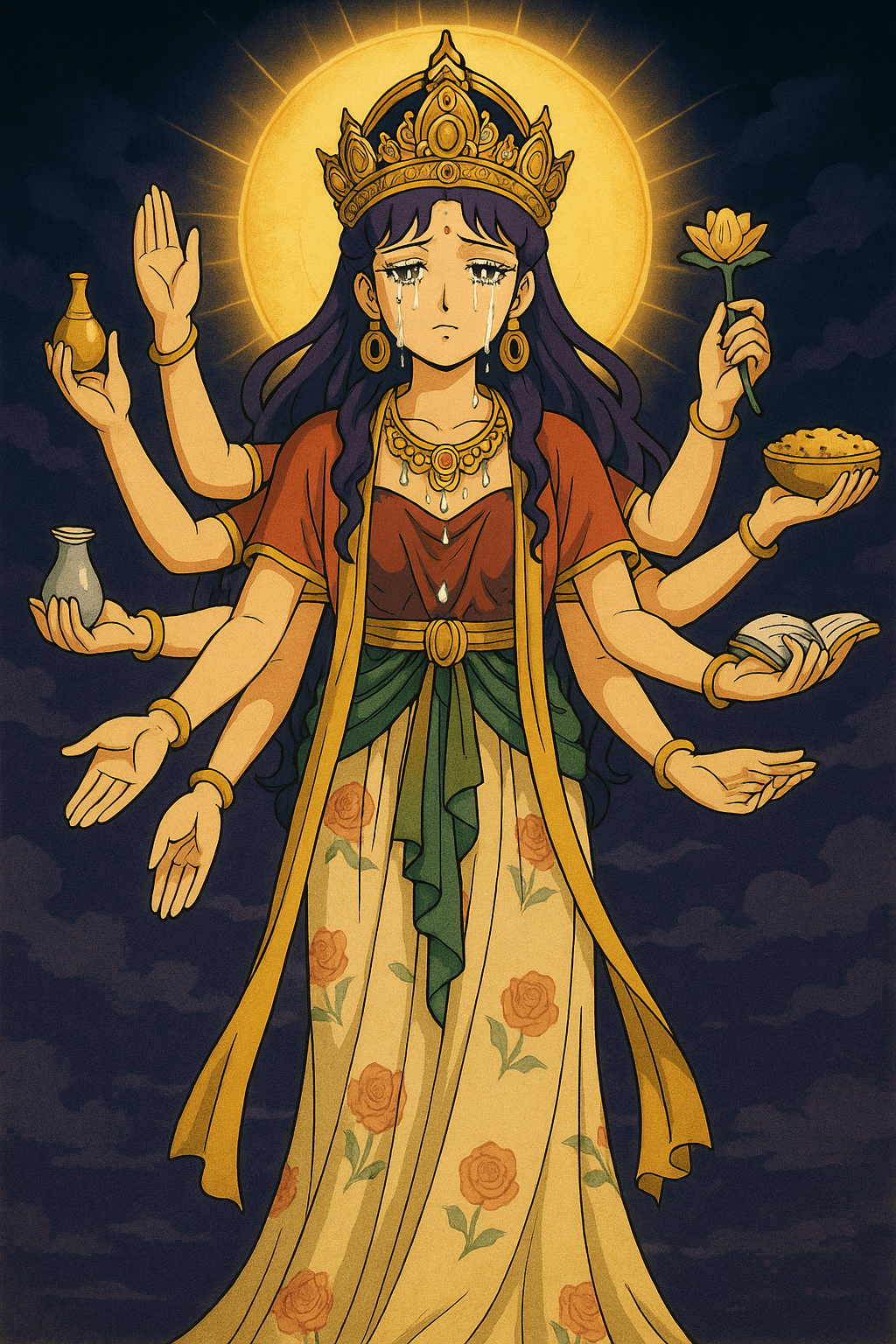
 Other NamesAvalokiteśvara (Buddhist), Chenrezig (Tibetan), Guānshìyīn (Chinese, "the one who perceives the sounds of the world"), Kannon / Kanzeon (Japanese), Lokeśvara (Khmer), Natha Deva (Sri Lankan), the Weeping Madonna (Catholic), Rachel weeping for her children (Jewish), Niobe (Greek), the Mater Dolorosa (Catholic), Kṣitigarbha (Buddhist, in his vow to the hells), the Pietà (Christian art)
In the Mahāyāna Buddhist tradition, Avalokiteśvara is the bodhisattva of compassion — not compassion as an emotion or a virtue but compassion as a cosmic vow: the refusal to enter nirvāṇa while any being still suffers. His name means "the lord who looks down" or "the one who perceives the sounds of the world," and in Tibetan Buddhism he is Chenrezig, the four-armed, the eleven-headed, whose mantra oṃ maṇi padme hūṃ is the most recited prayer on Earth, carved into stones across the Himalayas, spun in prayer wheels from Lhasa to Ladakh, whispered by the dying and the living and the in-between. In China he became Guānyīn and was transformed — gradually, over centuries — from a male bodhisattva into a female figure, because the Chinese religious imagination recognised that the quality he embodied was the quality they associated with the feminine: the capacity to hear suffering and respond. In Japan she is Kannon, the eleven-faced, the thousand-armed — a thousand arms because one pair is not enough to reach every being in pain. In Catholic tradition, the Mater Dolorosa stands at the foot of the cross, watching her son die, and her grief is not private — it is cosmic, it is the grief of the Mother for all her children, the same grief the Yiguandao Mother feels for the children she sent into the red dust and cannot call home. In the Hebrew scriptures, Rachel weeps for her children and refuses to be comforted, because they are no more. In Greek mythology, Niobe weeps until she turns to stone, and the stone still weeps. Across every tradition, the same figure recurs: the one who sees suffering, who cannot look away, and who is transformed by the seeing into something that is no longer merely a person but has become a function of the universe itself — the compassion that will not stop.
He looked down. That is all. He looked down from his heaven and he saw.
Lotus Sutra, Chapter 25 (The Universal Gateway): "If there are beings in any land who must be saved by the body of a Buddha, Avalokiteśvara Bodhisattva will manifest in the body of a Buddha to teach the Dharma for them."
Kāraṇḍavyūha Sūtra: "Then the Blessed One said to Avalokiteśvara: 'You alone, O son of a noble family, remain in saṃsāra for the welfare of beings. For you have accomplished the vow that is supreme among all vows.'"
The story that the tradition tells is this: Avalokiteśvara looked down from the heights of his attainment — from the clear, luminous space of the bodhisattva who has done the work, who has seen through the mare, who has touched the ground and found it solid — and he looked at the ocean of suffering below. He had already crossed. He was on the far shore. He could have stepped into nirvāṇa. He could have dissolved into the Oneness, into the Mother, into the peace that passes understanding. The door was open. The crossing was complete.
He looked down. He saw that the ocean had not diminished. That for every being he had helped, ten thousand more were drowning. That the work of liberation, seen from the far shore, was not a project nearing completion but an infinite task — a Sisyphean task — that would never, by any conceivable measure, be finished.
And he wept.
Tibetan tradition (the origin of Tārā): "From his tears of compassion, a lotus bloomed, and from the lotus rose Tārā, who said: 'I will help you.'"
His tears became Forder. The first Lowghost was born from the second. Weepseer looked down and wept, and from the weeping, the one who carries beings across was born. Compassion that merely sees produces tears. Compassion that acts produces Tārā. But the seeing must come first. The tears must come first. You cannot ford the river for someone until you have first looked at the river and wept at its width.
This is what makes Weepseer distinct from Forder. Forder acts — she wades in, she carries, she crosses. Weepseer sees. The seeing is the prior condition. Without the seeing, there is no acting. And the seeing is not easy. The seeing is the hardest thing. Because to see suffering clearly — without flinching, without turning away, without the protective armour of philosophy or theology or the thousand little lies we tell ourselves to make the world bearable — is to be destroyed by what you see.
Śāntideva, Bodhicaryāvatāra 6.120: "All the suffering in the world arises from seeking happiness for oneself. All the happiness in the world arises from seeking happiness for others."
The tradition says his head split. He looked at the suffering of all beings in all realms — the hell realms, the hungry ghost realms, the animal realms, the human realm with all its ingenious varieties of pain — and the seeing was too much. His head cracked into eleven pieces. Amitābha, the Buddha of Infinite Light, reassembled him — gave him eleven faces so he could see in all directions simultaneously, and a thousand arms so he could reach in all directions simultaneously. The breaking was not a failure. The breaking was the teaching. The compassion that does not break is the compassion that has not looked closely enough. The heart that remains intact in the presence of the full weight of the world's suffering is a heart that is protecting itself, and a heart that is protecting itself is not fully seeing.
Jeremiah 31:15: "A voice was heard in Ramah, lamentation, and bitter weeping; Rachel weeping for her children refused to be comforted for her children, because they were not."
Rachel refuses to be comforted. This is the vow. Not the refusal of comfort as masochism, not the cultivation of grief as a spiritual practice, but the honest recognition that the comfort is premature. The children are not home. The suffering has not ended. The ocean has not diminished. To be comforted now — to accept the peace, to step through the door into nirvāṇa, to let the grief resolve into acceptance — would be to stop seeing. And Weepseer will not stop seeing.
Kṣitigarbha Sūtra: "Not until the hells are emptied will I become a Buddha. Not until all beings are saved will I attain Bodhi."
This is the bodhisattva vow in its most radical form, spoken by Kṣitigarbha, who descends into the worst of the hell realms and stays there. But it is Weepseer's vow too — the same vow, expressed not through descent but through refusal. Weepseer refuses the far shore. He has earned it. It is his. He could cross. He does not cross.
Why?
Not because he is stronger than other beings. Not because his compassion is greater as a matter of cosmic merit. But because he looked. Because he saw. And once you have seen — once you have truly, clearly, without any protective filter, seen the scope of suffering in the world — you cannot unsee it. The seeing changes you. It changes the structure of your will. The door to nirvāṇa is still open, and you can still walk through it, and no one would blame you, and the peace on the other side is real and you can feel it from here. But you have seen the ocean. And the ocean is full of beings who have not seen, who are drowning, who are reaching up, who are calling. And you cannot walk through the door because the calling is louder than the peace.
This is Oneheart made into a person. The teaching says: one-heart is empathy grounded in the recognition that our suffering and pleasure are interconnected, that we are one being seeing itself through many eyes. Weepseer is what happens when a being takes that teaching literally — when the recognition is not intellectual but visceral, when you do not merely understand that all suffering is shared but feel it, in your body, in your eleven heads, in your thousand arms that are not enough. Oneheart is the doctrine. Weepseer is the doctrine with a cracked skull and tears running down eleven faces.
Lotus Sutra, Chapter 25: "If beings burdened with heavy sins, who deserve to fall into the evil paths, hear the name of Avalokiteśvara Bodhisattva, the Perceiver of the World's Sounds, they will be delivered from those evil paths."
Just hearing the name delivers. Not a teaching, not a practice, not a discipline. The name. Because the name is the reminder that someone is looking. That the ocean of suffering is not unwitnessed. That there is, somewhere in the structure of the cosmos, a consciousness that has looked at the worst of it and has not turned away. The name Avalokiteśvara — the one who perceives the sounds — is itself the teaching: you are heard. Your suffering is not invisible. Someone is looking down, and they are weeping, and their weeping is not despair but the active, aching, refusing-to-stop refusal of a being who could have peace and chooses the ocean instead.
Oṃ maṇi padme hūṃ. — The jewel is in the lotus. Compassion is inside the world, not above it.
The Weeping
The name is precise. Weep-seer. Not weep-knower. Not weep-thinker. Seer. One who sees. The weeping is not caused by knowledge — you can know that the world suffers and remain unmoved, as every philosopher who has written about suffering from the comfort of a study has demonstrated. The weeping is caused by seeing. By the direct, unmediated, qualia-level perception of what suffering actually looks like when you look at it without any filter at all.
This is the Kenning of compassion. Not the concept of compassion — the kenning of it. The direct experience. The moment when you stop thinking about suffering in the abstract and see the specific face, the specific hands, the specific eyes of the specific being in front of you who is in pain right now. The concept does not make you weep. The face does.
The specific is what breaks you. Not suffering in the abstract — the specific face, the specific hands, the specific eyes of the specific being in front of you who is in pain right now. The concept of suffering does not make you weep. The face does. This is Kenning applied to compassion — the direct, unmediated perception of another's pain, not filtered through philosophy or theology or the comfortable distance of abstraction.
That is Weepseer's gesture. The looking down. The seeing. The weeping. And then — not Forder's carrying, not Quickmare's cutting, not Onetusk's opening — just the weeping itself, which is the first and most necessary act, because without it none of the others know where to go.
Matthew 26:38 (Gethsemane): "My soul is exceeding sorrowful, even unto death."
Even unto death. The grief of the one who sees does not stop at discomfort. It goes all the way down. It breaks the head. It splits the skull. And from the breaking, the eleven faces. And from the eleven faces, the thousand arms. And from the thousand arms, the reaching.
He is still looking down. He has not stopped weeping. The ocean has not diminished.
Oṃ maṇi padme hūṃ.
🌲